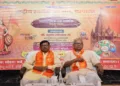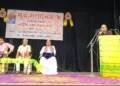
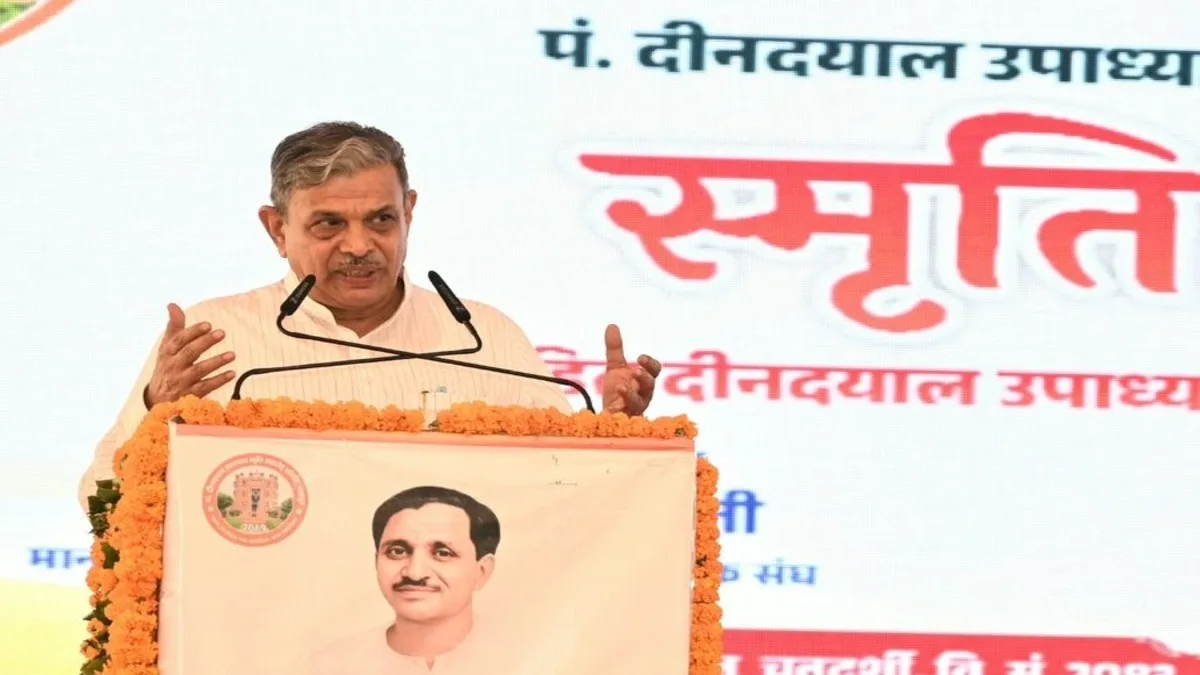
JAIPUR: Pandit Deendayal Upadhyaya gave Bharat a vision of life rooted in its civilisational ethos and presented it not merely for Bharat but as a source of guidance and a model for the entire world, said Rashtriya Swayamsevak Sangh (RSS) Sarkaryavah Dattatreya Hosabale while addressing the Pandit Deendayal Upadhyaya Memorial Lecture on Ekatma Manav Darshan (Integral Humanism) organised by the Pandit Deendayal Upadhyaya Smriti Samaroh Samiti at Dhankya on the occasion of Pandit Deendayal Upadhyaya’s 110th birth anniversary.
Hosabale said that Integral Humanism is not meant only for workers of the Bharatiya Jana Sangh or Bharatiya Janata Party, or for the people of Bharat, but for the entire humanity.
He said that he had the opportunity to visit the sacred land of Dhankya and seek inspiration from the memorial dedicated to Pandit Deendayal Upadhyaya. The memorial, he said, inspires those who visit it to work for the nation and society.
Describing Deendayal Upadhyaya as an extraordinary and inspirational personality, Hosabale appreciated the efforts of the Smriti Samaroh Samiti, which has been organising socially, culturally and nationally significant programmes for several years in his memory.
Hosabale said that Deendayal Upadhyaya distilled various aspects of Bharatiya culture and the Bharatiya way of life and provided a foundation for living in the modern age through Ekatma Manav Darshan (Integral Humanism). Just as Bhagwan Shri Krishna presented the essence of the Upanishads to humanity through the Bhagavad Gita, Deendayal Upadhyaya presented the essence of Indian culture for the modern age through Integral Humanism, he said.
He said that the world cannot be confined to only two alternatives – capitalism and communism. While excessive emphasis on freedom under one system led to inequality and exploitation, an excessive emphasis on equality under the other resulted in the curtailment of freedom. Both systems, he said, overlooked fraternity and the nature of relationships among human beings. Bharatiya thought, on the other hand, views social life through the relationship between the individual, society, creation and the Supreme Being.
Referring to Deendayal Upadhyaya’s vision, Hosabale said that Bharat does not have to become America, England or Japan; Bharat must become Bharat. A philosophy of life based on Bharat’s own personality, culture and values is not only relevant for Bharat but can also become a source of guidance and a model for the world.
He emphasised that these ideas cannot remain confined to books and research. Scholars should study them and write books, but their application in social life is equally necessary. The success of these ideas, he said, should become visible through society so that the world can develop confidence in their practical relevance.
Speaking about rural development, the RSS Sarkaryavah said that if education, livelihood and healthcare are available in villages, people will not be compelled to migrate to cities and villages will retain their character. Experiments promoting agriculture, cottage industries, handicrafts and local employment are necessary. He referred to the rural development initiatives undertaken by Nanaji Deshmukh in Chitrakoot and Gonda and stressed the need to apply the principles of Integral Humanism in social life.
He said that government schemes and policies are necessary, but such work cannot be accomplished through the government machinery alone. Society must become aware and participate in collective efforts. The experiences and wisdom of people living in rural areas should also form the basis of development initiatives.
Hosabale said that Deendayal Upadhyaya was not opposed to technology, but insisted that technology should contribute to human happiness, remain environment-friendly, should not economically weaken people, eliminate employment or erode social values. Technology, he said, should work for human welfare rather than make human beings its slaves.
Deendayal Upadhyaya had advocated making Swadeshi relevant to the changing times, he said. There should be no hesitation in accepting knowledge from abroad, but it must be adapted to Indian conditions. At a time when various forms of technology, including Artificial Intelligence, are being widely discussed, it is important to consider how technology can be made genuinely useful for humanity.
The RSS Sarkaryavah said that Deendayal Upadhyaya was a Swayamsevak, Pracharak, politician, scholar, economist, litterateur and writer. He not only spoke about social harmony, environment, family, Swadeshi and civic duties but also incorporated these values into his own life. Recalling an incident related to his civic responsibility, Hosabale said that Deendayal Upadhyaya did not use a radio after its licence had expired during one of his journeys.
He said that remembering Deendayal Upadhyaya should not remain limited to paying tribute to him on his birth anniversary. His ideas must be discussed and reflected upon, while efforts should also be made to learn from his life and incorporate those lessons into one’s own life.
“Deendayal Upadhyaya dedicated every moment of his life to the Param Vaibhav of Bharat. We should also draw inspiration from his life and resolve to dedicate ourselves towards this goal,” Hosabale said.
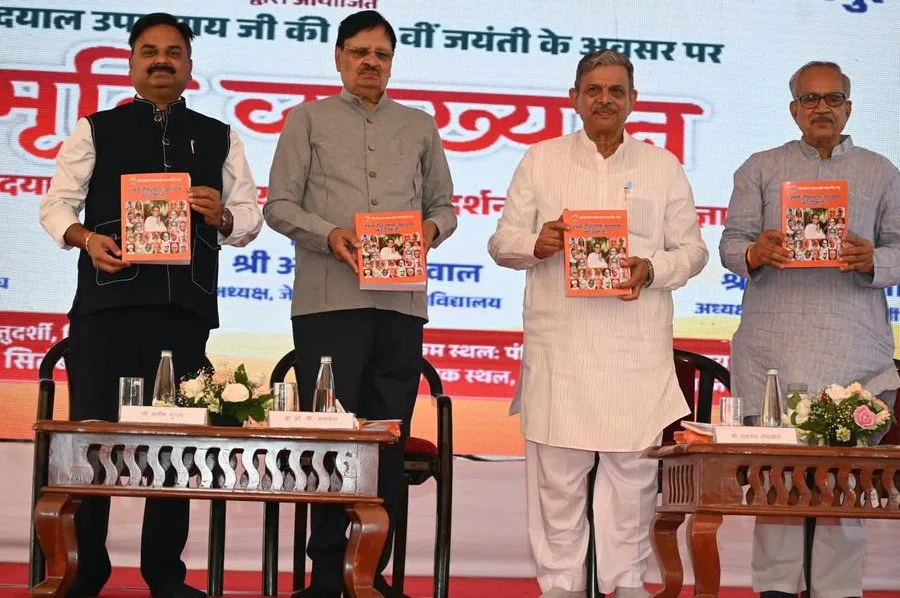
The programme was presided over by entrepreneur Manish Gupta. JECRC University Chairman OP Agarwal attended as the special guest. Smriti Samaroh Samiti President Professor Mohanlal Chhipa briefed the gathering about the activities and objectives of the committee, while its Secretary Pratap Bhanu Shekhawat outlined its future plans.
Several researchers and scholars were honoured for their research on the ideas and contributions of Pandit Deendayal Upadhyaya. They included Dr Sohan Singh, researcher at Ranchi University; Dr Jagbir Chandel of Himachal Pradesh Central University; Dr Anshuman Kaushik from Mathura; and Dr Nagesh Chaubey of Banaras Hindu University.
Padma Shri awardees Tagaram Bhil, known for his contribution to folk art and music, and Bhapang artiste Gafuruddin Mewati were also honoured for their contributions to the field of folk art and music.
The vote of thanks was delivered by committee Vice-President Neeraj Kumawat, while the programme was conducted by Gajendra Gyanpuriya.