OTTAWA/NEW DELHI: India and Russia are moving their longstanding defence partnership into a new phase, with cooperation increasingly centred on joint development, licensed production and manufacturing in India rather than a conventional buyer-seller model. A report published by Canada-based Geopolitical Monitor on September 24, 2026, said India’s expanding defence capabilities are reshaping military cooperation with Moscow.
The report comes shortly after the BRICS Summit in New Delhi, where Prime Minister Narendra Modi and Russian President Vladimir Putin discussed political, economic and energy issues, with defence cooperation reportedly also featuring. Days later, Indian Army Chief General Dhiraj Seth travelled to Russia on an official visit, the first such trip by a top Indian military leader in eight years.
From arms purchases to Indian production
For decades, Russian military hardware formed the backbone of India’s defence inventory. Russian-origin systems span infantry weapons, armoured vehicles, tanks, aircraft and missile-defence equipment. India was historically one of Russia’s largest defence customers, purchasing finished equipment directly from Russian manufacturers. That model has steadily evolved.
The Geopolitical Monitor report noted that a significant share of major Russian-origin platforms used by the Indian military is now produced in India through licensed manufacturing and joint ventures. This gives India a larger role in manufacturing, maintenance and technology absorption while preserving Russian involvement.
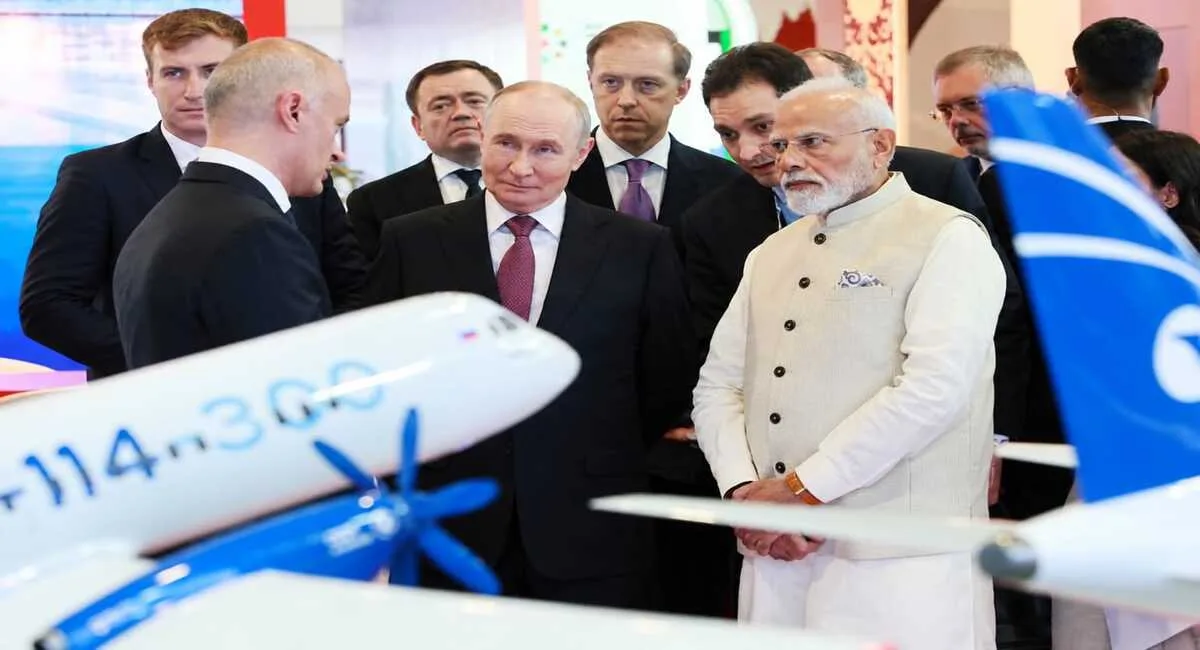
#WATCH | Delhi: Prime Minister Narendra Modi and Russian President Vladimir Putin hold a bilateral meeting on the sidelines of BRICS Summit 2026.
(Video Source: DD News) pic.twitter.com/KhlCIatMI2
— ANI (@ANI) September 11, 2026
The report also highlighted Russia’s proposed Su-57 fifth-generation fighter offer. Kremlin spokesman Dmitry Peskov confirmed Russia’s plans to supply the aircraft to India, while noting that local manufacturing remains part of ongoing negotiations. Peskov also indicated that Moscow could consider sharing advanced technologies to strengthen its strategic partnership with New Delhi.
India’s wider defence policy is moving in the same direction. The country has been strengthening domestic production while diversifying procurement and defence partnerships with the United States, France and Italy. Indian government estimates cited in the material put domestic production at about 65 percent of military hardware, compared with substantially greater import dependence a decade earlier.
BrahMos, T-90MS and new cooperation
Missile development remains an important area of India-Russia technological cooperation. The report identified BrahMos as a major example of the partnership’s evolution. Developed jointly by India and Russia, the supersonic cruise missile is derived from Russia’s P-800 Oniks family, specifically the export variant known as Yakhont. Over the past 25 years, India has introduced multiple modifications and upgrades, giving BrahMos capabilities that distinguish it from its Russian predecessor.
Further modernisation of BrahMos is being considered as both countries seek to keep the system relevant against increasingly advanced air-defence technologies. The project demonstrates how Russian technology and Indian engineering have combined to create a major defence platform with an expanding role in India’s military capabilities.
Armoured-vehicle cooperation could also expand. In July, Russia’s state arms exporter Rosoboronexport offered India an opportunity to jointly produce the T-90MS main battle tank. The proposal would extend an existing arrangement under which India already manufactures the vast majority of its T-90S tanks domestically using locally produced and Russian-supplied components.
The future of additional tank production will depend on India’s wider modernisation priorities. The Ukraine conflict has highlighted the growing battlefield importance of drones and other technologies, prompting renewed debate about conventional armoured platforms. For India, any future investment in tanks will therefore have to fit within a broader modernisation programme focused on emerging capabilities.
RELOS adds strategic depth
The transformation extends beyond equipment manufacturing. In February 2025, India and Russia signed the Reciprocal Exchange of Logistics Support, or RELOS, agreement, establishing arrangements for reciprocal logistical access and support. The framework provides for facilities and services including refuelling, repairs, maintenance and supplies, strengthening practical military cooperation.
The material cited provisions allowing each country to have up to 3,000 troops, five warships and 10 military aircraft on the other’s territory at any one time.
Russia’s naval losses during the Ukraine war could make logistical cooperation particularly relevant. Under RELOS, India could potentially provide maintenance or other support to Russian naval assets if required.
Taken together, the developments show a partnership increasingly built around shared production, technology cooperation, logistics and capability development. For India, the expanding domestic defence industry creates greater capacity to manufacture, maintain and upgrade systems within the country while retaining access to Russian expertise and established platforms.
For Russia, deeper production ties offer a route to sustain long-term defence cooperation with a major partner as India expands its own industrial capabilities and diversifies international defence relationships. The Geopolitical Monitor report therefore points to a relationship evolving beyond straightforward arms purchases, with India playing an increasingly important role in shaping the partnership.
The next phase is likely to centre on joint production and long-term strategic military coordination between both sides, including BrahMos modernisation, possible T-90MS production and discussions surrounding advanced platforms such as the Su-57. India’s growing industrial strength is creating new terms for cooperation, with manufacturing and technological partnership becoming increasingly central to ties with Russia.