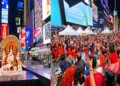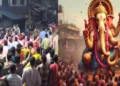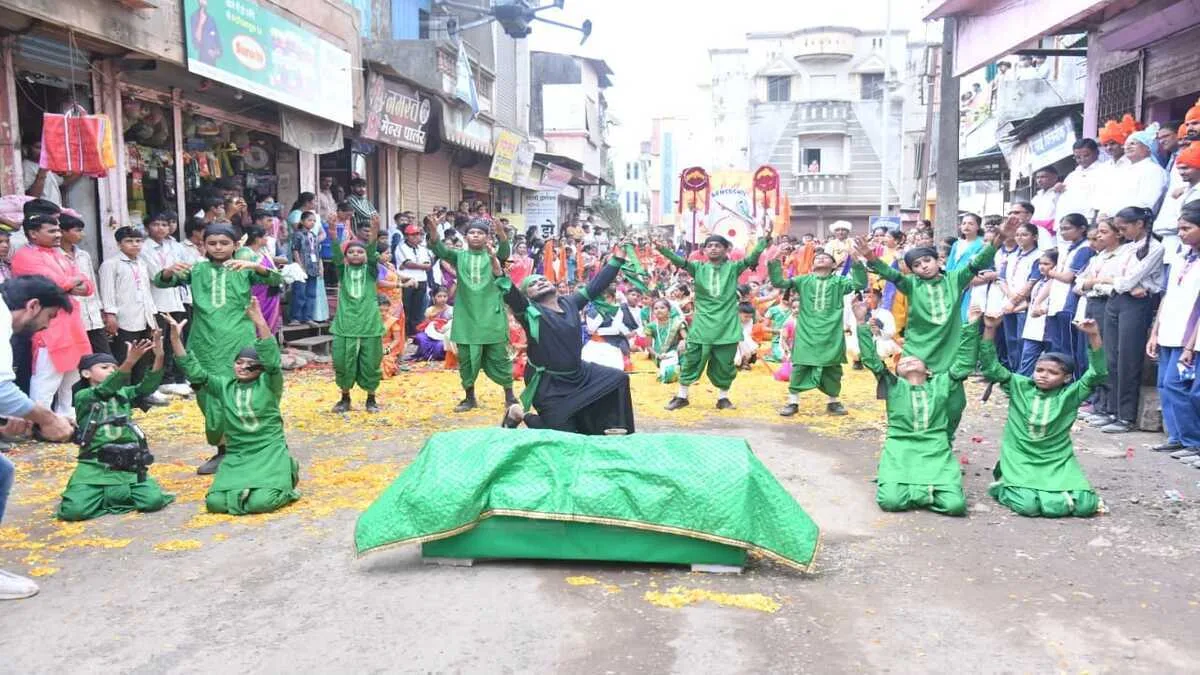
Taloda, Nandurbar: The reported display of a tomb replica during a Ganesh immersion procession in Taloda has triggered strong criticism among sections of the local Hindu community, raising questions about religious sensitivity, cultural responsibility and the standards expected from educational institutions.
The controversy concerns a display attributed to Nemsushil Vidyamandir, Taloda, during this year’s Ganesh festival. The school identifies itself as Nemsushil Vidyamandir and states that it operates from Hatoda Road, Taloda, offering education from playgroup to Class 10. Public education records also list Nemsushil institutions in Taloda, including Nemsushil Madhyamik Vidyamandir.
According to complaints circulating locally, a replica resembling a tomb was presented as part of the procession. Hindu organisations and local residents have objected to the display, arguing that the imagery was inappropriate for a festival centred on Bhagwan Ganesha and that it failed to respect the religious character of the occasion.
The objection is not simply about the presence of a particular architectural form. It concerns the context in which it was presented. Ganesh Chaturthi is a major Hindu religious festival and the immersion procession is traditionally associated with worship, devotional music, sacred imagery and public expressions of faith. Introducing imagery associated with burial and death into such a setting can reasonably invite questions about cultural sensitivity, particularly when the presentation is associated with an educational institution.
Educational institutions carry a responsibility that extends beyond academic instruction. Their public cultural activities can influence how young people understand religion, history and society. Creative expression and historical representation are legitimate parts of education, but they also require accuracy, context and sensitivity towards the beliefs of the communities involved.
There is also a separate historical question surrounding claims that the display represented an episode connected with the coronation of Chhatrapati Shivaji Maharaj. Such a claim should not be presented as historical fact without documentary evidence. If a historical event is being represented, the institution should be able to identify the historical source, contemporary record or scholarly reference on which the depiction is based.
Assertions concerning the coronation should therefore be assessed against primary and established historical sources rather than assumed to be authentic merely because they appear in a cultural presentation. The controversy consequently raises a straightforward question: What educational or historical purpose was the tomb replica intended to serve in a Ganesh immersion procession, and what source material was used to justify its inclusion?
Criticism of the display should remain focused on these questions rather than on individuals associated with the school. If the presentation was genuinely intended as an educational or historical representation, the school administration has an opportunity to explain its purpose, historical basis and relevance to the procession.
At the same time, if the display was found to be historically inaccurate or insensitive to the religious character of the festival, acknowledging the concern would be an appropriate institutional response. Several Hindu organisations have reportedly demanded a public explanation and an apology from the school administration. They have also indicated that they may pursue lawful administrative and legal remedies if their concerns are not addressed.
The matter now calls for evidence rather than escalation. The school should clarify what the display represented, who authorised it, what historical source supported it, and why it was considered appropriate for a Ganesh immersion procession. Local authorities, meanwhile, should examine any formal complaint objectively and according to applicable law.
Public festivals are spaces where religious devotion, cultural expression and community participation intersect. Precisely for that reason, those organising public displays—particularly educational institutions—should exercise a high degree of responsibility. Respect for religious traditions does not require abandoning creativity; it requires ensuring that creativity is historically grounded, contextually appropriate and respectful of the faith of those participating.