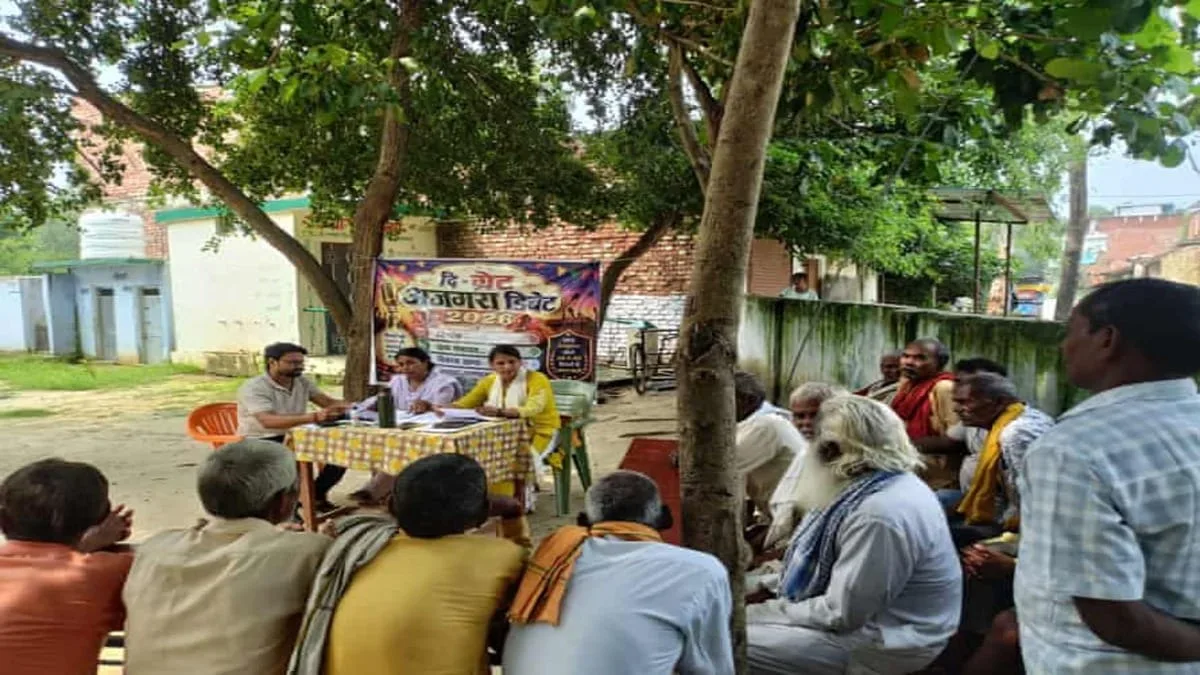
PRATAPGARH: The setting for what may be one of the country’s biggest exercises in public debate was quintessential rural India: lush paddy fields, a pond and a temple. On an ordinary evening in Ajgara village of Uttar Pradesh, villagers gather by the pond to discuss crop prices, the weather or even a missing goat.
But for more than a month, the conversations took a philosophical turn. Villagers debated questions such as whether deceit can be justified to defeat an evil enemy, whether a lie is acceptable to save a life, and what constitutes the nature of reality.
The initiative was conceived by Abhishek Pandey, the district magistrate of Pratapgarh. When he assumed the post two years ago, he became aware of the district’s rich archaeological and cultural links with the ancient Indian epic, the Mahabharata.
One of the epic’s central characters, Yudhishthira, engages in a series of philosophical exchanges on human existence. In the Ajgara episode, he answers a series of questions to save the lives of his four brothers.
Pandey, 35, grew up with the story, like millions of Indians, and was struck by the intellectual depth of its dialogues. During a fellowship at Oxford University, he was also impressed by the institution’s debating society and its two-century-old tradition. Yet India’s own tradition of structured public debate is far older, stretching back more than 3,000 years. This led Pandey to question why such a tradition had faded from public life.
“Indians have celebrated certain traditions for centuries. Why have we ceased to celebrate the legacy of debate and questioning?” Pandey asked. He began exploring whether this intellectual tradition could be revived, particularly given the importance of debate and questioning in a democracy. He saw the annual September fair at Ajgara as an ideal setting for the experiment. In the weeks leading up to the fair, Pandey and his team organised around 1,500 debates across the district, bringing philosophical questioning and public discussion into villages across Pratapgarh.
There was no age or educational qualification required to participate. The youngest contestant was a 10-year-old schoolboy, while the oldest was an 80-year-old farmer. Participants who argued for or against a motion were evaluated on the strength of their reasoning and their ability to demonstrate moral clarity.
The overwhelming response surprised Pandey. Thousands of people took part through several rounds, eventually narrowing the field to eight finalists — six men and two women.
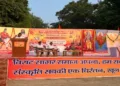
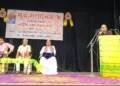
As villagers moved around the fairground, enjoying local food, watching folk theatre, shopping for traditional crafts and riding the Ferris wheel, an unusual silence filled the debating tent. The final round of the Great Ajgara Debate 2026, held on September 17, continued for nearly six hours.
One of the topics centred on women’s rights. Finalist Vivek Singh argued that although women may enjoy equality in law, societal expectations often restrict their ability to exercise those rights in practice.
Another finalist, 24-year-old Prajjwal Shukla, took a different approach. He argued that the central question was not the role society assigns to women, but who has the authority to make decisions about their lives. Whether a woman chooses a career, takes on household responsibilities, or combines both, he said, should ultimately be her own decision. For Pandey, however, the most striking aspect of the event was not merely the intellectual quality of the discussions, which he found impressive, but the atmosphere in which they took place.
“What amazed me the most was not the intellectual quality of the debates, but the atmosphere. Everyone listened respectfully, patiently, without interrupting. No one got personal. People sat for hours,” Pandey said. Karl Marx’s observation that history repeats itself, first as tragedy and then as farce, aptly captures the decline of public debate in India from the sublime to the absurd.
On television news debates, several participants often speak over one another, leaving little room for anyone to complete a point. Personal attacks, insults and sarcastic jibes frequently take centre stage, as anchors push the exchanges into increasingly heated confrontations.
Sadhana Dwivedi, one of the two women who reached the final round of the Great Ajgara Debate, is critical of the increasingly confrontational style of televised debates. “People need to learn to listen and understand that there may be value in another person’s point of view,” she says. “In a democracy, it is crucial for all opinions to be heard so that we can move closer to the truth.”
The remarkable turnout at Ajgara appeared to reflect the idea explored by economist Amartya Sen in his book The Argumentative Indian, which highlights India’s long tradition of questioning authority and accommodating diverse schools of thought.
The article then contrasts this tradition with what it describes as a more recent suppression of dissent, particularly under the ruling Bharatiya Janata Party (BJP). Author and commentator Parsa Venkateshwar Rao Jnr argues that this is at odds with the intellectual traditions associated with ancient Indian civilisation. “It’s ironic, because the BJP wants to recreate a Hindu state but is not even acquainted with the traditions of ancient Hindu civilisation, such as that of debate and being open to different ideas,” Rao says.
At the conclusion of the tournament, the eight finalists were honoured with garlands before being taken around Ajgara in an open-top car amid loud cheers. They were celebrated as “intellectual heroes”. The competition was won by 24-year-old Prajjwal Shukla, who is preparing for examinations to enter the civil services. “I can’t believe I am the winner of a debate that took place at the exact same spot as in the Mahabharata all those centuries ago. I participated just because I wanted to hear other people’s thoughts,” Shukla says.
Pandey said he was still reflecting on the extraordinary public response to the event. The turnout was so large in several places that his deputy even suggested additional police deployment. “My deputy asked me if we should get some police deployment because the turnout everywhere was so big, but I laughed and said no. That would be a sad affair,” Pandey recalls.
Pandey now hopes to take the initiative beyond Pratapgarh, expanding the debate to other states and potentially across the country. “We have to inculcate a culture of debate. It’s the hallmark of a democracy,” he says.
At Ajgara, meanwhile, he has left behind a permanent marker of the event. An inscription on a stone slab installed at the site reads: “The Great Ajgara Debate. First Debate 3152 BC: Yudhishthira. Second Debate 2026: Prajjwal Shukla.”