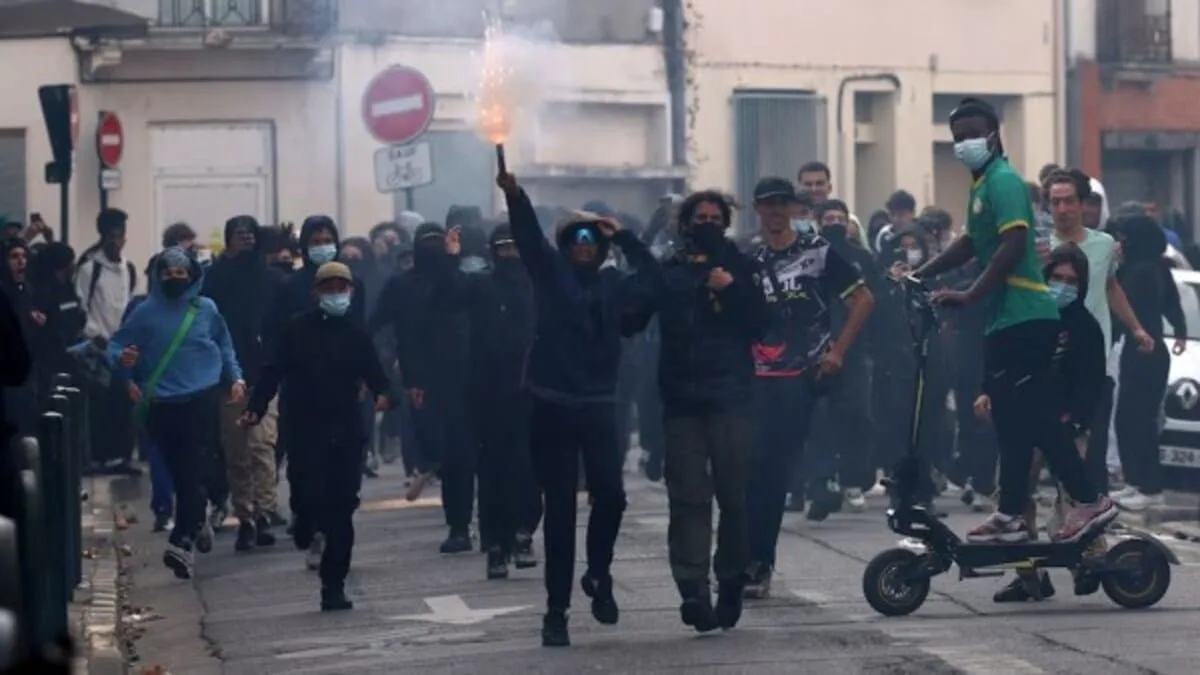
Student protests across the world constitute an unambiguous assertion of democratic citizenship. Some of the sharpest political minds have emerged from such protests. It is true that the triggers for such protests vary across countries; such movements periodically emerge when young people perceive a gap between educational ideals and lived realities. However, of late, protests in India have been incited by wokeist transnational elements.
The ongoing student protests in France, especially those spearheaded by students from non-bourgeois Parisian suburbs, provide a useful point of comparison with the nature of student activism in India.
Historically, in both countries, students have used collective action to challenge institutional inequalities, inadequate educational resources and policies affecting their futures. Yet in the contemporary scenario, they have been driven by political contexts, historical traditions and immediate grievances.
Tracing the historiography of education systems
The current French education system has evolved strongly around the ideals of the French Revolution. From church-governed medieval institutions to secularisation, the education system has witnessed immense transformation. As education became closely associated with liberty, equality, citizenship and secularism, the social structure also changed. Close reading of the Jules Ferry laws of the 1880s guaranteed free, compulsory and secular primary education, helping create the foundations of France’s republican educational model. The twentieth century witnessed expansion of secondary and higher education, particularly after the Second World War. The expansion of access to the baccalauréat and higher education transformed education from an elite privilege into a mass public institution. Nevertheless, disparities between schools and regions have persisted.
India, that is Bharat, possesses one of the oldest and most inclusive educational heritages. Ancient institutions such as Takṣaśilā and Nālandā, combined with gurukula and other indigenous traditions, represented different models of knowledge transmission. During British rule, education was reframed through colonial institutions with the purpose of serving the colonisers. Macaulay’s 1835 Minute, Wood’s Despatch of 1854 and the modern universities established in Calcutta, Bombay and Madras in 1857 were important milestones in the development of modern Western-style education. Post- 2014, Bhārat reimagined education as an instrument of nation-building and social transformation. The National Education Policy (NEP) 2020 has progressively expanded the scope of educational access and reform.
Thus, while France developed education principally through the republican ideals of citizenship and secular public schooling, India developed a plural educational structure combining ancient knowledge traditions, postcolonial institutions and policy-driven nation-building.
Convergences between French and Indian student protests
The first major point of convergence is transnational interest. The recent French protests have been particularly strong among students from economically disadvantaged suburbs who may belong to immigrant communities. The Union Syndicale Lycéenne (USL) is leading the protest. The radical-left party La France Insoumise (LFI) and teachers’ unions like SNES-FSU and have thrown their support behind the student-led movement. Students complain about inadequate infrastructure, overcrowded classrooms, teacher shortages and unequal educational opportunities.
In 2026 ,a movement in India led by CJP feigned to highlight disparities while simultaneously catering for ideologies that were not in the interest of the nation.
A second similarity is the imposition of woke ideology. French students have questioned whether the state is providing sufficient teachers, nurses, social workers and infrastructure. This is the typical modus operandi of the post-truth wokeists. CJP protest had similarly attempted to devise anarchy against the elected government and the status quo even after examination reforms were duly addressed and introduced by the current dispensation.
Third, students in both countries increasingly view education as connected to social justice. This is a genuine welcome step in an organic protest. Unlike the CJP protest, which created unrest and damage to public property, an organic protest is expected to address genuine concerns. Education is not understood merely as classroom instruction; it determines employment opportunities, social mobility and future citizenship. French students’ argument that one’s neighbourhood should not determine one’s educational prospects has a strong parallel in Indian education’s resolution for equitable access to quality education.
Fourth, political participation of fringe elements can be seen in both contexts. They frequently become politically active under the pretence of educational policies to fulfil their own agendas. Campus organisations, student unions, demonstrations, marches and social media have provided mechanisms for them through which young people can be misinformed.
Finally, both movements demonstrate the misuse of public space and digital communication. Streets, campuses and social-media platforms increasingly function as extensions of the anarchists. Such mobilisations can therefore rapidly move from a local grievance to an international conversation.
Divergences between the two movements
Despite these aforementioned similarities, the French and Indian positions differ significantly. The most important difference concerns the immediate causes of mobilisation. The recent French protests are strongly focused on the material conditions of schooling: teacher shortages, overcrowding, deteriorating buildings, inadequate facilities and insufficient support staff. Indian student protests, by contrast, have historically covered a much wider range of issues that hitherto aligned with the national interests, including examinations, unemployment, campus autonomy, political representation, and questions of national policy. The JP movement of 1974-75 was led by students of Bihar against soaring prices and chronic unemployment.
A second difference is the scale and structure of the education systems. France has a comparatively centralised public education system, making national government policy a particularly visible target of student protest. India has an enormous and highly heterogeneous education system involving central and state governments, public institutions, private schools and universities, making educational grievances more geographically and institutionally diverse.
A third difference concerns social diversity. Indian student politics exists at the intersection of class, gender, language, region and religion. Affirmative-action policies have repeatedly generated significant student mobilisation. French student protests, while strongly connected to class and geographical inequality, operate within a rigid social and constitutional framework.
There is also a difference in the historical relationship between student activism and national politics. India has a long tradition of students participating in major political movements, including the freedom struggle, the JP Movement of the 1970s and numerous post-independence movements. French student activism likewise has a distinguished history, most famously the May 1968 protests, when student demonstrations expanded into a much broader social and workers’ movement.
The French and Indian experiences demonstrate that student protests are rarely limited to students. They often reflect the demands of various interest groups. In France, the current movement is being associated with concerns about educational inequality, public investment, infrastructure and the unequal distribution of opportunities between affluent and disadvantaged communities. This requires further unbiased scholarship. In India, student activism has historically reflected the need for institutional autonomy and political representation. Recent CJP protests show subversive variation in this long legacy.
The strongest similarity is therefore the belief that education is a public good and a mechanism of social mobility, rather than merely a private commodity. The principal difference lies in the specific historical and socioeconomic structures through which that belief is articulated.