BAKU: Azerbaijan has intensified the enforcement of secular dress codes in public schools, bringing restrictions on hijab-wearing students and teachers into focus as school boycotts, staff dismissals and protests spread. The measures, introduced through changes to education regulations, have triggered a fresh dispute over the implementation of secularism in the Islamic-majority country.
Students at two schools have boycotted classes in protest against restrictions affecting pupils who wear the hijab. Imprisoned journalist Polad Aslanov, head of the Xeberman news website, has also launched a hunger strike against the restrictions, arguing that they interfere with the education rights of his child and other students.
The Baku City Education Department has announced that it will monitor the implementation of the new clothing requirements in public schools. The inspections mark a further step in enforcing the country’s secular education framework, under which authorities have introduced standardised requirements for student uniforms and teachers’ professional attire.
Azerbaijan is an Islamic-majority country, with approximately 96 per cent of its population identifying as Muslim. Around 65 per cent of Muslims are Shia and 35 per cent Sunni, while the remaining four per cent of the population comprises Christians, Jews, Baha’is, other religious communities.
September resolution establishes basis for Hijab restrictions
Azerbaijan’s Cabinet of Ministers adopted Decision No. 309 on September 21, 2026, amending student clothing requirements. The resolution prohibits elements of school attire that conflict with the principles of secular general education, providing the regulatory basis for restrictions on religious clothing, including the hijab.
The resolution does not explicitly use the word “hijab”. However, its provisions have become central to the enforcement of dress codes against students wearing Islamic headscarves in public schools. The subsequent monitoring initiative by the Baku City Education Department has placed school administrations under greater scrutiny over compliance with the new requirements.
🔴 Azerbaycan’daki okullarda uygulanmaya başlanan başörtüsü yasağına dair yeni görüntüler geliyor.
Celilabad bölgesinde bugün itibarıyla başörtüsü (hicab) ile okula gelen öğrenciler okula alınmayıp geri gönderildi. pic.twitter.com/zXn2Fv7s2B
— Daily Islamist (@dailyislamist) October 7, 2026
The legislative groundwork was laid in July 2026, when Azerbaijan amended its Law on General Education to reinforce the secular character of the public education system and establish requirements governing the appearance of students and teachers. The regulations form part of a wider effort to standardise school clothing in an education system where the state maintains a secular institutional framework.
Teachers dress code extended in October
On October 6, 2026, a new teacher dress-code order extended strict professional clothing requirements to educators. The regulations require teachers to follow a business-style dress code consistent with the secular education framework.
The introduction of the teacher dress code has coincided with reports of disciplinary action against educators who wear the hijab. A hijab-wearing teacher at Richard Sorge Secondary School No. 90 in Baku was dismissed, according to footage published by Meydan TV. The footage showed students crying and embracing the teacher following her removal.
The incident has added to the debate surrounding the application of Azerbaijan’s secular dress requirements. The regulations extend beyond student uniforms to the appearance of teaching staff, making compliance a matter for both pupils and educators.
Under the new framework, school authorities are expected to enforce clothing requirements as part of their responsibility to maintain the prescribed secular environment. The monitoring programme announced by the Baku City Education Department is intended to examine how the regulations are being implemented across public schools.
Students boycott classes over Hijab restrictions
The enforcement of Azerbaijan’s hijab restrictions has prompted class boycotts at two schools. Students at School No. 69 in Baku and B. Shiriyev Secondary School in the village of Mollaoba, Masally district, reportedly refused to attend classes.
According to reports by Meydan TV and footage circulating on social media, the students demanded that their hijab-wearing classmates be permitted to return to school. The protests have brought the consequences of the uniform regulations into classrooms, with disagreements over religious clothing disrupting attendance.
The school boycotts followed earlier reports of students being excluded from classes because of their headscarves. On March 10, 2026, Afat Jamalova, director of Secondary School No. 3 in the village of Mehdiabad, reportedly expelled 23 students for wearing the hijab.
Reports about a possible nationwide hijab ban had circulated from late February 2026 onwards. In March, social media posts described instances in which students wearing Islamic headscarves were allegedly prevented from attending classes because of dress-code violations.
The Azerbaijani authorities have not publicly announced a blanket ban on the hijab in schools. Nevertheless, the September student-uniform resolution and October teacher dress-code order have strengthened the regulatory framework under which restrictions on religious clothing are being enforced.
Imprisoned journalist Polad Aslanov begins hunger strike
Polad Aslanov announced on October 8, that he had begun a hunger strike in protest against the school clothing regulations. His wife, Gulmira Aslanova, disclosed the decision in a Facebook post, stating that he was being held at Penitentiary Facility No. 15.
Aslanov said his protest was intended to draw attention to the exclusion of hijab-wearing students from schools and the restrictions imposed on teachers’ clothing. He also maintained that the regulations had affected his own child’s right to education.
“I declare that I have begun a hunger strike to defend the rights of my own child and all hijab-wearing students whose right to education is restricted, as well as all hijab-wearing female teachers who are being forced to choose between education and wearing the hijab,” he said.
Aslanov said he had appealed several days earlier to Allahshukur Pashazadeh, head of the Caucasus Muslims Board, but had received no response. He argued that the clothing restrictions violated Article 48 of Azerbaijan’s Constitution, which guarantees freedom of conscience.
Azerbaijan bans teachers from wearing hijab into the school. Students are seen bidding farewell to their female teachers who refuse to comply with the new law.pic.twitter.com/6ppBTXq7Nb pic.twitter.com/2t7rI1nOo9
— Akinade (@IAmAkinade) October 10, 2026
Aslanov was arrested in 2019 on treason charges and initially sentenced to 16 years in prison. His sentence was subsequently reduced to 13 years. He denies the charges and maintains that his imprisonment is connected to his journalistic work.
His hunger strike has brought additional attention to the implementation of Azerbaijan’s hijab restrictions, particularly the effect of the school regulations on families whose children wear religious clothing.
Azerbaijan’s previous attempts to restrict the Hijab
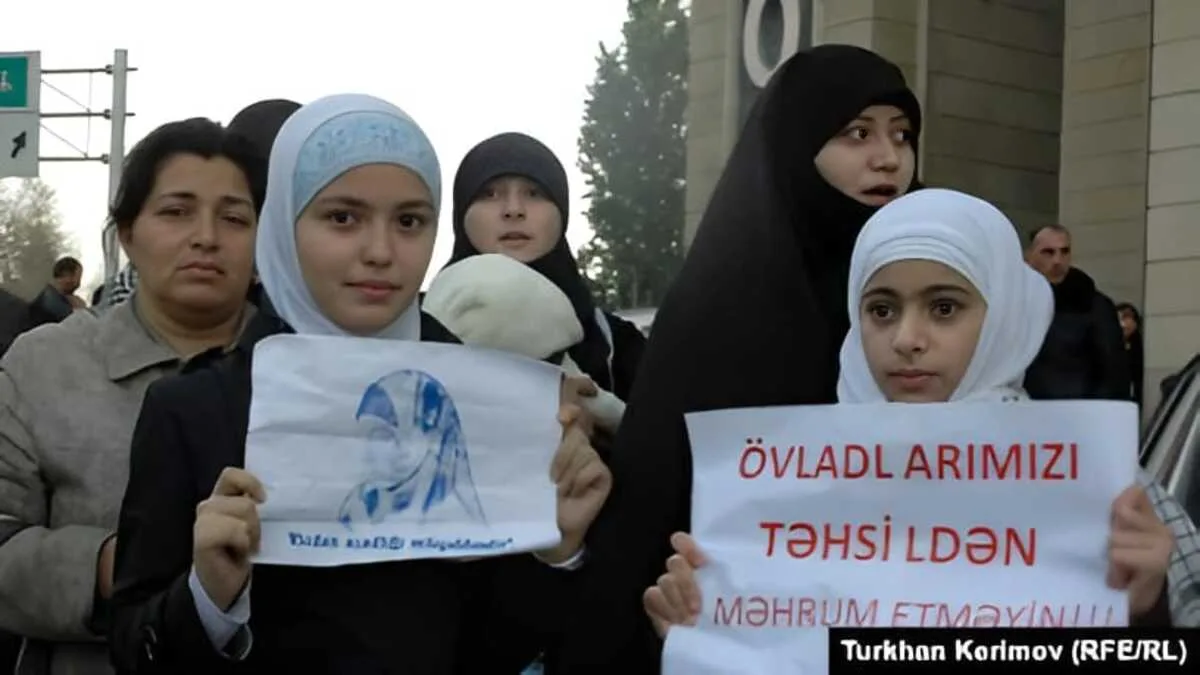
The current measures follow a series of confrontations dating back more than a decade. In November 2010, Azerbaijan’s Education Ministry attempted to introduce a school hijab ban but reversed its decision after protests in Baku, Ganja and other cities. Several demonstrators were detained during the protests.
Some of the largest demonstrations over the issue took place between 2010 and 2012. In December 2010, hundreds of people protested in Baku following the Education Ministry’s announcement of a hijab ban. Demonstrations were also held in Masally and Nardaran around the same period.
On May 6, 2011, another major demonstration took place outside the Education Ministry in Baku. Police dispersed the gathering, and the Interior Ministry reported that 45 people had been detained. On October 5, 2012, approximately 200 people participated in a demonstration in Baku under the slogan “Freedom for the hijab”. The protest developed into clashes between police and demonstrators, resulting in 65 detentions. Some of those detained subsequently received prison sentences of up to six and a half years.
Azerbaijan’s latest school dress regulations place the country’s secular education policy at the centre of a renewed dispute over religious clothing. The September 2026 resolution establishes requirements for student uniforms, while the October order extends professional dress standards to teachers.
The Baku City Education Department’s monitoring initiative, the reported dismissal of a hijab-wearing teacher, school boycotts and Aslanov’s hunger strike have brought the implementation of the regulations into public view.
Although the authorities have not publicly declared a comprehensive hijab ban in schools, the current rules have created a framework under which religious head coverings can become grounds for disciplinary action.