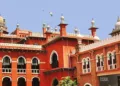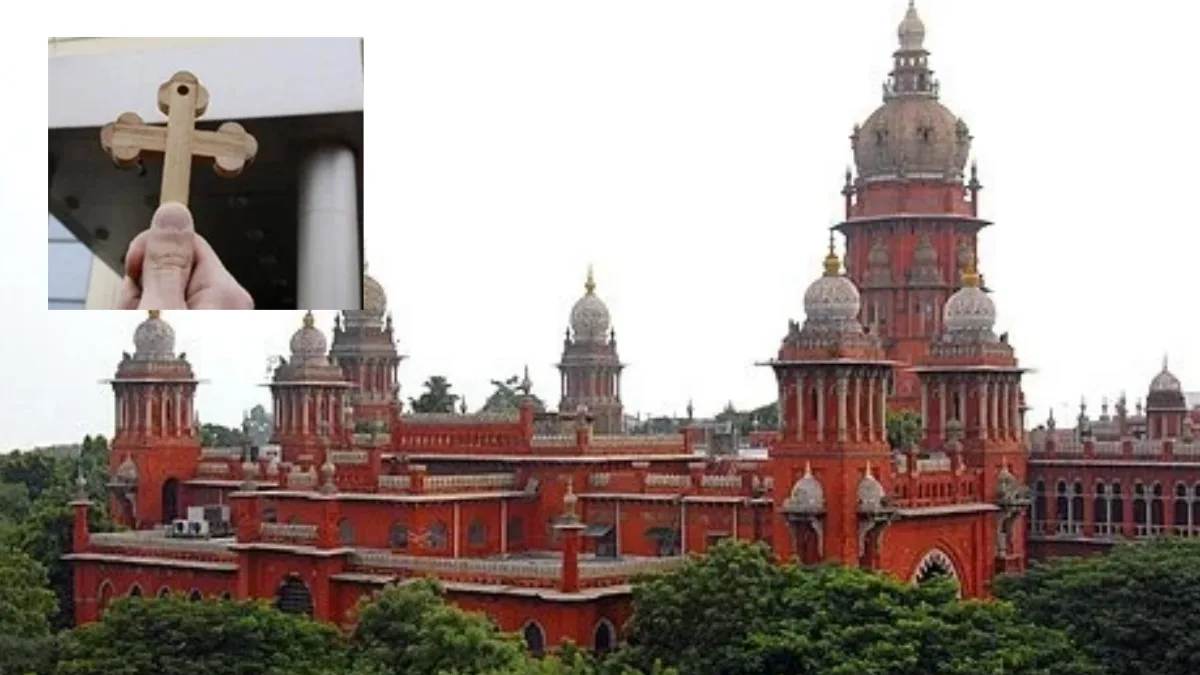
The Madurai Bench set aside a succession certificate granted to the deceased priest’s relatives, holding that property acquired after entering a religious order must be examined in the light of the obligations undertaken by the priest.
The Madurai Bench of the Madras High Court has set aside a succession certificate granted to the relatives of a deceased Catholic priest over fixed deposits worth ₹56 lakh and directed them to return the amount they received to the religious society to which he belonged.
The court held that property acquired by a priest after entering a religious order and undertaking the corresponding vows cannot be treated as his personal estate merely because the documents stand in his name.
In a common judgment dated 13 October 2026, a Division Bench comprising Justice N. Anand Venkatesh and Justice K. K. Ramakrishnan allowed appeals filed by the ABVM Society of the Catholic Apostolate (Pallottines), overturning the Principal District Judge, Karur’s order dated 18 September 2024.
The HC court directed the priest’s relatives to remit the amount received from the fixed deposits to the society within one month of receiving a copy of the judgment, without interest.
If they fail to do so within the stipulated period, the amount will carry interest at 9 per cent per annum from 13 October 2026 until actual payment.
Court distinguishes personal inheritance from property acquired after religious vows.
The dispute concerned six fixed deposits totalling ₹56 lakh held in the name of Rev. Father Deivakumar Arulanantham at the State Bank of India’s Kulithalai branch in Karur district.
He died on 24 February 2018 at St Philomena’s Hospital in Bengaluru.
The priest’s two brothers, A. Deiva Nayagam and A. Joseph, and his sister’s daughter, P. Mary Jameela, claimed the deposits as his legal heirs.
The religious society, however, argued that the funds represented property acquired after he entered the religious order and should therefore belong to the institution under the obligations governing his religious life.
Explaining the legal distinction, the High Court observed:
“The position would, however, be different in respect of properties which came to him by way of inheritance or intestate succession from his family members. In respect of such inherited properties, the Society cannot claim an independent interest merely by reason of his subsequent entry into the religious order.”
The Bench made it clear that the society’s entitlement was not based simply on the fact that the deceased was a priest. It depended on the nature and circumstances of the acquisition of the property, as well as the religious obligations undertaken by him.
The judgment stated: “The legal consequence of such acquisition must therefore be determined in the light of the religious obligations undertaken by him and the institutional character in which those properties were acquired, rather than merely by the fact that the title documents stood in his individual name.”
The court held that the society could claim property acquired by the deceased after entering the religious order through his office, service, personal occupation or other activities undertaken in his capacity as its priest. However, property independently inherited from family members could not automatically be claimed by the society.
Why the 1988 document mattered
A key element in the case was a document dated 2 July 1988, headed “MY LAST WILL”, which the priest signed at Pallotti Bhavan in Nagpur. It stated that the Society of the Catholic Apostolate would have rights over his personal belongings after his death, while his family would retain rights over family inheritance.
The document predated his ordination as a priest on 15 May 1989. The relatives did not dispute its existence, signature or contents, but argued that it could not be treated as a valid Will because it lacked the required attestation.
The High Court accepted that the document could not be treated as a proved Will operating upon the priest’s death. However, it held that this did not prevent the document from being considered as evidence of his religious undertaking.
The Bench explained, “This Court is not treating Ex.P3 as a testamentary disposition or as a Will operating upon the death of the priest. Rather, the document is being considered for the limited and distinct purpose of ascertaining the undertaking voluntarily given by the priest to the Society upon his entry into the religious order.”
The court further held that the document’s significance had to be assessed from its contents and the circumstances in which it was executed, rather than merely from the heading “Will”.
Court sets aside lower court’s order
The relatives had filed petition in 2019 seeking a succession certificate, while the society filed petition seeking recognition of its entitlement to the deposits.
On 18 September 2024, the Principal District Judge, Karur, allowed the relatives’ petition and dismissed the society’s claim.
The High Court also criticised the trial court’s handling of the two proceedings, noting that the claims were substantially interconnected and should have been examined together.
“The learned trial Judge ought to have considered the pleadings, evidence and documents in both proceedings together and rendered a comprehensive finding regarding the nature and ownership of the deposits,” the judgment said.
It added that the approach adopted by the trial court in conducting the proceedings separately was “not correct”.
Allowing both appeals, the High Court set aside the order granting the succession certificate to the relatives and the order dismissing the society’s petition. It allowed S.O.P. No. 30 of 2019 filed by the society and directed the relatives to return the amount received from the fixed deposits within one month, failing which interest at 9 per cent per annum would apply from the date of the judgment.
Critics argue that such Church property disputes raise broader questions about the sources of income and wealth accumulated by priests and religious institutions, particularly when their activities are presented as charitable work carried out in the name of Jesus Christ. They question how substantial assets are acquired and accumulated by institutions whose stated mission centres on religious service and charity.
Across India, the Church has accumulated property over several decades, including assets dating back to the British colonial period. Critics point to land and infrastructure inherited from the colonial era, along with properties acquired for religious purposes and through various commercial and religious activities. They argue that the scale of these assets warrants greater public scrutiny of how Church institutions acquire, manage and account for their property and income, while ensuring that such questions are examined in the light of applicable Indian laws and the specific circumstances of each institution.