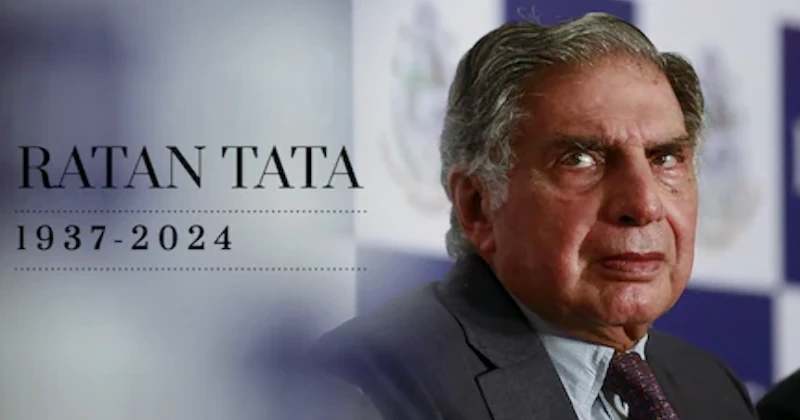
Ratan Naval Tata, one of the country’s most esteemed business leaders, passed away in a Mumbai hospital at the age of 86. His death marks the end of an era for the Tata Group, a conglomerate that has become synonymous with trust, integrity, and innovation in Indian industry. Known for his visionary leadership and profound philanthropy, Tata leaves behind a legacy deeply intertwined with the fabric of Indian society.
Born on December 28, 1937, in Mumbai, Ratan Tata was the great-grandson of Jamsetji Tata, the founder of the Tata Group. His family lineage is storied, with the Tata name representing one of India’s most significant industrial legacies. Raised by his grandmother, Navajbai Tata, after his parents, Naval Tata and Sooni Tata, separated in 1948, Ratan’s upbringing instilled in him the values of resilience, integrity, and dedication to service. He completed his education at the esteemed Cornell University, where he earned a bachelor’s degree in architecture in 1962. His education provided him with a solid foundation, blending creativity with practical knowledge, which would serve him well in his future endeavors.
Ratan Tata’s early career began in 1961 at Tata Steel, where he started from the ground up, working on the shop floor. This hands-on experience was invaluable, allowing him to understand the intricacies of operations and manufacturing. It laid the groundwork for his rise within the Tata Group and fostered a deep respect for the workforce that would later influence his leadership style.
Transformative Leadership
In 1991, Ratan Tata succeeded J R D Tata as chairman of Tata Sons, stepping into a role that would see him lead one of India’s largest conglomerates through a transformative era. His leadership coincided with the liberalisation of the Indian economy, a period that reshaped Indian business and industry. Under his stewardship, the Tata Group expanded significantly, venturing into new industries and achieving global recognition.
One of Tata’s most notable achievements was his role in spearheading high-profile acquisitions that propelled the Tata Group onto the international stage. In 2000, Tata Tea’s purchase of Tetley marked one of the first major international acquisitions by an Indian company, establishing the Tata brand as a formidable global player. Tata Motors’ acquisition of Jaguar Land Rover in 2008 and Tata Steel’s purchase of Corus in 2007 further solidified the group’s international reputation, enhancing its portfolio and capabilities. These strategic moves positioned Tata Group as a significant competitor in various global markets, showcasing Tata’s vision for an integrated and diversified business model.
Perhaps the crowning achievement of Ratan Tata’s tenure was the launch of the Tata Nano in 2009. Marketed as the world’s cheapest car, priced at just Rs 1 lakh, the Nano became a symbol of Tata’s commitment to innovation and affordability. This groundbreaking vehicle was designed to make car ownership accessible to India’s burgeoning middle class, reflecting Tata’s belief in providing value to the community. The Nano’s launch not only showcased the Tata Group’s engineering prowess but also demonstrated Ratan Tata’s dedication to creating products that catered to the needs of the common man.
Philanthropic Legacy
Beyond his remarkable business acumen, Ratan Tata was deeply committed to philanthropy. Through Tata Trusts, which control much of the Tata Group’s wealth, he significantly contributed to healthcare, education, and rural development. His charitable initiatives, such as establishing cancer care facilities across India, demonstrated his unwavering dedication to social betterment. Tata Trusts developed and augmented ten cancer care facilities in states like Assam, Jharkhand, Andhra Pradesh, and Karnataka, ensuring that quality treatment was accessible to underprivileged communities.
Prime Minister Narendra Modi, in his tribute, praised Tata as a “visionary business leader, a compassionate soul, and an extraordinary human being.” This sentiment reflects the profound impact of Tata’s philanthropic work on society. Under his leadership, Tata Trusts became a vital pillar of support for various social causes, from education and healthcare to rural development and women’s empowerment.
Ratan Tata’s commitment to philanthropy was reflected in his humble lifestyle, as he consistently chose to give back rather than amass personal wealth. He never featured prominently on billionaire lists, and his modesty was a hallmark of his character. According to the IIFL Wealth Hurun India Rich List of 2022, he ranked 421 with an estimated net worth of Rs 3,800 crore, emphasising that his focus was never on personal accumulation but rather on making a lasting difference in the lives of others.
A quiet yet impactful presence
Ratan Tata’s leadership style was characterised by humility, integrity, and a strategic vision that propelled the Tata Group to new heights. He navigated numerous challenges, including internal disputes within the group and the contentious removal of Cyrus Mistry as chairman of Tata Sons in 2016. Despite the pressures of leadership, Tata remained grounded, often described as a modest and kind leader who prioritised the welfare of his employees and the nation over his own interests.
His quiet yet impactful approach to leadership earned him respect both within the Tata Group and the broader business community. His ability to foster unity and cohesion during challenging times, particularly during the early years of his chairmanship when he faced resistance from established leaders within the organisation, was a testament to his character and vision. Ratan Tata’s focus on ethical business practices set a high standard for the industry, ensuring that the Tata Group operated with integrity and social responsibility.
Even in his later years, Ratan Tata remained actively engaged with the Tata Group, holding the honorary title of chairman emeritus after stepping down in 2012. His commitment to the group’s values and mission persisted, ensuring that the principles instilled by his forebears continued to guide the organisation.
A tribute to a true visionary
Ratan Tata’s passing leaves a void that will be difficult to fill. His contributions to the business world and society at large have set a high standard for future generations of leaders. He was a multifaceted individual—an industrialist, a philanthropist, and a dog lover—who balanced his passion for business with a genuine concern for societal welfare. His dedication to animals was evident in his support for initiatives focused on the welfare of street dogs, demonstrating his compassion for all living beings.
Ratan Tata’s love for speed was well-known; he was a trained pilot who flew F-16 fighter jets and often indulged in racing speedboats across Mumbai’s harbor. However, he was equally passionate about the idea that every Indian should be able to afford a car, which was the driving force behind the launch of the Nano. His ability to balance his personal interests with his professional responsibilities showcased the depth of his character.
As India mourns the loss of a great leader, Ratan Tata’s legacy will undoubtedly continue to inspire entrepreneurs and philanthropists alike. His remarkable journey, defined by innovation, integrity, and altruism, will be celebrated and remembered for generations to come. Tata’s commitment to his country, his employees, and his community has set a benchmark for future leaders, and his spirit will continue to resonate within the walls of the Tata Group and beyond. His contributions to the Tata Group and to India as a whole will forever be etched in the hearts of millions.