For decades, development in India travelled along highways and railway lines, settling in towns and spilling over into the villages nearest to them. The habitations beyond, tucked into forests, hills and river valleys, waited at the end of the queue.
Many of them were home to India’s janjati communities, whose contribution to the nation’s culture, ecology and freedom struggle has been immense, but whose share in its material progress remained thin.
Two programmes launched in quick succession have set out to change that order. The Pradhan Mantri Janjati Adivasi Nyaya Maha Abhiyan (PM-JANMAN) and the Dharti Aaba Janjatiya Gram Utkarsh Abhiyan (DA-JGUA) together mark a deliberate shift in approach.
Instead of waiting for growth to trickle down, the state is now carrying basic services directly to the janjati village and measuring success by whether the last household has been reached.
PM-JANMAN: Starting with the most vulnerable
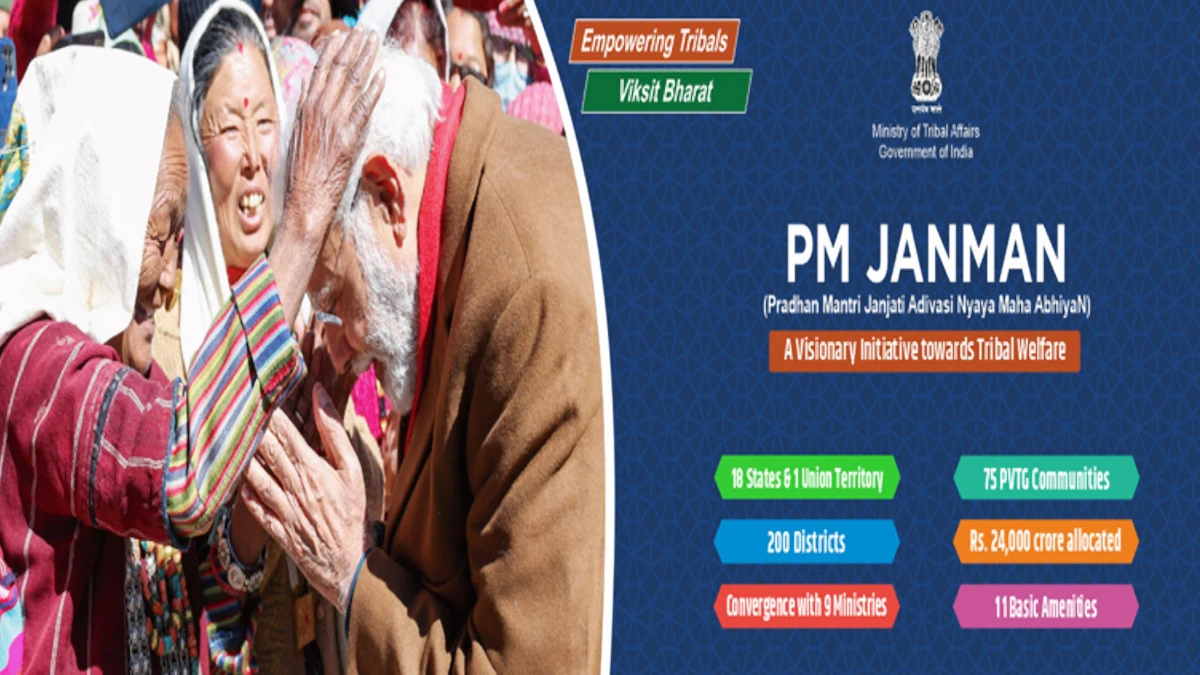
PM-JANMAN was launched on 15 November 2023, Janjatiya Gaurav Divas, from Jharkhand the land of Birsa Munda. Its focus is the Particularly Vulnerable Janjati Groups (PVTGs), 75 communities spread across 18 states and one Union Territory.
These are among the most isolated people in the country, often living in small, scattered hamlets with low literacy, fragile livelihoods and little access to roads, electricity or health care.
The mission carries an outlay of Rs 24,104 crore, with the Centre contributing Rs 15,336 crore and the states Rs 8,768 crore. Its design is notable for its convergence. Eleven critical interventions are delivered through nine ministries, covering pucca housing, all-weather roads, piped drinking water, mobile medical units, anganwadi centres, hostels, multipurpose centres, household electrification, mobile connectivity and livelihoods through Van Dhan Vikas Kendras.
The results reported to Parliament in mid-2025, showed both the scale of the effort and the size of the challenge. About 4.6 lakh pucca houses had been sanctioned, of which 1.36 lakh were completed. Some 694 mobile medical units were running, bringing doctors and medicines to habitations that had never seen a clinic.
More than 2,000 anganwadi centres and around 800 multipurpose centres were functional. Roughly 1.2 lakh PVTG households had been electrified, over 7,400 villages had piped water and more than 2,500 habitations had gained mobile connectivity. Over 330 Van Dhan Vikas Kendras were helping communities add value to forest produce.
These numbers matter because of where they come from. A road that reaches a hilltop PVTG settlement does more than shorten travel time. It brings the school, the ration shop, the ambulance and the market within reach. A pucca house with a power connection change how a child studies at night and how a family weathers the monsoon.
DA-JGUA: Scaling the model to 63,000 villages
If PM-JANMAN tested the approach on the most vulnerable, DA-JGUA has taken it to scale. Approved by the Union Cabinet on September 18 2024, the mission was launched by Prime Minister Narendra Modi from Hazaribagh, Jharkhand, on October 2 2024.
Its name honours Birsa Munda, revered as Dharti Aaba, Father of the Earth and it was launched in the run-up to his 150th birth anniversary.
The ambition is considerable. With an outlay of Rs 79,156 crore, including a central share of Rs 56,333 crore, the mission covers about 63,843 Janjati-majority villages across 549 districts, 2,911 blocks and 30 States and Union Territories.
More than five crore janjati people stand to benefit. Over five years, 17 ministries will deliver 25 interventions, each drawing on its own existing schemes but targeted together at the same villages.
These interventions cover the full spectrum of village life. They include housing, roads, electricity and solar power, drinking water, health and nutrition, schooling and hostels, skilling, digital connectivity and livelihoods rooted in agriculture, animal husbandry, fisheries and forest produce. The guiding idea is about every eligible household in every covered village should receive every entitlement it is due.
Why convergence is the real innovation
Janjati welfare in India has never lacked schemes. What it often lacked was coordination. One department built a school, another a road, a third a health centre, frequently in different places and on different timelines. The result was a patchwork in which a village might have a building but no teacher, or a road but no water. Both missions attack this problem at the root.
They take the village or habitation, rather than the department, as the unit of planning. Gaps are identified household by household and line ministries are expected to fill them in a coordinated manner. Progress is tracked against the village, not just against a ministry’s spending targets.
The approach is already shaping other national programmes. On September 30 2026, the Department of Drinking Water and Sanitation held a follow-up review on extending water coverage in Janjati areas.
Under Jal Jeevan Mission 2.0, Rs 5,000 crore has been dedicated specifically to PM-JANMAN and DA-JGUA villages, with states asked to reconcile their Janjati welfare and water databases and identify every uncovered village and habitation.
People at the centre, not the margins
A recurring criticism of earlier development efforts was that they were designed far from the communities they were meant to serve. The newer approach tries to correct this by building local capacity alongside physical infrastructure.
The Adi Karmayogi Abhiyan aims to train a cadre of 20 lakh change leaders across one lakh Janjati villages. These include officials, frontline workers and community members who will help plan, monitor and sustain development at the village level.
The Janjati Village Vision 2030 Action Plan draws on more than 50,000 village-level plans and brings PM-JANMAN and DA-JGUA within its framework. This bottom-up planning matters. Tribal communities have their own knowledge of land, forest and water, also development that respects that knowledge is far more likely to endure.
The livelihood components reinforce the same principle. Rather than pushing Janjati families into unfamiliar occupations, the missions build on what communities already do well, from collecting and processing minor forest produce to millets, honey, lac and handicrafts. Van Dhan Vikas Kendras and market linkages help ensure that more of the value stays in the village.
The challenges that remain
Ambition on this scale meets hard realities on the ground. Many habitations are in difficult terrain, where construction seasons are short and material costs are high. Completion has lagged behind sanctions in several components, especially roads and hostels, which take longer to build.
Data gaps between state departments and national portals, highlighted in the recent water review, can leave some hamlets uncounted. Sustaining services once they are built, keeping medical units staffed, hostels running and water schemes maintained, will require steady attention long after the ribbon is cut.
There is also the question of quality. A house built to a standard design must suit local climate and culture. A school must have teachers who can communicate with children in their mother tongue. Saturation is a powerful goal, but it must be matched by services that work well and last.
A shift in national priorities
Taken together, PM-JANMAN and DA-JGUA reflect a broader change in how India thinks about inclusion. The principle of Antyodaya, serving the last person first, has long been part of the nation’s political vocabulary. These missions give it a concrete shape by placing the remotest janjati village at the top of the delivery list rather than at its end.
They also carry a message of respect. Naming a national mission after Dharti Aaba Birsa Munda and launching it from the janjati heartland, signals that janjati communities are partners in nation-building, not passive recipients of welfare. Their heritage, forests and ways of life are treated as assets to be strengthened, not obstacles to be overcome.
As India pursues the goal of Viksit Bharat by 2047, the real measure of progress will not be found only in its cities and industrial corridors. It will be found in whether a family in a forest hamlet has a safe home, clean water, a working school and a road to the wider world. PM-JANMAN and DA-JGUA are an honest attempt to make sure that answer is yes and that the last village is no longer left behind.