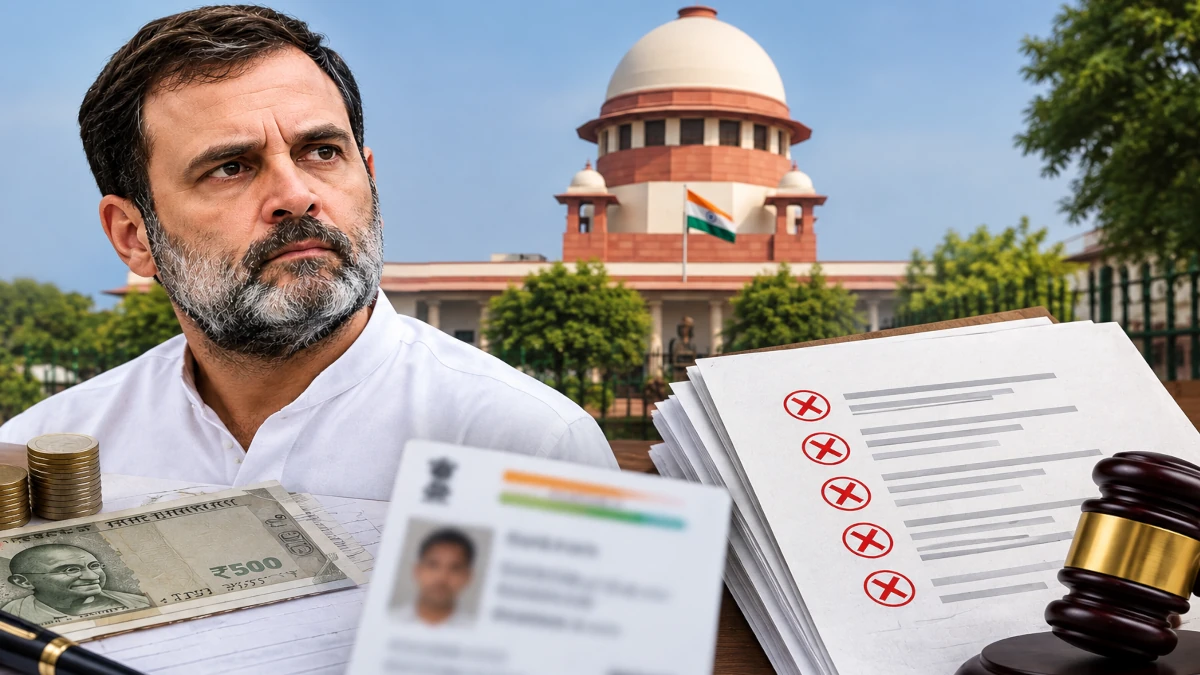
NEW DELHI: The INDI bloc’s high-profile legal challenge to the Election Commission’s Special Intensive Revision (SIR) of electoral rolls has hit a procedural roadblock, with the Supreme Court Registry flagging 14 defects in the petition led by Congress leader Rahul Gandhi. Among the objections are a shortfall of just ₹220 in court fees, missing legal authorisations from nine petitioners and an unclear photocopy of Congress president Mallikarjun Kharge’s identity card.
The objections have drawn attention to a series of filing deficiencies in a case through which the Congress has sought urgent judicial intervention over alleged electoral irregularities and voter deletions. The petitioners must rectify the defects before the matter can be listed for hearing, delaying their attempt to secure immediate relief against the SIR exercise.
For an Opposition bloc that has mounted an aggressive political campaign around allegations of “vote chori”, the Registry’s list presents an unwelcome preliminary hurdle: before the court can examine the allegations, the petition must satisfy its procedural requirements.
Rs 220 shortfall, missing signatures and defective documents
The Supreme Court Registry has identified multiple deficiencies in the petition, ranging from incomplete legal paperwork to problems with the quality and presentation of documents.
The most striking objections include a shortfall of Rs 220 in the court fee paid and the absence of vakalatnamas formal authorisations permitting lawyers to represent clients from nine petitioners, excluding Rahul Gandhi and Mallikarjun Kharge.
The Registry has also flagged an illegible or blurred copy of Kharge’s identity card, raising questions about the quality of a document submitted as part of the filing. Other objections concern discrepancies in the names of certain respondents and the lack of an explanation for impleading private individuals as respondents.
The petition has reportedly been filed without a copy of an earlier judgment that was required to accompany the documents. Additional defects include missing pages, discrepancies in page numbering, dim or illegible text, vernacular pages, small fonts and the failure to provide coloured copies of two documents.
Taken together, the 14 objections mean that the legal team must undertake a round of corrections before the petition can proceed through the court’s listing process.
Congress’s legal offensive follows Delhi march
The petition was filed on October 12, as INDI bloc leaders and supporters gathered in central Delhi and marched towards the Supreme Court to protest alleged electoral irregularities.
The Congress’s campaign has focused on allegations of large-scale voter deletions and irregularities in the SIR exercise. The leaders have demanded that the revision be halted and have called for the removal of Chief Election Commissioner Gyanesh Kumar.
The petitioners include Rahul Gandhi, Congress president Mallikarjun Kharge, Trinamool Congress MP Saugata Roy, Samajwadi Party chief Akhilesh Yadav, Rashtriya Janata Dal leader Tejashwi Prasad Yadav, NCP (Sharadchandra Pawar) leader Supriya Sule, Shiv Sena (UBT) leader Sanjay Raut, Communist Party of India leader D Raja, Jharkhand Mukti Morcha leader Mahua Majhi, CPI(M) general secretary M.A. Baby and Indian Union Muslim League leader E.T. Mohammed Basheer, among others.
The Election Commission of India, Kumar and Election Commissioners Sukhbir Singh Sandhu and Vivek Joshi have been named as respondents.
The political mobilisation was accompanied by an attempt to seek an audience with Chief Justice of India Surya Kant. Congress leaders had wanted to submit a memorandum demanding an end to alleged vote theft, Kumar’s resignation, a halt to the SIR and a return to paper ballots.
The Chief Justice declined the request for a meeting, observing that the matter was sub judice. He also said the Supreme Court remained open to everyone, including ordinary citizens and elected representatives, seeking legal remedies.
What Rahul Gandhi and the INDI bloc want
The petition seeks a series of directions relating to the SIR and decisions taken by the Election Commission. It asks the court to summon records connected with the revision exercise and examine whether the disputed decisions comply with constitutional and statutory requirements.
A key demand is the constitution of an independent committee headed by a retired Supreme Court judge and assisted by technical experts and other eminent citizens. The proposed committee would conduct an independent audit, within a fixed timeframe, of deletions and modifications made to electoral rolls.
The petition also seeks safeguards to ensure that no elector is deleted without notice and a reasonable opportunity to be heard in accordance with law. It asks that eligible voters in Punjab and other states heading towards elections be allowed to seek inclusion in electoral rolls until the last date permitted by law.
Seeking interim relief, the petitioners have urged the court to suspend the ongoing SIR across states while the legal questions are considered. They have also sought scrutiny of whether the Election Commission’s decisions comply with Article 324 of the Constitution, Section 18 of the Chief Election Commissioner and Other Election Commissioners (Appointment, Conditions of Service and Term of Office) Act, 2023, and relevant Supreme Court rulings.
Article 324 vests the Election Commission with the superintendence, direction and control of the preparation of electoral rolls and the conduct of elections. The petitioners’ challenge therefore raises questions about the limits and exercise of the poll panel’s powers, as well as the safeguards available to eligible voters.
These substantive issues, however, remain distinct from the Registry’s objections to the filing.
The petition is not expected to be taken up until the defects have been rectified and the matter is processed for listing. The legal team must address the deficiencies, including the court-fee shortfall, missing authorisations and defective documents, before the challenge can move forward.
The immediate setback is procedural rather than a judicial rejection of the Congress’s claims.