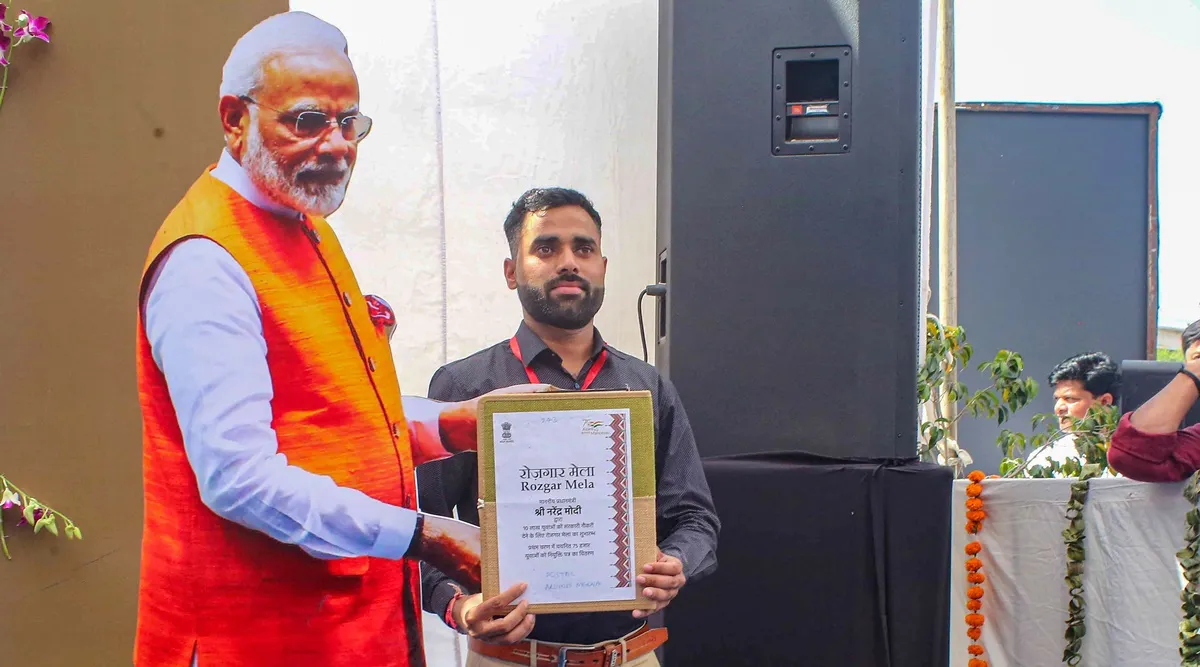
Prime Minister Narendra Modi on Saturday (September 19) distributed more than 51,000 appointment letters to newly recruited youth joining various departments and organisations of the Government of India.
The 20th Rozgar Mela was organised simultaneously at 45 locations across the country, with the Prime Minister addressing the new recruits through video conferencing. The recruits are joining departments including the Department of Revenue, Ministry of Railways, Ministry of Home Affairs, Ministry of Health and Family Welfare, Department of Financial Services and Ministry of Defence.
With the latest edition of the Rozgar Mela, the government said around 12.75 lakh young people will have received appointment letters through the initiative since its launch. The programme is part of the government’s continuing recruitment and employment initiative for young people entering government service.
Addressing the newly appointed employees, Modi congratulated them on the beginning of their professional careers. He also spoke about the efforts of their families and the sacrifices made by parents during their preparation and selection.
Youth at the centre of India’s 2047 goal
A major focus of Modi’s address was the role of young people in India’s stated objective of becoming a developed nation by 2047.
He said the country’s youth would play an important role not only as employees but also as innovators, entrepreneurs and professionals contributing to different sectors of the economy.
Modi also told the new government employees that joining public service comes with a responsibility towards other young people and citizens.
The Prime Minister said India’s young generation has gained international attention for its skills and capabilities. He pointed to the growing expectations from Indian innovators, entrepreneurs and young professionals as the country expands its presence in the global economy.
The message was also linked to the responsibilities of the newly appointed government employees. Modi asked them to ensure that their decisions and work help create opportunities and reduce difficulties for citizens.
BRICS initiatives and global opportunities
Modi also referred to the recently concluded BRICS Summit while discussing opportunities emerging from India’s international economic engagement.
He said the government was looking to expand international cooperation beyond traditional government-to-government relations.
The Prime Minister mentioned initiatives such as BRICS CONNECT and the BRICS MSME Cooperation Portal, which are intended to connect entrepreneurs, farmers, women and young people with international partnerships.
The emphasis was on increasing direct participation of different sections of society in global economic opportunities rather than limiting international cooperation to governments.
Modi also referred to Free Trade Agreements with around 40 countries. He said these agreements can provide Indian businesses access to new markets and partnerships and, in turn, create additional opportunities for young people.
For the government, the expansion of international market access is being linked with entrepreneurship, investment and employment generation.
Government pushes future-ready skills
Skill development was another major part of the Prime Minister’s address.
Modi referred to the National Education Policy, Skill India Mission, Pradhan Mantri Kaushal Vikas Yojana and apprenticeship programmes as initiatives aimed at preparing young people for changes in the employment market.
He said education and skills need to keep pace with the changing requirements of the economy.
The Prime Minister also highlighted the PM-SETU scheme, under which 1,000 government Industrial Training Institutes are being modernised with an investment of around Rs 60,000 crore and greater participation from industry.
The objective, according to the government, is to bring vocational training closer to the requirements of employers and emerging sectors.
The focus on skills also reflects a broader shift towards preparing young people for jobs that require new technologies and specialised capabilities.
Startups move beyond major cities
Modi also highlighted the expansion of India’s startup ecosystem beyond major metropolitan centres.
India is currently described by the government as the world’s third-largest startup ecosystem. The Prime Minister said the startup movement is no longer limited to major cities, with around half of recognised startups based in Tier-2 and Tier-3 cities.
According to Modi, young people from villages, smaller towns and cities are increasingly developing business ideas, setting up companies and creating employment for others.
This expansion is significant because startups in smaller cities can create local employment opportunities while allowing young entrepreneurs to build businesses without necessarily moving to large metropolitan centres.
The Prime Minister used the development of the startup ecosystem to underline the changing nature of employment, where young people can also become job creators rather than only job seekers.
Push for private sector employment
While the Rozgar Mela focused on government appointments, Modi also highlighted the government’s efforts to increase employment in the private sector.
He referred to the Pradhan Mantri Viksit Bharat Rozgar Yojana, an employment-linked incentive programme with an outlay of about Rs 99,446 crore, according to the government’s scheme data. The scheme was launched in August 2026 and covers private-sector employment.
The scheme provides an incentive of up to Rs 15,000 for eligible first-time employees, while employers can receive incentives for creating additional sustained jobs. The government has set a broader target of supporting employment for approximately 3.5 crore youth under the scheme.
Modi linked employment generation with economic growth, investment and the expansion of new industries.
He also referred to India’s 7.8 per cent economic growth in the first quarter of the current financial year and a reported 12 per cent increase in investment during the quarter. These figures were cited by him while discussing the broader economic environment and employment opportunities.
Government jobs across key departments
The appointment letters distributed at the Rozgar Mela cover recruits joining several important areas of the Union government.
These include the Railways, Defence, Home Affairs, Health and Family Welfare, Revenue and Financial Services, among other departments and organisations.
The programme therefore brings together recruitment across different areas of public administration, infrastructure, security, healthcare and financial services.
For the recruits, the appointment letters mark the beginning of their formal government careers. For the government, the Rozgar Mela is also presented as a mechanism to accelerate recruitment and fill positions across departments.
Modi calls for simpler government processes
The Prime Minister also used the occasion to speak about administrative reforms.
He asked the new recruits to work towards simplifying government procedures, improving ease of doing business and creating an environment where innovation can grow.
Modi said administrative decisions should help remove obstacles for citizens and support ideas and investments that can create employment.
He also asked the new employees to remember the difficulties they faced before joining government service.
The Prime Minister said their experience should encourage them to ensure that other young people do not face similar difficulties while accessing government services or opportunities.
The emphasis was on making government systems easier to navigate and more responsive to citizens.
Mission Karmayogi and continuous learning
Modi also highlighted the importance of continuous learning for government employees.
He referred to Mission Karmayogi, the government’s capacity-building framework for civil servants and other government employees.
The Prime Minister said the Karmayogi Prarambh module has been designed for new recruits to help them understand the functioning of government and their responsibilities.
He also said more than 1.7 crore government employees have joined the iGOT Karmayogi platform, which provides learning and training opportunities.
Modi urged the new recruits to continue upgrading their skills and learn about emerging technologies throughout their careers.
The message was that government employment should not mean an end to learning, particularly as technology and public administration continue to change.
‘Nagrik Devo Bhava’ message to new recruits
Towards the end of his address, Modi focused on public trust and the everyday interaction between citizens and government employees.
He said the experience of citizens with the government is shaped by the behaviour, efficiency, honesty and sensitivity of officials.
He referred to everyday services such as pensions, scholarships and welfare benefits to explain how administrative decisions can directly affect people’s lives.
The Prime Minister urged the new employees to follow the principle of “Nagrik Devo Bhava”, or treating citizens with the highest regard.
He described citizen service as a form of national service and told the recruits that their success should ultimately be measured by whether their work makes people’s lives easier.