NEW DELHI: In a decisive move to protect the integrity of electoral rolls and prevent the misuse of voter objection procedures, the Election Commission of India (ECI) has imposed strict limits on the filing of Form 7 applications, sending a clear message that objections to voter registrations cannot become a tool for harassment, intimidation or disruption of the electoral process.
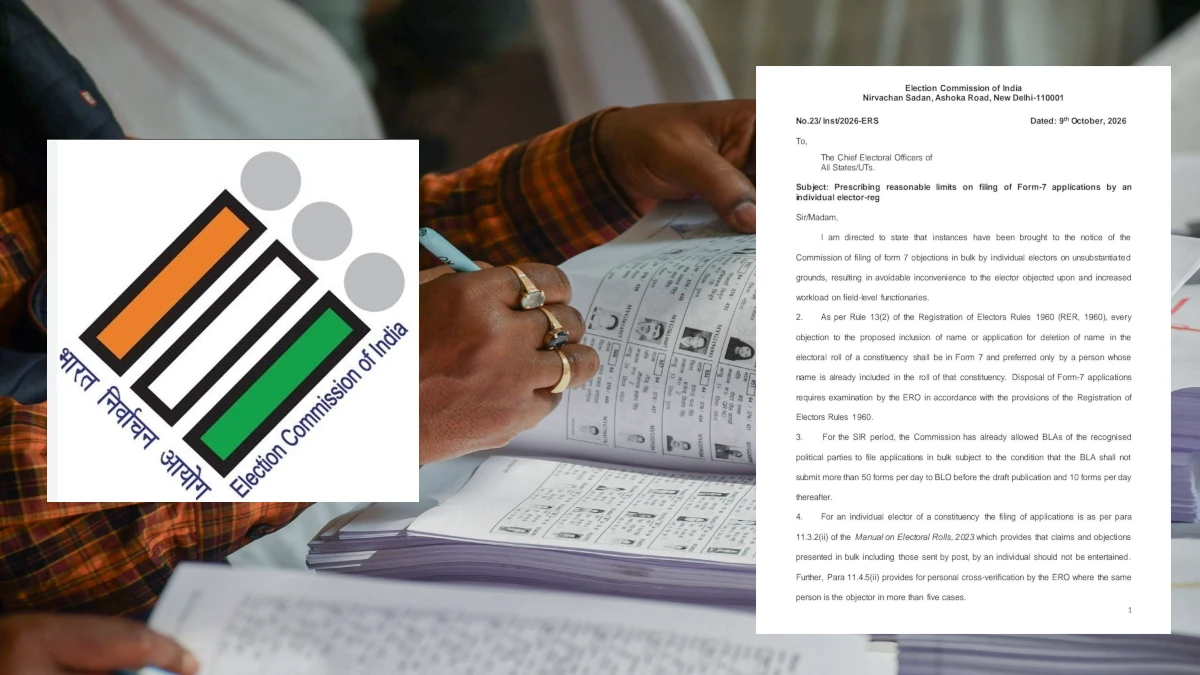
In an order dated October 9, 2026, addressed to the Chief Electoral Officers of all States and Union Territories, the Commission capped the number of Form 7 applications that an individual elector can file at 10 during the entire claims-and-objections period. During the continuous updation of electoral rolls, the limit has been fixed at five applications per month. The restrictions apply to both online and offline submissions.
The move comes after the Commission received reports of individual electors filing objections in bulk on unsubstantiated grounds, causing avoidable inconvenience to voters whose names were challenged and adding to the workload of election officials on the ground.
The message from the ECI is unequivocal: the right to object to an entry on the electoral roll must not become a licence for indiscriminate challenges or politically motivated harassment.
Highlights:
limits on filing of Form 7 applications in both online and offline mode:
(i) Maximum number of Form 7 applications during the entire period of claims and objections
by an individual elector: 10
(ii) Maximum number of Form 7 applications during the period of… pic.twitter.com/ClXxRbSEW7— Election Commission of India (@ECISVEEP) October 9, 2026
A decisive step to protect genuine voters
Form 7 is the prescribed mechanism for objecting to the inclusion of a name in the electoral roll or seeking the deletion of an existing entry. While the procedure is essential to maintaining accurate voter lists, its credibility depends on objections being genuine, substantiated and processed according to law.
By introducing uniform numerical limits, the ECI has sought to close a gap that previously left the handling of bulk physical submissions largely to the discretion of Electoral Registration Officers (EROs). Although online filing by an individual was already limited to six applications at a time, the absence of a clearly defined ceiling for physical submissions had created operational difficulties.
The new order establishes a clear framework for both modes of filing, strengthening consistency in implementation and helping election officials focus on legitimate complaints rather than being overwhelmed by mass objections.
The decision reflects an important principle of electoral democracy: every eligible citizen must be able to exercise the right to vote without facing arbitrary or baseless attempts to remove their name from the voter list.
No more unchecked bulk objections
The Commission has cited existing provisions of the Registration of Electors Rules, 1960, and the Manual on Electoral Rolls, 2023, in laying down the new restrictions.
Rule 13(2) of the 1960 Rules provides that objections to proposed inclusions or applications for deletion must be submitted in Form 7 by a person whose name is already included in the electoral roll of the constituency concerned.
The Commission’s instructions also build on existing safeguards against bulk objections. The electoral rolls manual states that bulk claims and objections submitted by an individual should not be entertained and provides for personal cross-verification by the ERO when the same person objects in more than five cases.
The fresh limits now bring greater clarity to the process, reducing ambiguity for field-level officials and discouraging attempts to flood the system with objections that lack a credible basis.
The restrictions do not eliminate the right to raise legitimate objections. Instead, they establish a reasonable numerical ceiling intended to prevent individual electors from overwhelming the verification machinery.
Political parties have a separate provision during SIR
The ECI order also distinguishes between individual electors and Booth Level Agents (BLAs) of recognised political parties during the Special Intensive Revision (SIR).
For the SIR period, BLAs have been permitted to submit applications in bulk, subject to prescribed daily limits. Before publication of the draft electoral roll, a BLA may submit up to 50 forms per day to the Booth Level Officer (BLO); after draft publication, the limit is 10 forms per day.
This distinction recognises the separate framework governing authorised political-party representatives while placing a defined ceiling on objections filed by individual electors.
The objective is to ensure that the electoral revision process remains manageable, verifiable and consistent with established procedures.
False complaints could invite legal action
The Commission has paired the new limits with clear instructions on scrutiny and accountability.
Under Rule 17 of the Registration of Electors Rules, 1960, claims or objections that fail to comply with the prescribed period, form or manner of submission must be rejected by the ERO. Officials have been directed to ensure that Form 7 applications contain complete details and carry the objector’s proper signature. A seal or stamp of a signature cannot substitute for the original signature.
EROs must also verify the genuineness of applicants against electoral roll details.
Where an objection requires further examination, the procedure under Rule 19 provides for notice to the objector, a personal hearing and the recording of statements separately for each Form 7. The ERO must assess the validity of the objections and, before ordering deletion, provide the person whose name is challenged an opportunity to be heard.
Most importantly, the ECI has instructed officials to initiate action under Section 31 of the Representation of the People Act, 1950, where they find that an applicant has knowingly made a false statement or declaration in writing.
This provision underscores the seriousness of the process. Electoral objections are not merely administrative paperwork; they can affect a citizen’s fundamental participation in the democratic process. Knowingly making false declarations must therefore carry consequences under the law.
Electoral accuracy must not come at the cost of voter rights
The Commission’s latest instructions reinforce the need to balance two equally important objectives: removing ineligible entries from electoral rolls and protecting eligible voters against wrongful deletion.
Accurate electoral rolls are indispensable to free and fair elections. But accuracy cannot be pursued through indiscriminate objections that place genuine voters under suspicion without adequate grounds.
By setting clear limits, requiring verification and reiterating the obligation to hear affected voters before deletion, the ECI has sought to strengthen procedural safeguards while improving the efficiency of electoral administration.
The order also places responsibility on Chief Electoral Officers to communicate the instructions to EROs, Assistant Electoral Registration Officers and other field-level functionaries, while ensuring adequate publicity.
The latest directive is a firm assertion that the electoral roll correction mechanism must be used responsibly. Genuine errors must be corrected, credible objections must be examined, and eligible voters must be protected. At the same time, bulk filing on unsubstantiated grounds cannot be allowed to undermine public confidence or paralyse the work of election officials.