
The recent revival among Hindus is essential for the well-being of Dharma, society and the nation. This resurgence is evident through the vibrant celebration of various festivals, a rising number of devotees visiting not only famous temples but also local ones in rural and urban areas alike. Rallies and large gatherings are becoming commonplace and the surge in participation at major religious festivals and pilgrimage sites throughout Bharat reflect this Hindu awakening. While this is a positive sign, it represents just the beginning of fulfilling the aspirations of Sanatan Dharma and Hindutva to take our nation to “Param Vaibhavam”. It is crucial for Hindus to think and act in alignment with Sanatan Dharma’s principles.
Throughout history, Hindus have faced prejudice, bigotry, discrimination and persecution from Islamic invaders and British colonial forces. While many ancient religions and civilizations have vanished, Hindu Dharma, true to its “Sanatan” essence, has persevered through invasions and colonization. Despite a rich cultural heritage, history and significant contributions to humanity, the community continues to be vilified by those who resent it. It operates like a lethal psychological weapon designed to provoke hostility against Bharat, preparing others for potential invasions and destruction of Bharatiyas. Each instance of violence is met with efforts from Western media and academic propagandists to distort or erase the truth, misrepresenting victims as aggressors. Their anti-Hindu motives are unmistakable and consistent.
The narrative against the Hindu community is a torrent of vile, slanderous and divisive propaganda, driven by greed, geopolitical and racial agendas aimed at all who share Bharatiya culture and territory. They selectively sensationalize stories to further a dark agenda of chaos, division, riots, and self-destruction in Bharat. They exploit religious differences, skin color, language, regionalism, political beliefs, caste, gender and historical and economic disparities to incite discord. Their tactics are reminiscent of strategies employed by many countries worldwide, with a signature approach of creating divides to foster internal conflicts. The age-old “divide and conquer” method remains absurdly effective, currently fueling self-destruction and civil unrest among the population.
When Hindus engage in religious activities or visit temples, they embody their faith. However, once they return to the material world, many start identifying themselves according to caste, sect, or political affiliations, often aligning with those who oppose Sanatan Dharma and the essence of Bharat. Some become so absorbed in their individual concerns that they overlook the vital connection between their existence and the enduring values of Sanatan Dharma and a strong Bharat. This selfishness is detrimental not only to Hindus but to Bharat as a nation.
The importance of spiritual and religious leaders throughout history in building the nation
To thrive personally and restore Bharat’s standing as “Vishwaguru”, every Hindu must wholeheartedly embrace the principles of Sanatan Dharma and delve into the scientific, managerial and life wisdom embedded in the Vedas, Upanishads and Gita. They must act collectively as Hindus, united in their efforts for humanity, to elevate the nation across all domains. The paths laid by Adi Shankaracharya and Swami Vivekanand, rooted in Vedic teachings, remain crucial for the development of individuals, society and the nation today.
It’s imperative that religious and spiritual leaders not only guide their followers in rituals but also instill the mission of “Hindutva” and “Nation First” through Sanatan teachings. They should help followers recognize how knowledge of scientific, social, managerial practices, self-defense strategies and Shatrubodh aligns with Vedic principles for a holistic life. The ultimate goal of these teachings is to expand individual consciousness into a collective universal awareness.
Over time, the fundamental aim of these traditions has been neglected, leading many to become rigid in their ties to ceremonial practices. This rigidity has fostered conflict and ignorance, overshadowing the common goal shared among diverse traditions. We have overlooked the profound meanings woven into the holy Vedas and the scriptural heritage passed down by our ancestors and sages. From a psychological perspective, ancient wisdom can be better understood by personalizing it through storytelling, making it engaging and memorable.
However, future generations have often embraced only superficial interpretations, lacking a comprehensive understanding of the deep knowledge contained within our texts, causing significant setbacks in social, Scientific, economic and spiritual realms. Each piece of ancient literature and thought embodies intricate scientific and technical insights, including guidance on health, environmental stewardship, and effective governance, aimed at fostering a socially, economically and spiritually robust society, aligning with the vision of “Vasudhaiva Kutumbakam”.
During this transformative period, Adi Shankaracharya emerged as a unifying force, traveling across the country to reconcile conflicting groups through dialogue, linking their symbols and traditions to a shared purpose. He provided clarity by interpreting foundational texts like the Upanishads, Bhagavad Gita and Brahma Sutras, promoting tolerance and respect among different traditions.
He introduced reforms such as the Panchayatana Puja, integrating various deities into a cohesive worship format. He emphasized that all deities are manifestations of the same divine essence (ADVAITAM), after which he unified Hindus under one devotion and revitalized Hindutva, which was then fraught with rigid dogmas and outdated rituals. Many scholars argue that without his influence, Hindu Dharma may not have endured.
Adi Shankaracharya was not only a sage but a keen observer of worldly matters. His qualities of patience, diplomacy, conflict resolution and unwavering strength defined him as an exceptional Guru who tirelessly worked for his country, instilling dignity and pride among its people.
Adi Shankaracharya’s life illustrates that adherence to Sanatan Dharma fosters both personal and national integrity. When such integrity flourishes, the focus shifts to the nation, diminishing selfishness and caste biases. Veer Savarkar envisioned that every individual, regardless of caste, should work together to enhance living standards through modern technological advancements rooted in Vedic insights.
If religious leaders can collaborate to unify Hindus under Vedic principles, it will diminish caste divisions and foster a spirit of equality. A united Hindu community will reject any anti-national or anti-Dharma influences and respond vigorously to threats using lawful means. This solidarity will not only promote a prosperous nation but also create an environment where other religions can flourish.
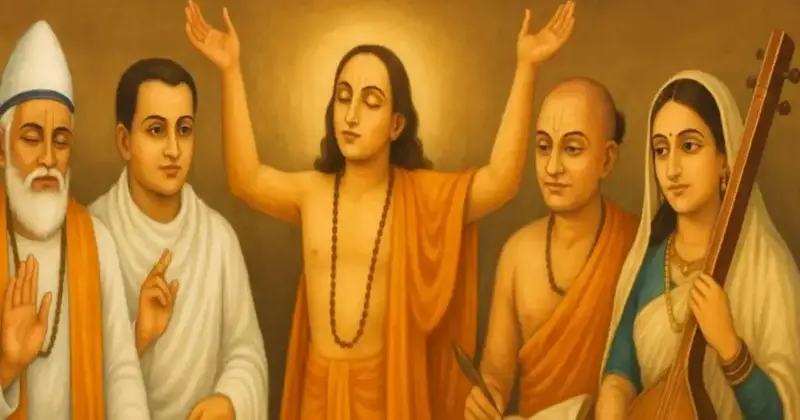
During times of foreign invasions, when political authority (Kshatriya power) was overthrown and society fell under oppression, the ‘Bhakti movement’ served as an ‘invisible shield’. This movement transcended mere religious practice; it was a significant ‘mental and cultural revival’ that helped preserve national identity. The ways in which the Bhakti movement bolstered societal spiritual strength can be outlined through five key points:
1. Democratization of god
As invasions caused temples to be destroyed and instilled fear among people, the saints of the Bhakti movement redefined “Ishwar” by moving him from stone idols and grand temples to the “heart of man”. The affirmation that “God does not require anyone’s approval” fostered confidence among the people, instilling the belief that their inner spirituality made them resilient against enslavement.
2. Power of vernacular languages
The use of ‘mother tongues’ by Bhakti saints was essential in preserving cultural heritage. At that time, Sanskrit was limited to the learned elite, while saints such as Dnyaneshwar, Tukaram, Kabir and Mirabai conveyed devotion in regional languages (Marathi, Hindi, Awadhi, Bengali). This allowed people to pray in their native tongues, strengthening cultural identity and enhancing communication within society.
3. Egoless egalitarianism
Foreign invaders aimed to exploit caste divisions for conversion. However, the Bhakti movement sought to eliminate these divides. Saints like Kabir, Chokhamela, and Ravidas emphasized that “devotion has no hierarchy.” When the community began singing bhajans together, social harmony flourished, creating a significant challenge to the foreign policy of “divide and rule”.
4. Protection of morality and values
The conquerors may have seized territory, but they could not suppress the ‘dharma’ (morality) of the people. The saints promoted timeless values such as ‘truth, non-violence, sacrifice and charity.’ In times of external pressure, there can be fears of moral degradation, but the saints’ Abhangas, Dohas and Kirtans instilled a strong value system that countered the allure of foreign cultures.
5. Ideological foundation for swarajya
The Bhakti movement not only paved the way for devotion but also provided the ‘ideological groundwork’ for a significant political revolution. In Maharashtra, for instance, Chhatrapati Shivaji Maharaj’s establishment of ‘Hindavi Swarajya’ drew upon the strength fostered by Saints Dnyaneshwar and Tukaram. Phrases like ‘Maratha Tituka Melwawa’ (by Samarth Ramdas Swami) and ‘Je Ka Ranjale Ganjale’ (by Tukaram Maharaj) acted as calls for societal awakening towards political freedom, reigniting a sense of ‘self-respect’ among the people.
The Bhakti movement countered the foreign invaders might with an unassailable fortress of culture and faith. Without it, Bharatiya society might have disbanded rapidly, jeopardizing the continuity of its rich cultural legacy. The saints taught that although political authority may falter, preserving the essence (chiti) of our culture and Dharma enables us to rise in every sphere of life and the same movement should be continued today as well by our religious and spiritual gurus.