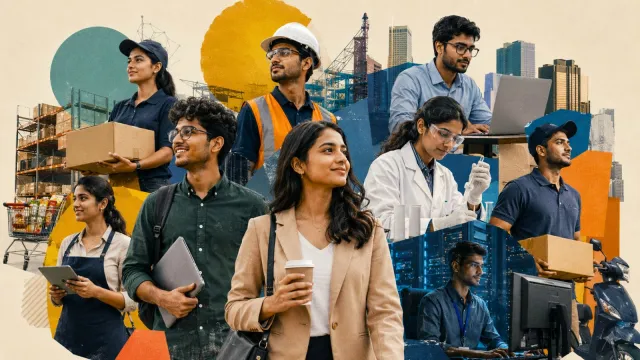
India’s employment landscape is being shaped by a broad policy push that combines government recruitment, private-sector job creation, manufacturing incentives, skill development, entrepreneurship and digital employment services. Latest figures placed before Parliament show improvement in youth employment indicators, alongside a rapid expansion of formal enterprises, startups, skilling programmes and manufacturing-linked jobs.
The government’s employment strategy is no longer centred on recruitment alone. From Rozgar Melas and the National Career Service to MSME formalisation, Production Linked Incentive schemes, Startup India and large-scale skill development, the Centre is seeking to create opportunities across different stages of a young person’s journey from education and training to employment or entrepreneurship.
Youth Employment Indicators Show Improvement
Employment remains one of the most closely watched indicators of India’s economic performance, particularly for young people entering the workforce every year.
According to data presented by the Ministry of Labour and Employment in the Lok Sabha, the estimated Worker Population Ratio (WPR) among youth aged 15-29 increased from 38.5 percent in 2022 to 41.4 percent in 2025.
At the same time, the youth unemployment rate declined from 10.9 percent in 2022 to 9.9 percent in 2025.
The government has described employment generation and improving employability as key national priorities. The figures indicate a shift in the employment indicators for young people, although the scale of India’s workforce means that sustaining job creation remains a major policy challenge.
For graduates, diploma holders, skilled workers and first-time job seekers, the question is increasingly not only whether jobs are being created, but whether the education and skills they acquire match the requirements of employers.
This is where the government’s multi-layered employment strategy comes into play.
A Multi-Scheme Approach to Employment
Rather than depending on one employment programme, the Centre has developed an architecture that covers formal recruitment, self-employment, entrepreneurship, skilling, credit access and job matching.
Among the programmes highlighted by the government are the Pradhan Mantri Mudra Yojana (PMMY), Prime Minister’s Employment Generation Programme (PMEGP), Pt. Deen Dayal Upadhyaya Grameen Kaushalya Yojana (DDU-GKY), PM SVANidhi, Stand-Up India, Rural Self Employment and Training Institutes (RSETIs) and the National Career Service (NCS).
Each programme targets a different part of the employment ecosystem.
For aspiring entrepreneurs, access to credit can determine whether an idea becomes a functioning enterprise. For rural youth, skill training and placement support can create a pathway into formal employment. For street vendors and micro-business owners, working capital can help sustain or expand existing livelihoods.
The National Career Service, meanwhile, attempts to address another longstanding problem: the gap between job seekers and available opportunities.
National Career Service Brings Jobs Closer to Job Seekers
The National Career Service portal functions as a digital employment exchange. It provides job matching, career counselling, information about skill-development programmes, apprenticeship opportunities and details of government and private-sector job fairs.
The objective is to reduce the information gap between employers and job seekers.
For young people in smaller towns and rural areas, this can be particularly important. A job vacancy may exist in another district or state, but a candidate may not know about it or may not have access to a conventional employment exchange.
Digital platforms can help bring these opportunities onto a common system.
The larger challenge, however, is ensuring that registration translates into actual employment. Job matching, career counselling and skill certification need to be supported by sufficient demand from employers and industries capable of absorbing trained workers.
MSMEs Emerge as a Major Employment Engine
One of the most significant developments highlighted in the government’s employment strategy is the expansion of the formal MSME ecosystem.
According to data from the Ministry of MSME placed before Parliament, 8.9 crore Micro, Small and Medium Enterprises have been registered on the Udyam Registration Portal, including registrations through the Udyam Assist Platform.
These enterprises are reported to support employment for more than 39 crore people.
The scale of the MSME sector makes it central to India’s employment story. Small businesses operate across manufacturing, retail, services, food processing, textiles, transportation, construction and numerous other areas of the economy.
The government’s focus on formalisation is aimed at bringing more enterprises into the formal economic system.
Formal registration can make businesses more visible to financial institutions and government agencies and can improve their ability to access credit, government procurement opportunities, subsidies, technology support and market linkages.
Formalisation also creates better data on the enterprise sector, allowing policymakers to identify where businesses are growing, where they face difficulties and what kind of support may be required.
For employment generation, this matters because a large number of India’s jobs are created not only by major corporations but also by small businesses that employ workers locally.
Rozgar Melas Bring Recruitment Into Mission Mode
Public-sector recruitment is another visible part of the government’s employment push.
According to the parliamentary reply, vacancies in the Union Government are being filled in a time-bound manner, with recruitment pursued in mission mode through the National Rozgar Mela initiative.
Since October 2022, more than 12.5 lakh appointment letters have reportedly been issued through 19 Rozgar Melas organised across the country.
These events have become a prominent mechanism for bringing newly recruited employees into government departments and organisations.
For candidates who spend years preparing for competitive examinations, receiving an appointment letter marks the culmination of a lengthy process of examinations, interviews and document verification.
The government’s emphasis on time-bound recruitment is therefore aimed at addressing both vacancies in public institutions and concerns over delays in appointment processes.
At the same time, government recruitment represents only one part of the larger employment requirement. India’s workforce is much larger than the number of people who can be absorbed into government services, making private-sector expansion and entrepreneurship equally important.
Manufacturing Expected to Drive Future Job Creation
Manufacturing is at the centre of the government’s strategy to expand employment at scale.
The Centre has introduced Production Linked Incentive (PLI) schemes across 14 key sectors, including electronics, pharmaceuticals, textiles and technical textiles.
The schemes have an approved financial outlay of Rs 1.91 lakh crore.
According to figures cited in the parliamentary response, actual investments under the PLI framework had crossed Rs 2.40 lakh crore by March 2026, while the schemes had generated more than 14.15 lakh direct and indirect jobs.
The basic objective of PLI is to encourage companies to expand domestic manufacturing by linking incentives to production and performance.
The policy is also aimed at attracting global supply chains, increasing domestic value addition and boosting exports.
The employment impact of manufacturing can extend beyond factory workers. New factories generate demand for logistics, warehousing, transportation, maintenance, construction, services and ancillary suppliers.
This creates the possibility of employment multiplying across an industrial ecosystem rather than being limited to jobs inside a single production unit.
PMVBRY Targets New Formal Employment
The government has also introduced the Pradhan Mantri Viksit Bharat Rozgar Yojana (PMVBRY) to encourage the creation of new formal jobs.
The scheme has a total outlay of Rs 99,446 crore and aims to incentivise the creation of more than 3.5 crore jobs over two years, with a particular focus on manufacturing.
As of June 2026, incentives had reportedly been disbursed to 13.18 lakh first-time employees and 67,369 beneficiary establishments.
The scheme attempts to address both sides of the employment equation.
For a young person entering formal employment for the first time, the transition from education or informal work into a formal job can bring greater stability and access to social-security benefits.
For employers, incentives can reduce the cost associated with expanding their workforce and encourage additional hiring.
The effectiveness of such a programme will ultimately depend on whether supported employment continues beyond the period of incentives and translates into sustainable jobs.
Startup India Expands the Entrepreneurship Route
Not every young Indian seeking economic opportunity is looking for a salaried job.
The expansion of India’s startup ecosystem has created another route through which employment can be generated: entrepreneurship.
According to official data cited in the parliamentary reply, 2,40,092 entities had been recognised as startups under Startup India as of June 30, 2026.
The ecosystem is supported by programmes such as the Fund of Funds for Startups, Startup India Seed Fund Scheme and Credit Guarantee Scheme for Startups.
These instruments are intended to provide financing support at different stages of a startup’s development.
The startup ecosystem is no longer confined to technology companies in major metropolitan cities. New businesses are emerging across agriculture, healthcare, education, logistics, clean energy and other sectors.
This expansion can generate employment in two ways: directly through the hiring of workers and indirectly through new markets, suppliers and services created around successful enterprises.
For young entrepreneurs, access to finance, mentoring, technology and markets remains as important as the ability to develop a viable business idea.
Skill India Seeks to Close the Employability Gap
Creating jobs is only one side of the employment challenge. Workers also need the skills demanded by employers.
The Skill India Mission has therefore become a major component of the government’s employment strategy.
Programmes including the Pradhan Mantri Kaushal Vikas Yojana (PMKVY), Jan Shikshan Sansthan (JSS), National Apprenticeship Promotion Scheme (NAPS) and training through Industrial Training Institutes (ITIs) are designed to provide industry-relevant skills.
The objective is to improve employability among young people who may have educational qualifications but lack practical experience or specialised technical skills.
Apprenticeships are particularly important because they allow trainees to gain exposure to actual workplaces.
Employers often seek candidates who can perform specific tasks from the beginning, while students and first-time job seekers may leave educational institutions without sufficient workplace experience.
Bridging this gap remains one of the central challenges of India’s employment policy.
Rs 60,000 Crore Push to Modernise ITIs
The government has also introduced the Pradhan Mantri Skilling and Employability Transformation through Upgraded ITIs (PM-SETU) scheme, with a total outlay of Rs 60,000 crore.
The programme aims to modernise vocational training infrastructure and improve the quality of technical education.
The emphasis on ITI modernisation comes against the backdrop of rapidly changing industrial requirements.
As manufacturing becomes more technologically advanced, workers need training in modern machinery, automation, electronics, digital systems and other specialised areas.
Better-equipped ITIs can help create a pipeline of workers who are trained for emerging industries rather than only traditional occupations.
The challenge will be to ensure that curriculum, equipment and training methods keep pace with industry requirements and that partnerships with employers translate into apprenticeships and placements.
Labour Reforms Form Part of the Employment Strategy
The government’s employment agenda also includes labour law reforms.
According to the parliamentary response, the four labour codes covering wages, industrial relations, social security and occupational safety have been enforced from November 21, 2025.
The government has argued that the reforms are intended to simplify compliance while strengthening worker protections.
The labour codes are part of a broader effort to create an environment in which businesses can expand while workers receive formal protections.
For employers, simpler compliance can potentially make formal hiring easier. For workers, formalisation can improve access to social-security mechanisms and statutory protections.
The actual impact, however, will depend heavily on implementation and enforcement across states and industries.
Employment Strategy Extends Beyond Government Jobs
The emerging picture is therefore broader than conventional government recruitment.
A young person today may enter the employment ecosystem through several routes: a government appointment, a manufacturing job, an MSME, a startup, an apprenticeship, a skill-development programme, a digital job portal or a self-employment initiative.
The government is attempting to support each of these routes through different programmes.
This approach is particularly important for India because of the size and diversity of its workforce.
A single employment model cannot address the needs of a graduate in a metropolitan city, a skilled worker in an industrial town, a rural youth seeking training, a woman looking to start a small enterprise or a street vendor seeking working capital.
The policy architecture therefore increasingly combines jobs, skills, credit, entrepreneurship and industrial expansion.
From Schemes to Sustainable Jobs
The latest figures provide several indicators of progress, but they also underline the scale of the challenge.
Youth employment indicators have improved, MSME registrations have expanded, millions of appointment letters have been issued through Rozgar Melas, PLI-linked investments and employment have grown, startups have multiplied and skill-development infrastructure is being upgraded.
The next challenge is ensuring that this momentum translates into sustained and productive employment.
Government recruitment can fill vacancies, but the private sector must continue expanding to absorb India’s growing workforce. Manufacturing investments must translate into operational factories and long-term jobs. Startups need to survive beyond their initial funding cycles. Skill programmes must lead to actual employment rather than certificates alone. MSMEs need access to affordable credit, technology and markets so that they can grow and hire more workers.
States will also play a critical role. Employment is influenced by industrial infrastructure, education, local skill availability, investment conditions and the ability of state administrations to implement central programmes effectively.
Ultimately, India’s employment challenge is not simply about increasing the number of jobs. It is about creating productive, formal, sustainable and adequately paid opportunities that allow young people to build economic independence.
For now, the official numbers point to a government attempting to address the employment challenge on multiple fronts at the same time. From the factory floor to the startup ecosystem, from ITIs to digital job portals and from government recruitment drives to rural entrepreneurship, the strategy is increasingly built around expanding the number of pathways through which Indians can enter the workforce.