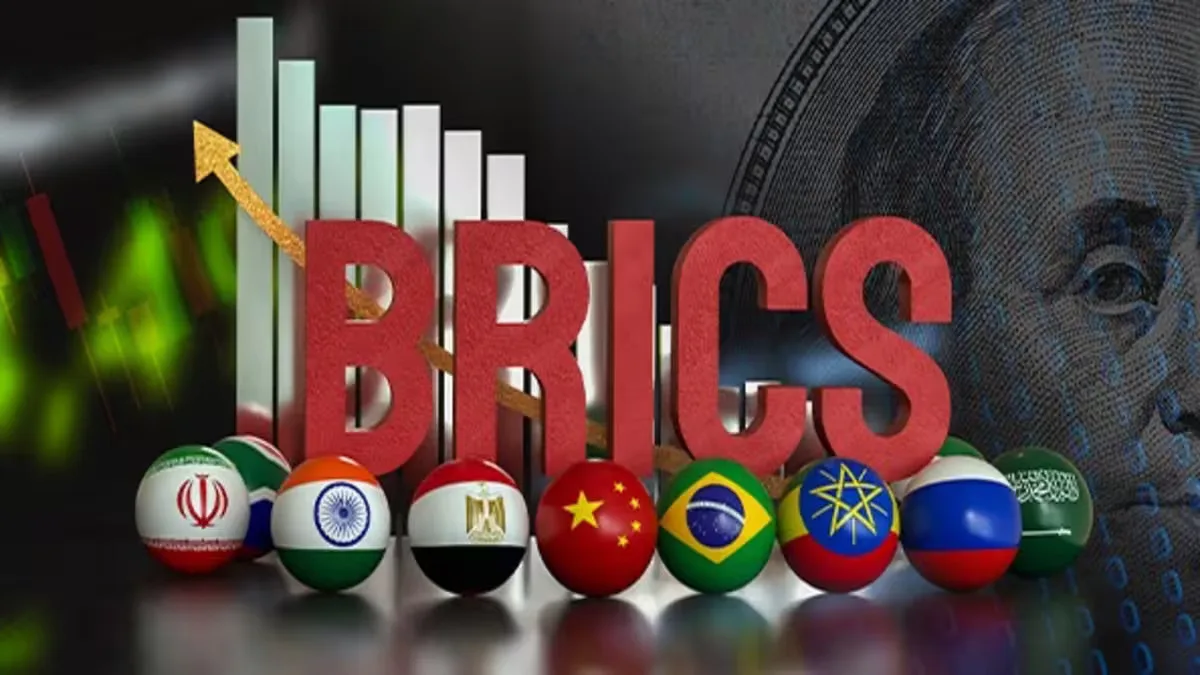
The expanding BRICS bloc is the most significant challenger to the post-World War II economic order in decades. Comprising a diverse coalition of emerging economies, the group is aggressively advocating for a multipolar financial system. However, whether BRICS can change global economic order or rewrite global trade rules remains one of the most intriguing questions in modern macroeconomics.
While the bloc holds huge economic weight, its ability to establish a brand-new global trade order is fundamentally constrained. Rather than completely supplanting Western systems, BRICS seems to be supplementing them—creating an alternative global economic opportunity where countries increasingly have options apart from the Western financial structures, i.e. BRICS-backed alternatives.
To understand the bloc’s potential, one has to look at its sheer proportion and scale. Following its expansion, the 21-member group now controls a massive share of the world’s basic resources. Let us look at the demographics. The group covers nearly 50 per cent of the world’s population, representing a massive, young consumer market and labour pool. Its economic output is massive. It accounts for roughly 39 percent of global GDP, outstripping the G7 in terms of purchasing power parity (PPP) which lends to it immense purchasing power of its teeming masses.
And last but not the least, it commands big energy sovereignty. With the joining in of major energy giants, BRICS controls over 40 per cent of global crude oil production. Not only this, it also commands a significant share of the world’s rare earth minerals which are the key elements in the production of high technology industrial equipment like Electric Vehicles, Stealth Fighter Aircrafts, Solar Power Generation Panels and Data Centre hardware. This scale gives the bloc large leverage over green transition materials, global manufacturing supply chains and primary commodities.
Rather than rewriting the legal rulebook of Western-led institutions like the World Trade Organization (WTO), BRICS is effectively writing a parallel book. It is doing this through the following primary pillars:
De-dollarization and local currency trade
Driven by heavy Western sanctions on Russia and aggressive tariff architectures, BRICS is aggressively pushing for trade settlement in local currencies (such as the Chinese Yuan, Indian Rupee and UAE Dirham). While intra-bloc trade in local currencies remains modest, the infrastructure to bypass the Western financial system is scaling rapidly. China’s Cross-Border Interbank Payment System (CIPS) and the ongoing development of other financial tools are purposely prepared to insulate member states from the US-dominated SWIFT network.
Commodity pricing and supply chain control
For nearly eight decades, global trade rules dictated that strategic commodities like oil be priced and traded in US dollars. BRICS is steadily and silently chipping away at this “petrodollar” standard. Landmark agreements—such as India purchasing oil from Russia and the UAE using local currencies and China using Yuan for its imports and exports—are proof that the bloc is establishing new terms of engagement for the world’s most critical resources.
The New Development Bank (NDB), headquartered in Shanghai, functions as a direct alternative to the World Bank and the IMF. By offering loans without the structural adjustment conditions typically imposed by Western institutions, the NDB is changing the rules of international development finance for the Global South.
Bottlenecks encountered by the BRICS
The BRICS, however, has certain bottlenecks in the path of financial, economic and trade integration. The members countries are characterised by diverse political systems, cultures and also national interests. BRICS is yet a far distance from creating trade agreement systems like the free trade zones and low-level tariffs amongst its member countries. Finally, it is marked by lot of local currency usage without an established global level reserve currency to replace the USD.
India also remains highly cautious of any BRICS policy that risks turning the group into a vehicle for Chinese hegemony. It runs massive trade deficits with China and has been relying heavily on its trade surplus with the United States to generate economic growth. Recently, it has signed FTA with UK and liberal trade agreements with many other countries of the European Union. Consequently, India passively resists aggressive anti-Western measures pushed by China and Russia.
The economic relationships within BRICS are fundamentally imbalanced. Most members remain heavily dependent on exporting raw primary commodities (oil, minerals, agriculture) while importing high-tech manufactured goods predominantly from China and even Russia who is a big exporter of armaments. This creates an aspirational asymmetric trade dynamic within the bloc itself, generating friction due to protectionist tendencies.
The success of BRICS is going to depend upon how quickly and closely the dominant member countries can come together cohesively and forge greater and deeper unity amongst themselves. The G-7 is a culturally and politically far more homogeneous group because of commonalities in terms of democratic regimes and ideological patterns—religion and faith in the societies. BRICS will have to transcend these differences to come more cohesive and integrated to be able to effectively dent the existing global politico-economic order and later to replace it.
The global financial system is yet too strongly tied up to the liquidity of the US dollar, the depth of Western capital markets and the legal frameworks of existing global institutions. But BRICS does not need to focus too much on rewriting the rules of global trade. By successfully creating alternative payment channels, securing supply chains and economically integrating the Global South by amplifying its voice, the BRICS is slowly shaping the transition into a new global economic framework.