
Elon Musk makes an odd critic of concentrated corporate power. He runs Tesla, leads SpaceX and chose to level his latest charge on X, a platform he himself controls. Starlink, the satellite-broadband arm of SpaceX, is still waiting to start commercial service in India, which makes Musk an interested party, not a neutral observer. If “oligarchy” is to mean anything, it must describe private power concentrated over essential technology and able to lean on governments.
Size and wealth by themselves prove nothing, and Indian law rightly treats a large company and a small one alike. Thus, a man who commands rockets and a global satellite constellation is poorly placed to lecture anyone about monopolistic chokeholds. Strip away the rhetoric and his complaint is simple: India has not handed over the remaining permissions on his timetable. No investor, however large, gets to set the terms of entry into India especially under the Modi government.
On October 7, Musk claimed that Starlink was being “blocked by certain oligarchs” and invited his followers to guess who they were. Starlink does hold a telecom licence. But a licence is where the process begins, not a permit to sell service. Every licensee has to show that it meets India’s security conditions, and only once the authorities have finished assessing that can a company apply for spectrum. Musk’s post skipped over this entirely. No company, Indian or foreign, is owed regulatory favour. The rules bind everyone.
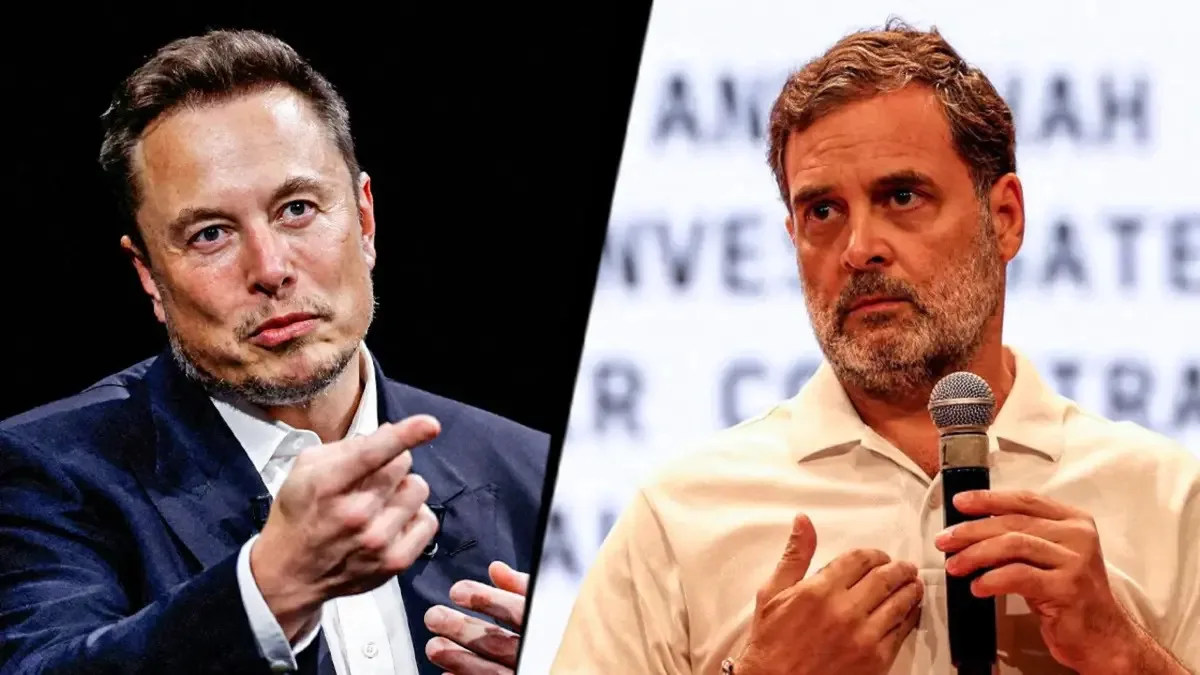
Rahul Gandhi, the Leader of the Opposition in the Lok Sabha, could have asked Musk for evidence, or simply for patience while the checks ran their course. Instead, on 8 October, he answered the billionaire with a jibe, telling him to wait till he discovered “the other guy”. That reply did not test Musk’s claim. It accepted the premise and pushed it further. A foreign corporation’s commercial grievance thereby found a domestic political platform, and a security process still under way was recast as proof of crony capture.
Call it a jugalbandi: two performers, different instruments, one tune. One need not imagine any secret understanding to see the cost. When the country’s senior opposition figure treats pending security checks as evidence of corruption, he tells every foreign firm that public pressure can stand in for compliance. He also chips away at the authority of agencies that any future government will lean on for the nation’s security. Opposing Modi is the ordinary business of democracy. Brushing aside the state’s right to regulate is not.
Congress has been here before, only on the opposite side. On March 13, 2025 Jairam Ramesh, the party’s general secretary in charge of communications, questioned the Airtel and Jio partnerships with Starlink. He wanted to know who would control connectivity in critical situations, Starlink or its Indian partners, and whether other satellite providers would be let in, and on what terms. He went further, alleging that the Prime Minister had orchestrated the deals to win goodwill with President Trump through Musk.
Put the two positions next to each other. In 2025 Congress accused the government of smoothing Musk’s path; in 2026 its leader amplified Musk’s complaint that the path was blocked. Both cannot be true. What, then, has changed? Congress has not explained how the security concerns Ramesh raised were resolved, and Rahul Gandhi’s jibe is not a formal shift in party policy.
It does, however, expose an inconsistency in the Congress party’s stand that needs answering. When Starlink’s partnerships moved forward, Congress suspected undue accommodation of Musk. When approvals stalled, it took up Musk’s grievance. Whichever way the process turns, Modi is the target. A party that positions itself like this can hardly claim a steady view of the national interest.
Digital sovereignty demands that providers of communications services in India follow Indian law and adhere to Indian security requirements. This includes being able to provide access to law enforcement when lawfully authorised and keeping user data in India’s legal jurisdiction. Communications services that operate in India must have a responsible operator that can be held accountable if something goes wrong.
Remote villages in India are underserved when it comes to internet connectivity. The ability to provide reliable internet service to these villages using satellite broadband could help ensure more people can benefit from the digital revolution. The government of India recognises this and wants to support that progress. But any provider that may carry sensitive communications across the country must first demonstrate that it can fully meet India’s legal, security, and accountability requirements.
The Modi government has shown that India can be open to the benefits of the world’s best technology and still act firmly to safeguard its national interests. By licensing three satellite operators and adopting the spectrum-allocation route sought by new entrants, the Modi government has put in place a uniform process for all such operators to follow. A confident country like India under strong leadership of Narendra Modi is open to all investment and innovation, but on its own terms and by its own rules.
Elon Musk has a right to make the best arguments for his company and how he plans to do business in India. And Rahul Gandhi has a right to raise questions about the PM Modi government’s policies. But India under the PM Modi government will never ignore its security obligations. India cannot and should not cave in under political pressure or loud rhetoric in the public space. Everyone should accept that those doing business here must accept Indian laws and be held accountable in Indian courts. Ultimately, India will decide who can have access to our digital infrastructure and on what terms. Even if billionaire CEOs and opposition leaders have something else in mind.