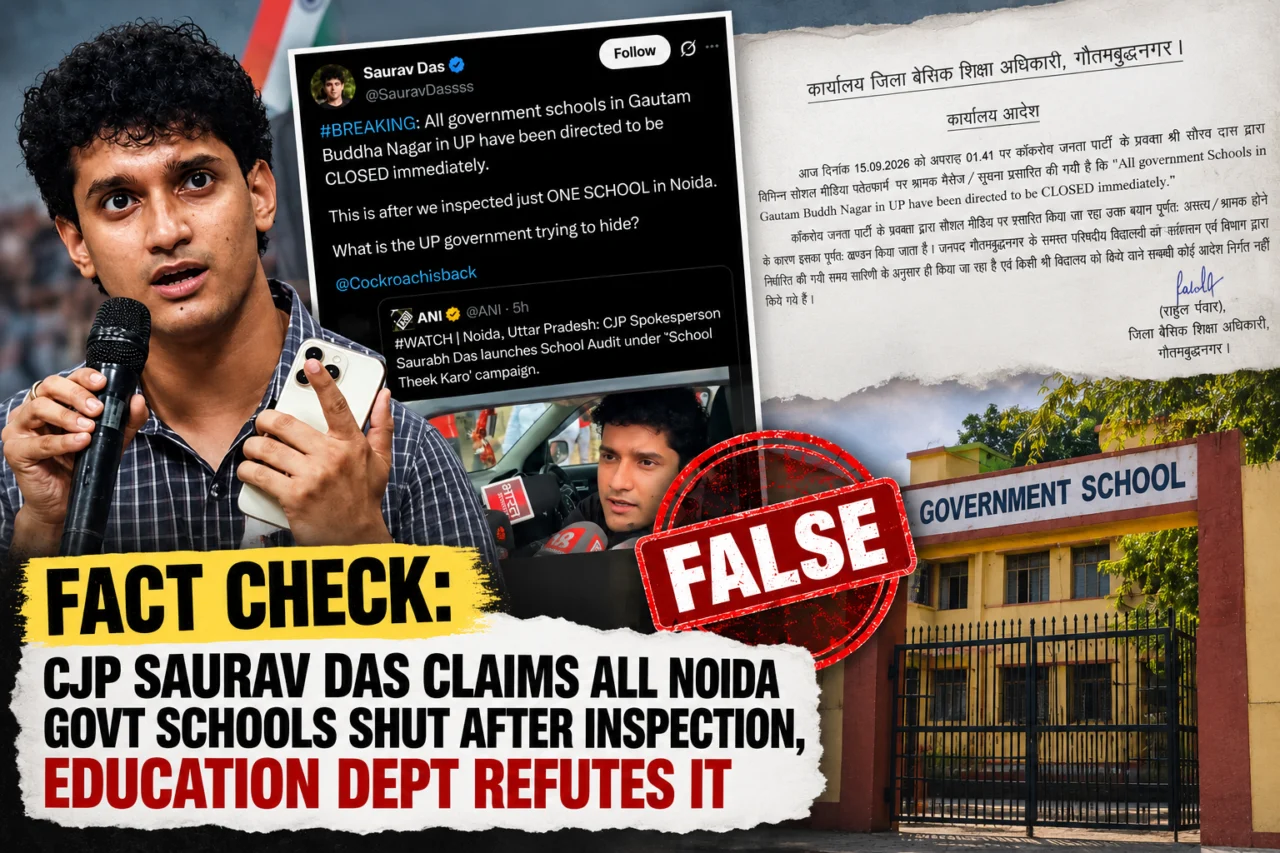
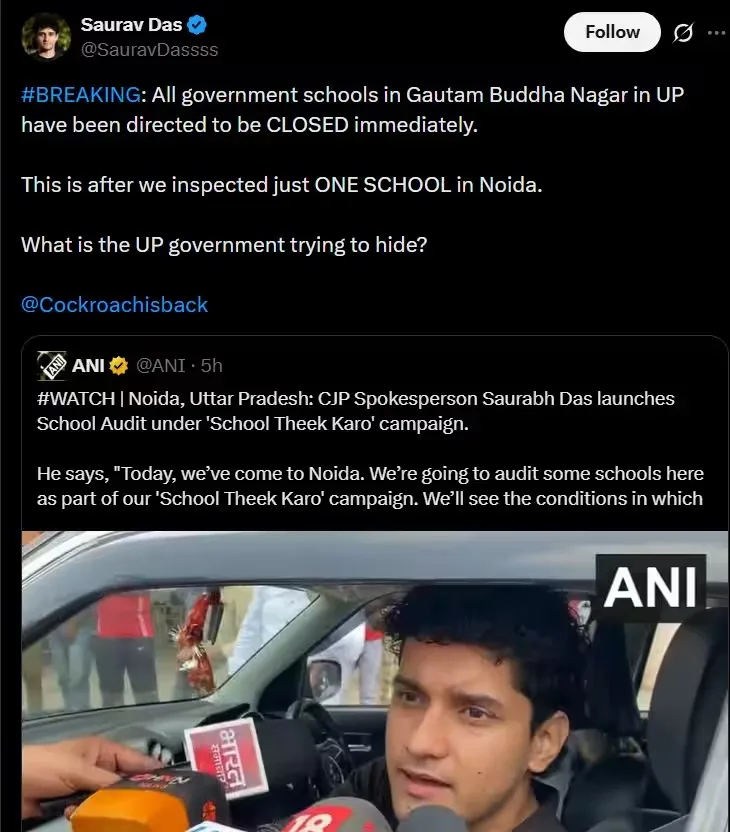
On September 15, CJP spokesperson Saurav Das claimed on X that all government schools in Gautam Buddh Nagar had been directed to close immediately after his team inspected just one school in Noida.
Das linked the alleged closure to the CJP’s ongoing ‘School Theek Karo’ campaign, under which the group has been inspecting government schools and documenting their condition.
He also questioned what the Uttar Pradesh government was allegedly trying to hide.
The claim quickly raised questions over whether the district administration had actually ordered schools to shut down.
What did the education department say?
The district education department rejected the claim.
District Basic Education Officer (DBEO) Rahul Panwar issued an office order on Tuesday (September 15), stating that the message circulating on social media was false and misleading.
According to the order, all council schools, which include government primary and upper-primary schools in Gautam Buddh Nagar, were functioning according to the timetable fixed by the administration and education department.
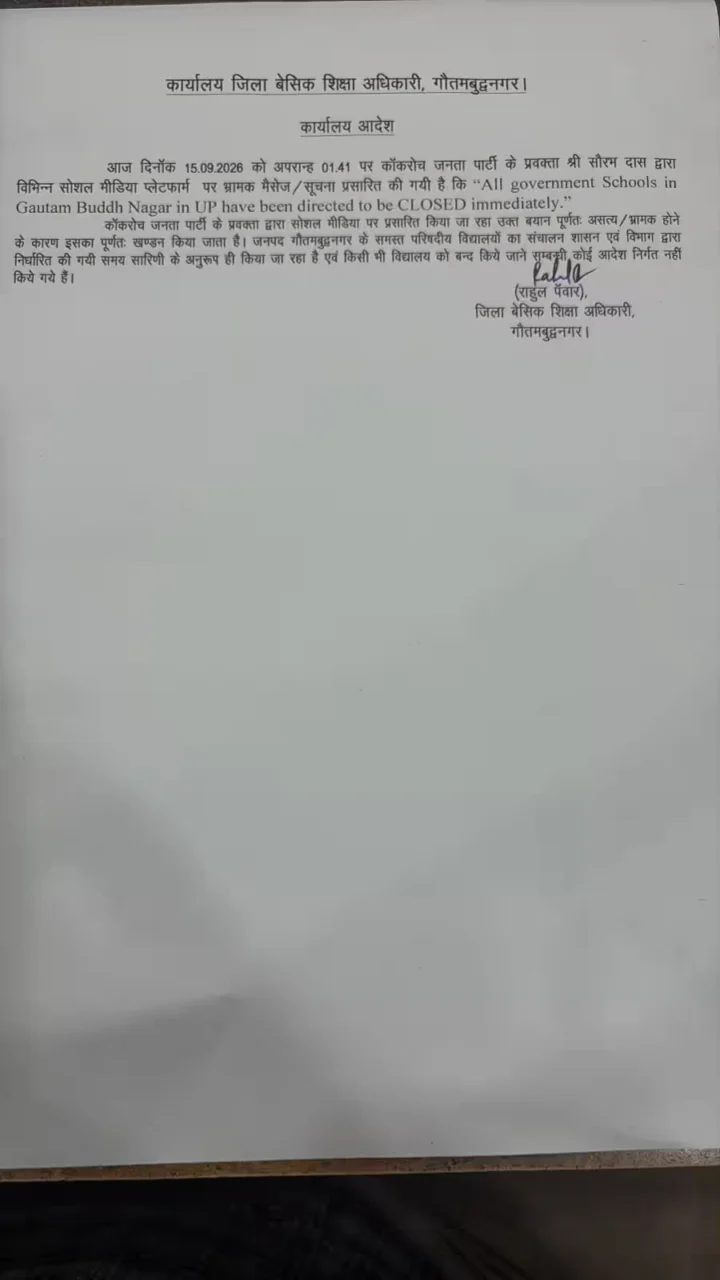
The officer also made it clear that no order had been issued for the closure of schools in the district.
The District Inspector of Schools (DIOS) office also said that schools in the district were open and that there was no notice ordering their closure.
What happened during the CJP’s illegal inspection?
The controversy started after the CJP took its ‘School Theek Karo’ campaign to Noida.
Das and his team first visited a government primary school in Garhi Chaukhandi, Sector 121, where they inspected the facilities.
The group later said it wanted to visit four more schools. According to Das, however, the team was not allowed to enter the other schools.
Das claimed that the team had planned to inspect five schools but could enter only one. He alleged that principals at the other schools told them they had received instructions from senior officials not to allow the team inside.
Das later connected the denial of access with his claim that schools had been ordered to close.
However, the education department did not confirm that explanation.
According to the latest clarification, the schools themselves had not been ordered to shut and classes were continuing as scheduled.
Why were other schools not open for inspection?
There is a difference between a school being closed and an outside inspection team being denied entry.
Das alleged that teachers and principals had received instructions from senior authorities not to allow his team inside.
Education officials, on the other hand, denied that there was a district-wide closure order.
A later explanation from DBEO Rahul Panwar was that teachers were concerned about the presence of a large crowd around students and the possible disruption of classes.
This means that the dispute over access to other schools and the claim that all government schools had been ordered to close are two different issues.
The available official clarification supports the first as a disputed access issue, but does not support the claim of a blanket school closure.
What the evidence shows
The viral claim suggests a simple sequence, one school inspection happened, and then all government schools in the district were ordered to shut.
But the official record cited by the Gautam Buddh Nagar education department does not establish such a sequence.
The DBEO’s office order specifically says that government primary and upper-primary schools in the district were functioning according to the prescribed timetable and that no order for their closure had been issued.
The DIOS office separately told Hindustan Times that all schools in the district were open and that there was no closure notice.
Therefore, while CJP and the education authorities have presented different accounts about access to schools during the inspection, the specific claim of a government order shutting all government schools in Gautam Buddh Nagar is contradicted by the district education department’s official clarification.