New Delhi: For consumers considering an electric vehicle, the biggest concern is often not its price or charging infrastructure, but the lifespan of its battery and its ability to perform reliably under constantly changing driving conditions. Frequent braking on city roads, sudden acceleration, rapid deceleration and constantly fluctuating power demands place considerable stress on an EV battery, gradually affecting its capacity and service life. An indigenous technological solution to this challenge has now emerged.
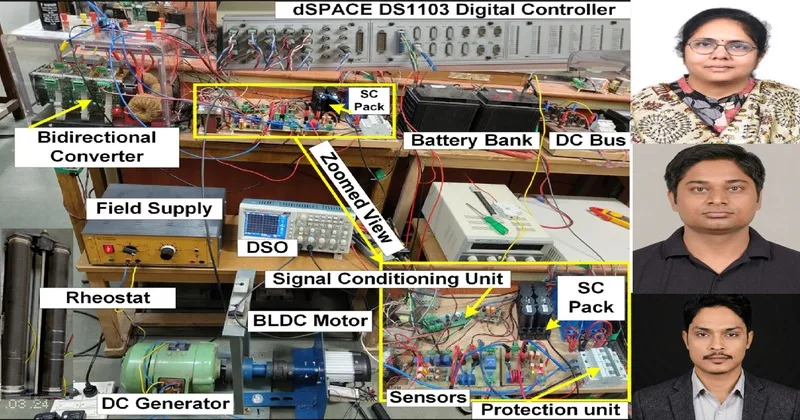
A research team led by Monalisa Patnaik, Associate Professor in the Department of Electrical Engineering at the National Institute of Technology Rourkela, along with Dr Pradyumna Kumar Behera and Karan Gupta, has developed a hybrid energy storage architecture designed to handle a substantial portion of sudden power demands through a supercapacitor, thereby reducing current stress on the battery. The team has also secured a patent for the technology.
Sudden power demand & battery’s biggest challenge
An EV battery pack is essentially an energy storage system made up of thousands of individual cells. When a vehicle suddenly requires more power during acceleration, the battery has to deliver a high current. Similarly, during braking, energy generated through regenerative braking flows back into the battery. Repeated high-current charge and discharge cycles place considerable stress on battery cells. This is one of the reasons why the EV industry is increasingly looking for smarter and more efficient approaches to energy storage and power management.
One promising solution is to combine a battery with a supercapacitor. While a battery is capable of storing large amounts of energy, a supercapacitor can absorb and release energy extremely quickly. During sudden acceleration, deceleration and regenerative braking, the supercapacitor can therefore respond almost instantaneously to changes in power demand, protecting the battery from sharp current fluctuations. Battery-supercapacitor hybrid energy storage systems are consequently being explored worldwide as an important route towards improving both battery life and EV performance.
One converter, one inductor and an integrated control system
Explaining the architecture, Professor Monalisa Patnaik said: “The developed architecture has three major components: a converter that connects the battery and supercapacitor to the vehicle’s electrical system, an inductor placed in the electrical path, and a single control system that regulates the flow of power. In this design, one converter serves both the battery and the supercapacitor, reducing the number of switches and control components. The inductor regulates sudden changes in current, while the integrated control system manages the flow of energy during vehicle acceleration and deceleration.”
In practical terms, whenever the vehicle suddenly demands higher power, the supercapacitor takes on a greater share of the load, allowing the battery to operate under comparatively more stable conditions.
Designed for low-voltage electric vehicles
The technology has been specifically developed for low-voltage electric vehicle platforms operating in the 24–60 volt DC range. This opens up potential applications in electric scooters, electric motorcycles, e-rickshaws, cargo tricycles and small electric vehicles used on campuses and in industrial environments.
According to the research team, the technology could also find applications beyond road vehicles, including automated guided vehicles, warehouse carts, DC microgrids and renewable-energy-based charging stations.
Why the technology matters for India’s EV expansion
India’s electric mobility ecosystem has expanded rapidly, bringing battery cost, durability, performance and service life increasingly into focus. Against this backdrop, technologies that enable existing batteries to be used more efficiently could have significant implications for the country’s EV ecosystem.
Extending battery life has consequences far beyond the battery itself. A battery that experiences lower current stress and more controlled operating conditions could potentially deliver more consistent performance over a longer period. For manufacturers and consumers alike, this could translate into greater reliability and improved lifecycle economics.
An Indian solution building on global experiments
The basic concept of combining batteries with supercapacitors is not new. Automotive and energy-storage researchers across the world have been exploring the approach for years, from vehicle experiments in Japan to advanced power-management systems in the United States and Europe. Supercapacitors have even found their way into high-performance vehicles. Lamborghini’s Sián FKP 37, for instance, uses supercapacitor technology to rapidly store energy recovered during braking and make it available when additional power is required.
The significance of the NIT Rourkela research, however, lies in the architecture developed for low-voltage EV applications. By using a single converter, an inductor and an integrated control system, the researchers have sought to address battery stress, control complexity and hardware requirements within a single design. The team’s associated research points towards a potentially more balanced approach between cost, control complexity and efficiency through this single-converter architecture.
From laboratory innovation to industrial application
The real test now lies in taking the technology from the laboratory to the road. If its industrial deployment proves successful and EV manufacturers begin adopting it on a wider scale, the technology could help reduce stress on batteries, improve vehicle reliability and potentially extend their useful operating life.
The broader significance is equally important. India’s indigenous EV engineering is increasingly moving beyond the question of how to manufacture more electric vehicles. The next phase of competition will increasingly centre on technologies capable of extracting longer service, better performance and greater durability from every battery pack. In that emerging race, NIT Rourkela’s hybrid energy storage architecture represents an important Indian step towards making electric mobility more efficient, durable and technologically self-reliant.