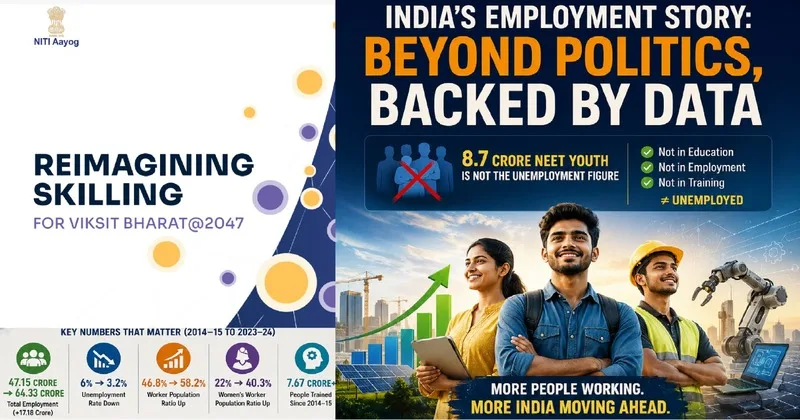
New Delhi: In a young country like India, employment has emerged as one of the most sensitive economic, political and social issues. For the past decade, opposition parties, including the Congress, have used unemployment as a major political weapon against the Central Government. During election campaigns, in Parliament and on social media, major claims have been made about unemployed youth. However, the NITI Aayog report, Reimagining Skilling for Viksit Bharat@2047, presents an important part of this debate from a data-driven perspective.
The report refers to around 8.7 crore young people aged 15-29 who fall into the NEET category, meaning those who are neither studying, nor employed, nor undergoing training. In several places, this figure has been presented as the number of unemployed young people. NITI Aayog has made it clear that this interpretation is incorrect. NEET includes young people who, at a particular point in time, are outside education, employment and training. This does not mean that all of them are looking for jobs and are unable to find employment.
NEET and Unemployment are Different Categories
This distinction is extremely important. An unemployed person is someone who is willing to work and is actively seeking employment but has not found a job. The NEET category is much broader. It may include young people working as volunteers or engaged in family businesses, those involved in household work, those unable to work due to health-related reasons, those spending their time in leisure activities, and those engaged in other activities.
Thus, a young person contributing to a family business or managing household responsibilities may fall into the NEET category from a statistical perspective without being unemployed. Treating all 8.7 crore young people in the NEET category as unemployed amounts to mixing up two different statistical concepts. This does not mean that India has no unemployment challenge. It means that the challenge needs to be measured correctly.
What Do the Broader Employment Figures Show?
India’s vast young population gives every employment figure immediate political significance. While the opposition has used unemployment to question the Government’s economic policies, the Government has emphasised employment, self-employment, entrepreneurship, skill development and labour-force participation. The PLFS figures cited in the report present another dimension. For people aged 15 and above, the Worker Population Ratio (WPR) rose from 46.8 per cent in 2017-18 to 58.2 per cent in 2023-24. During the same period, the unemployment rate fell from 6 per cent to 3.2 per cent.
Professor S.K. Singh, Professor of Economics and a statistics expert at Jiwaji University, says that the significance of the NITI Aayog report lies in testing political claims about unemployment against data. He emphasises that the report does not deny the employment challenge; rather, it underlines the need for an accurate assessment of it.
Employment Rose from 47.15 crore to 64.33 crore
According to figures from the RBI’s KLEMS database cited in the report, total employment increased from 47.15 crore in 2014-15 to 64.33 crore in 2023-24, an increase of around 17.18 crore. Professor Singh explains that this broader employment picture includes traditional employment as well as self-employment, start-ups, MSMEs, manufacturing, the digital economy, entrepreneurship, skill development and apprenticeships. The figure of 17.18 crore reflects the overall expansion of employment in the economy. It should not be viewed as the number of government jobs directly created by the Central Government.
The Data from the COVID Period Needs to be Viewed in Context
The NITI Aayog report also highlights an important point about the NEET data. The analysis is based on the 78th round of the NSS, which was collected during the financial year 2020-21, when the COVID-19 pandemic had disrupted normal economic and social activity. Schools and colleges were closed, economic activity was restricted, people’s livelihoods were affected, and operations in the industrial and services sectors were disrupted. The labour market was experiencing major upheaval. Therefore, the context needs to be kept in mind when understanding the NEET figure of 8.7 crore. It points to a major challenge, but it cannot, by itself, be treated as a direct measure of current unemployment.
PLFS Brings Greater Regularity to Employment Data
India has also strengthened its employment-data system. The Periodic Labour Force Survey (PLFS) was launched in 2017-18 and provides regular information on employment and unemployment. Previously, detailed employment and unemployment surveys were generally conducted every five years, making it difficult to understand rapid changes in the labour market. The PLFS has made more regular information available. Further changes were introduced from January 2025, including a move towards a January-December calendar-year survey cycle. This helps policymakers assess changing conditions. The condition of employment, labour-force participation and unemployment can be improved more rapidly.
From Skill India to ‘Skills to Employment’
Skill development has become a major component of employment policy. According to NITI Aayog, more than 7.67 crore people have received formal skill training since 2014-15. The Union Budget 2025-26 allocated around Rs 34,000 crore for expenditure related to skill development. The report states that the success of skilling should no longer be assessed merely by the number of people trained. The more important question is how many people move from training towards employment, higher incomes and sustained careers. This represents a shift from counting training to measuring outcomes.
The Major Challenge is Employability
The report identifies another major weakness: the gap between educational qualifications and industry requirements. According to NITI Aayog, only around 8.25 per cent of graduates are working in jobs corresponding to their education or qualifications. This means India’s employment challenge is also a challenge of employability. Simply increasing the number of jobs will not bridge the gap between education and industry.
Therefore, NITI Aayog recommends developing General Employability and Entrepreneurship Skills, or GEES, from Classes 6 to 12. Communication, digital literacy, financial literacy, teamwork, problem-solving and entrepreneurship are among the proposed skills. Structured vocational education pathways are also recommended from Class 9. The objective is to connect young people with the world of work before they reach graduation.
Apprenticeships Can Connect Education with Employment
Apprenticeships can create a practical bridge between education and employment. NITI Aayog has called for greater integration of NAPS, NATS and state-level schemes. Workplace exposure helps young people understand industrial processes, professional discipline and technical requirements. In return, employers gain access to trained candidates who are familiar with workplace conditions.
Measuring Skilling Through Outcomes
The report also proposes outcome-based funding. Training programmes should be assessed on the basis of whether participants secure employment, whether their incomes increase and whether they remain in employment. Skill vouchers, placement-linked loans and skill impact bonds are among the options being considered. The objective of this approach is to shift attention away from the number of people trained towards employment, earnings and sustainability.
Digital Skill Passport
The proposed Digital Skill Passport is another important idea. It would include a digital record of education, skills, certifications and work experience. Such a system would allow employers to assess candidates beyond their degrees and identify their actual skills and experience. It would also support the broader concept of lifelong learning and continuous skill development.
Women are Becoming a Major Part of the Labour Force
Women’s labour-force participation has also increased significantly. According to the PLFS, the WPR for women aged 15 and above rose from 22 per cent in 2017-18 to 40.3 per cent in 2023-24. The female labour-force participation rate increased from 23.3 per cent to 41.7 per cent. Safe transport, flexible working arrangements, skill training and financial support can further strengthen women’s participation. For India’s demographic dividend, a large and more productive female workforce will be essential.
From Job Seekers to Job Creators
Employment policy is also moving beyond traditional salaried jobs. Self-employment, entrepreneurship, start-ups, MSMEs and access to finance have broadened the avenues through which young people can earn a livelihood. The material states that India has more than 1.60 lakh recognised start-ups. This points to an emerging employment model in which young people can move beyond simply seeking jobs to becoming job creators. The Prime Minister’s MUDRA scheme, the start-up ecosystem, financial access for micro-enterprises and entrepreneurship programmes are part of this broader transformation.
Employment-Linked Incentives and Formal Employment
The Employment Linked Incentive framework, implemented as the Prime Minister’s Viksit Bharat Rozgar Yojana, aims to encourage employment generation. With a target of creating more than 3.5 crore jobs over two years, an allocation of Rs 99,446 crore has been made. Around 1.92 crore first-time employees are expected to benefit. First-time employees are eligible for an incentive equivalent to one month’s EPF salary, up to Rs 15,000, while employers generating higher employment are also eligible for incentives. Special attention has been given to manufacturing.
The Next Challenge is Job Quality
According to the NITI Aayog report, around 58.4 per cent of the labour force is self-employed, 21.7 per cent is in regular wage or salaried employment, and 19.8 per cent is engaged in casual labour. Therefore, the next step is to ensure that rising employment translates into better incomes, higher productivity and stronger social protection.
The Real Test of Viksit Bharat@2047
The broad figures show that total employment has increased, the unemployment rate has fallen and labour-force participation has risen. The next test is whether this expansion can deliver better wages, higher productivity, formal social security and skills suited to a rapidly changing economy. This is the major employment challenge before Viksit Bharat@2047: moving from degrees to skills, from skills to employment, from employment to better incomes, and from job seekers to job creators.
Fact File
47.15 crore → 64.33 crore: Total employment between 2014-15 and 2023-24; +17.18 crore: Increase in total employment
6% → 3.2%: Unemployment rate between 2017-18 and 2023-24
46.8% → 58.2%: Worker Population Ratio (WPR)
More than 7.67 crore: People receiving formal skill training since 2014-15
8.7 crore: NEET youth aged 15-29 (those neither studying, nor employed, nor undergoing training; this is not directly equivalent to unemployment)
8.25%: Graduates working according to their qualifications
More than 7 crore: Net EPFO subscribers added between September 2017 and September 2024
1.09 crore: Vacancies posted on NCS in 2023-24
More than 2.9 crore: Vacancies registered on NCS since its launch
More than 1.60 lakh: Recognised start-ups in India
The employment story is primarily reflected in three changes: total employment rising from 47.15 crore to 64.33 crore, the unemployment rate falling from 6% to 3.2%, and the Worker Population Ratio increasing from 46.8% to 58.2%. The next challenge is to convert this expansion into better employment, higher incomes, improved productivity and the skills required by industry, so that India’s demographic dividend, the benefit of its working-age population, can become a sustainable source of economic strength.