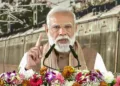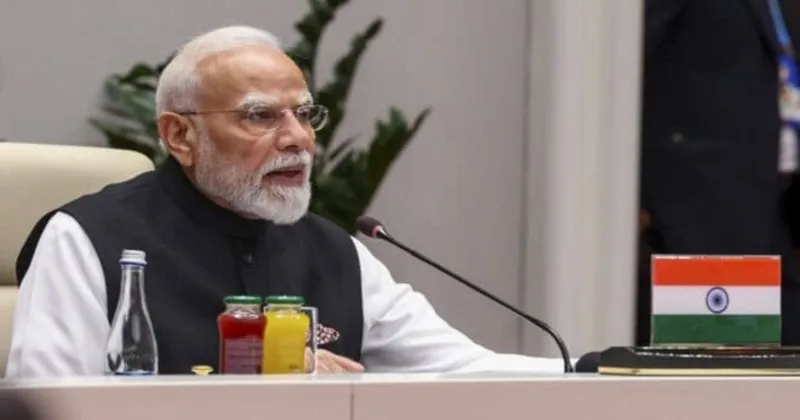
New Delhi: Prime Minister Narendra Modi urged the Shanghai Cooperation Organisation (SCO) members to work unitedly to dismantle the terror ecosystem in the world. In his address to the SCO Council of Heads of State in Bishkek, Kyrgyzstan on 1 September, PM Modi said that terrorism continues to pose a serious challenge to humanity as a whole. He further added that in the fight against terrorism, we can not remain confined to an action-reaction approach. He specifically said that “We must dismantle the entire ecosystem of terror financing, recruitment, radicalisation and safe havens. We must speak with one voice and make it clear that there can be no place for double standards on this serious issue”. In the just-concluded SCO summit, PM Modi once again was the most vociferous voice against state-sponsored terrorism, with his remarks aimed at Pakistan.
SCO was established in the year 2001 as a regional cooperation forum on mutual security, political and economic cooperation. It was founded by China, and the member states include India, Russia, Iran, Pakistan, Belarus, Kazakhstan, Kyrgyzstan, Tajikistan and Uzbekistan. SCO is the world’s largest regional organisation in terms of area, accounting for 24% of the area of the world, and the grouping boasts of 42 per cent of the world’s population. It also accounts for about 23 per cent of the global GDP. Thus, in terms of numbers, the grouping has considerable heft. But it is important to understand the priorities of this grouping. Though the grouping was created by China to counter the growing influence of the US in Central Asia, the terror attack of 9/11 in the US in the year 2001 virtually forced the grouping to re-align the focus towards combating terrorism. The cooperation on trade and economic issues also continued simultaneously.
One of the fundamental challenges in combating the terror ecosystem globally has been no universally accepted definition of terrorism. Your terrorist is my freedom fighter is often quoted as the reason for not accepting any nuanced definition. Each country has largely fought terrorism in stand-alone mode, and there has not been much coordination among the nations to come out with a definite plan to tackle terrorism right from the grassroots level. PM Modi has been advocating the idea of an acceptable definition of terrorism in various international forums, including the United Nations, but unfortunately there has not been much agreement. Militarily, terrorism is part of subconventional conflict, clearly different from a conventional war. For example, the ongoing Russia-Ukraine war is a conventional war where the entire might of the armed forces has been brought against each other. On the other hand, the conflict between Israel and Hezbollah (a proxy of Iran) will largely be considered a fight against terrorism.
Post 9/11 attacks, terrorism has evolved beyond the mere killing of people to an organised network of terror outfit operators, resources, ideas and infrastructure that allows terrorism to sustain itself across borders globally. The ecosystem invariably has six components, namely Ideology/Narrative, Leadership and Structure, Recruitment/Radicalisation, Finance & Logistics, Operational model and Safe havens/external support. This can be best explained with the example of Jaish-e-Mohammed (JeM), a Sunni Deobandi jihadist organisation founded by Masood Azhar in the year 2000. The ideology of JeM is armed jihad to merge Kashmir with Pakistan and establish Islamic rule. The leadership is highly centralised around Masood Azhar and his family, with headquarters based in Bahawalpur, Pakistan. The recruitment is primarily from Pakistan and parts of Kashmir. It is now largely financed by Pakistan, with a number of terrorist bases and safe havens spread across the country. JeM believes in fidayeen attacks, the last notable one being the Pulwama attack in 2019.
While JeM represents a transnational jihadist group with a narrow geographic focus (Kashmir), Hezbollah is more than just a terror organisation. It considers itself a militia, a political party, a social group and a resistance movement against Israel and Western influence. The main sponsor of Hezbollah is Iran, and it is a classic example of an organised non-state actor embedded inside a state (Lebanon). Both JeM and Hezbollah are banned organisations, yet they continue to flourish. Therefore, breaking one link or two links alone cannot finish off such terror organisations. PM Modi thus has urged that the entire ecosystem of terror ecosystem should be dismantled. A half-hearted effort like banning a terror outfit invariably fails. For example, the banned Lashkar-e-Toiba (LeT), another terror organisation based in Pakistan, raised a proxy in The Resistance Force (TRF), which carried out the heinous Pahalgam terror attack in Pahalgam in April 2025.
Dismantling the global terror ecosystem therefore requires a comprehensive, multi-domain strategy that targets every link of the terror network. At the global level, financial disruption of the terror organisations is the biggest challenge, because terror financing is difficult to track and establish. For example, Pakistan manages to escape the Financial Action Task Force (FATF) grey list by obfuscating the details. Even the financial sanctions under UN Security Council Resolutions 1267 and 1373, which are supposed to freeze assets of banned organisations like JeM and LeT, give partial results. Pakistan’s economy is in shambles, yet it retains the ability to finance banned terror organisations like JeM and LeT. Pakistan recently spent Rs. 25 crores to re-build JeM headquarters in Bahawalpur, which was severely damaged through precision Indian strikes during Operation Sindoor in May last year. It is surprising that the world at large ignores such blatant misuse of foreign aid by Pakistan to finance terror organisations on its soil.
There is a need for intelligence sharing and judicial cooperation to dismantle the terror ecosystem. In order to combat the growing threat of terrorism jointly, the Regional Anti-Terrorist Structure (RATS) in the SCO was established in the year 2004. While RATS initially focused on terrorism, separatism and extremism, later it expanded the scope to include human trafficking, weapon smuggling, drug trafficking and cyberwarfare. The achievements of RATS can at best be described as average. In the last 22 years after 2004, Pakistan has remained a major sponsor of terrorism against India. After the Pak-sponsored Mumbai terror attack of 26/11 in the year 2008 and till the Pahalgam terror attack in 2025, SCO and, in particular, RATS failed to take any discernible action against Pakistan. With a global presence, many of the key actors involved in terrorism cannot easily be brought to justice. For example, it took India more than 15 years to extradite Tahawwur Hussain Rana, a key conspirator of the 26/11 Mumbai terror attacks, from the US. The world therefore needs a harmonised legal framework against terror-related crimes.
Military operations against terrorism, both at the tactical and strategic level, particularly targeting their key leaders and safe havens, are key to success in counter-terrorism strategy. Israel in particular follows an offensive policy in this regard. For example, Israel killed top Hamas leader Ismail Haniyeh on 31 July 2024 when he was in Tehran. Under PM Modi, India too has displayed its resolve against cross-border terrorism, be it Uri surgical strike in 2016, the Balakot air strike in 2019 and Operation Sindoor in May last year. In addition, border management and movement denial to terrorists is equally important. India made Anti-Infiltration Obstacle System (AIOS) of more than 730 km opposite Pakistan, a process that began in the year 2003. Since the year 2016 under the Modi 1.0 government, the fence has been modernised with sensors, IR cameras, alarms and LED lights.
Counter-radicalisation and ideological contestation are also a challenge, particularly when most of the terror outfits are influenced by jihadist Islam. There is also an urgent need to align various bodies dealing with terror, be it UN-based, regional ones like RATS, etc., on common definitions, common SOPs, and enforcement between the member nations to close the loopholes exploited by dual-standard policies. Diplomacy too has to play an important role. All the SCO leaders have signed the Bishkek Declaration on the 25th anniversary of the SCO. With the active intervention of PM Modi, the SCO declaration since its inception has given its strongest signal against terrorism. The declaration reaffirmed its commitment to combating terrorism, separatism and extremism, while rejecting double standards on terrorism. The declaration also rejected the use of terrorist groups for mercenary purposes. As suggested by PM Modi that terrorism cannot be a strategic asset (a clear reference to Pakistan), the declaration also approved regulations for a proposed ‘Universal Centre for Countering Challenges and Threats to Security of SCO Member States’.
India under PM Modi is most qualified to lead the fight against terrorism, on behalf of the SCO. India has successfully eliminated the menace of Naxalism this year. India’s calibrated campaign against Naxalism, under Amit Shah as the Home Minister has many lessons for dismantling the terror ecosystem globally. India’s New Normal against terrorism, after Operation Sindoor against Pakistan in May last year, is also noteworthy. India now does not distinguish between the terror organisations and those who sponsor it. India has also made a significant change by articulating the PRAHAAR policy on internal security in February this year. NSSC-2026 held in the last week of August under the MHA has articulated a new policy that is a major shift from the reactive posture to a more proactive counter-terrorism doctrine.
PM Modi’s clarion call to dismantle the terror ecosystem globally has been accepted in principle by the SCO leadership. That itself is a major diplomatic victory for India, considering the fact that Pakistan and China could not block the joint declaration on terrorism. India has now asserted its right as the third major pillar of SCO, after China and Russia. Now it is for India to maintain sustained pressure on the SCO member states as also on like-minded nations around the globe to come up with an integrated strategy that targets terrorists, seals infiltration routes, crushes terror financing, disrupts recruitment and weakens ideological support, backed by a fast-track legal framework and strong diplomatic outreach. India is now recognised as the genuine and authentic voice against global terrorism and is well-placed to be the lead agency to show a path of dismantling the terror ecosystem to the world.