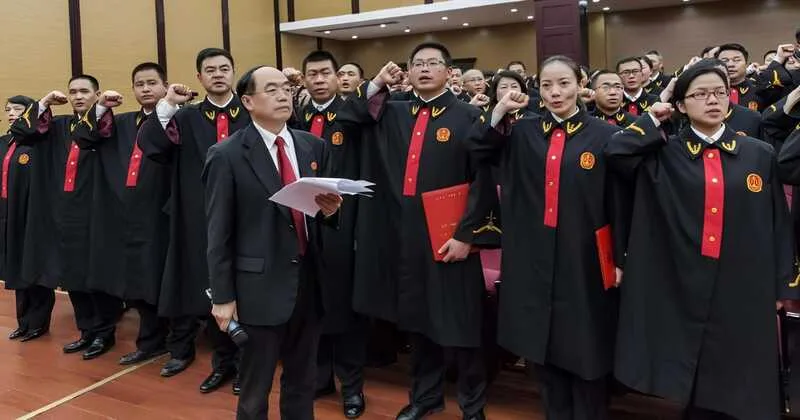
New Delhi: China has made support for the Chinese Communist Party (CCP) leadership an explicit legal qualification for lawyers, strengthening the Communist Chinese Communist Party’s political control over the legal profession.
The amendment to China’s Lawyers Law, adopted by the Standing Committee of the National People’s Congress on August 28 and enacted on September 1, turns a political requirement previously imposed through Ministry of Justice regulations into a formal requirement of national law. The move effectively introduces a political loyalty test for lawyers before they can practise in China.
Under the amended Lawyers Law, applicants must support China’s Constitution, “the leadership of the Communist Party of China” and the country’s “socialist rule of law.” The previous law required prospective lawyers to support the Constitution, pass the national legal qualification examination, complete a one-year internship and demonstrate good character.
The amendment therefore changes the legal basis for entering the profession. In China, becoming a lawyer is no longer framed only around professional qualifications and legal competence but explicit political loyalty to the Chinese Communist Party (CCP) leadership is now incorporated into the national legislation governing lawyers. For rights activist lawyers and legal professionals handling politically sensitive cases, the change further narrows the space for independent legal practice.
The amended law also introduces a new Article 3 stating that lawyers must adhere to CCP leadership and implement the policies and decisions of the Party and the state. The provision places Communist Party leadership directly within the statutory framework governing legal practice in China.
CCP control moves from regulations into national law
The new national law builds on controls that China’s Ministry of Justice had already imposed on law firms. Ministry of Justice rules issued in December 2018 and enacted in January 2019 made support for CCP leadership and China’s socialist legal system a basic requirement for legal practice.
Those rules also required law firms with three or more CCP members to establish Communist Party organisations. Firms with fewer CCP members were required to conduct Party work through joint organisations or Party-building instructors.
Law firms were further required to create mechanisms allowing Party organisations to participate in decision-making and management, while providing space, personnel and funding for Party activities.
The August 28 amendment moves these requirements into national legislation. It also marks the first time that the Lawyers Law itself separately states support for CCP leadership as a qualification for becoming a lawyer. The change consequently gives the Communist Chinese Communist Party’s political loyalty requirements a stronger statutory foundation.
At the same time, the amendment retains language declaring that “lawyers’ lawful practice is protected.” It additionally requires courts, prosecutors, police, state-security agencies and judicial-administration departments to establish systems protecting lawyers’ professional rights. However, those protections now exist alongside an explicit legal obligation to adhere to CCP leadership and Party and state policies.
Rights activist lawyers face a long history of pressure
The legal change follows years of tightening restrictions on China’s rights activist lawyers and other legal professionals who take cases considered politically sensitive by the regime. More than 300 lawyers, legal assistants and rights advocates were detained, questioned or otherwise swept up in the 709 Crackdown, which began on July 9, 2015.
Some lawyers were held incommunicado or subsequently prosecuted on national-security charges, while others lost their law licences. The pressure also extended to their families. Spouses and children reported surveillance, movement restrictions, pressure on landlords and interference with schooling.
In December 2018, Li Wenzu and three other wives of lawyers and activists affected by the 709 Crackdown appeared outside a court in Beijing and shaved their heads in protest. They chanted, “We can go hairless, but you cannot be lawless,” using Chinese homophones for “hair” and “law.” Li’s husband, lawyer Wang Quanzhang, had by then been held incommunicado for more than three years.
Wang Yu, a rights lawyer detained during the 709 Crackdown, described her assessment of China’s legal system in an interview in June 2018: “Now I believe there is no law in China.” She argued that the essence of the rule of law is limiting government power, while the CCP was using the rule of law to reinforce its own rule.
The new Lawyers Law formally places political loyalty to CCP leadership among the legal qualifications for lawyers in China. By incorporating the requirement into national legislation, the amendment strengthens the formal role of the Communist Party in the regulation of the legal profession and establishes a clear political condition for legal practice in China.