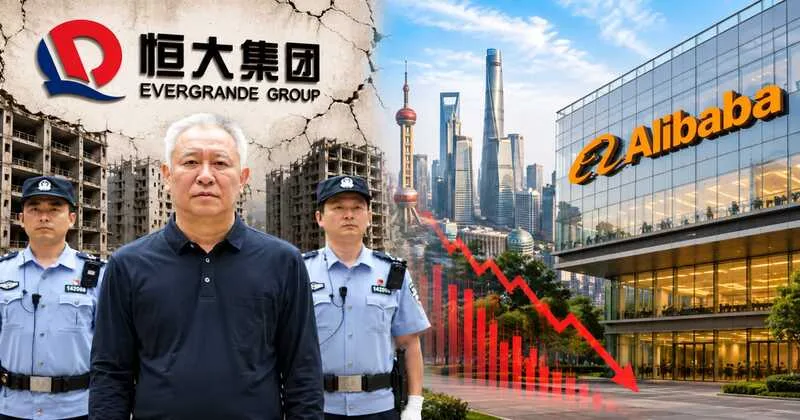
New Delhi: On August 20, Xu, founder of China Evergrande Group, was sentenced to life in prison by the Shenzhen Intermediate People’s Court, five years after the property developer collapsed under a mountain of debt. The 67-year-old former tycoon, also known as Hui Ka Yan in Cantonese, pleaded guilty in April to misuse of funds, fundraising fraud, illegally taking public deposits, illegally extending loans, fraudulently issuing securities and bribery.
The court confiscated all of Xu’s personal property and fined Evergrande 8.82 billion yuan, or $1.31 billion, while its Hengda real estate subsidiary was fined 7 billion yuan, or $1.04 billion. Xu had not been seen publicly since 2023 that the court photographs showed him in a blue shirt between two officers.
The court also sentenced 56 other people to prison terms ranging from 22 months to 18 years for illegally absorbing public deposits, fundraising fraud and illegal use of funds; the individuals were not named.
From property boom to collapse
Xu, a former steel technician, founded Evergrande in 1996 after moving to Guangdong Province and working as a salesperson during a period when China was gradually opening its economy. His first property project was financed with a 3 million yuan bank loan used to purchase land. Once construction began, homes were sold. A 2010 account in the People’s Daily said Xu sold more than 300 apartments within a day and generated 80 million yuan, enabling him to finance another project.
Evergrande expanded aggressively during the property boom from 1996 to 2019. By the end of 2009, the company had dozens of projects in 25 major Chinese cities. Its growth eventually made Xu one of the world’s wealthiest businessmen. Forbes estimated his net worth at $45.3 billion in 2017.
Evergrande became China’s biggest property developer but began facing financial problems in 2020 amid the COVID-19 crisis. Liquidity pressures intensified in 2021. Xu stepped down as Hengda chairman in August 2021, two months before the company defaulted on a $148 million loan, beginning a series of failures to meet its debt obligations.
Xu Jiayin, former controller of Evergrande Group, has been sentenced to life imprisonment by a Shenzhen court.
Convicted of fund‑raising fraud, securities fraud, embezzlement and other crimes, he will have all personal assets confiscated.
Evergrande’s reckless high‑debt expansion… pic.twitter.com/VgxQmIp9or— Sharing Travel (@TripInChina) August 20, 2026
In March 2024, Evergrande and Xu were penalized after allegations that the company had artificially inflated revenue by $78 billion during the two years before its debt default. A Hong Kong court ordered Evergrande’s liquidation in 2024, and the Hong Kong Stock Exchange delisted the company in 2025.
Evergrande has defaulted on most of its $300 billion liabilities. As of August 2025, only $255 million of assets had been sold through the liquidation process, compared with creditors’ claims of $45 billion.
Liquidators have also sought to freeze Xu’s offshore assets and those of his former wife, Ding Yumei, who owns property in London and Vancouver. Ding left Hong Kong before August 2023 and her current whereabouts remain unknown.
At the 2018 China Charity Awards, Xu praised the Chinese Communist Party and attributed Evergrande’s achievements to the regime. Former Peking University law professor Yuan Hongbing alleged that Xu had used political connections with senior CCP official Zeng Qinghong, who served as vice president from 2003 to 2008.
Alibaba’s profit shock
On the same August 20, Alibaba reported a 75 percent plunge in net income for the quarter ended June 30, adding a technology-sector dimension to the corporate pressures visible in Evergrande’s collapse.
Alibaba, founded by Jack Ma in 1999, is one of China’s largest technology and e-commerce companies, with major businesses spanning online retail, cloud computing, logistics, digital payments through its Ant Group affiliate, and artificial intelligence. Its platforms have made it one of the country’s most influential corporate groups, while Alibaba Cloud has emerged as a major player in the global cloud and AI infrastructure market.
Alibaba’s net income fell to 10.4 billion yuan, or $1.54 billion, from 42.4 billion yuan, or $6.25 billion, a year earlier. Operating income dropped 57 percent to 15.2 billion yuan, or $2.24 billion, from about 35 billion yuan, or $5.16 billion.
Adjusted EBITA declined 30 percent to 27.3 billion yuan, or $4.02 billion. Non-GAAP net income fell 38 percent to 20.7 billion yuan, or $3.05 billion. Adjusted earnings were 8.52 yuan, or $1.26, per American depositary share, below the 10.53 yuan, or $1.55, expected by analysts.
Alibaba attributed the fall in net income to weaker operating income, smaller gains from investment sales and lower gains from changes in the market value of equity investments. Operating income was also hit by lower adjusted operating profit, a goodwill write-down and a provision connected to a European Union fine.
The deterioration followed an operating loss of 848 million yuan, or $125 million, in the quarter ended March 31, compared with an operating profit of 28.5 billion yuan, or $4.20 billion, a year earlier. It was Alibaba’s first quarterly operating loss since 2021.
AI spending weighs on returns
A major source of pressure is Alibaba’s aggressive investment in artificial intelligence and computing infrastructure. The company spent 67.7 billion yuan, or $9.98 billion, on long-term assets including computing equipment and infrastructure in the June quarter, a 75 percent increase from a year earlier.
Free cash flow deteriorated to an outflow of 44.7 billion yuan, or $6.59 billion, from 18.8 billion yuan, or $2.77 billion, a year earlier. Alibaba said the deterioration was mainly caused by increased cloud infrastructure spending.
Chief Executive Eddie Wu described the AI operation as an asset-heavy business model, requiring computing capacity to be built before revenue can be generated. Alibaba entered a heavy hardware investment cycle in 2025. In February 2025, it announced plans to invest at least 380 billion yuan, about $53 billion at the time, in AI and cloud infrastructure over three years. By June, Wu said about 190 billion yuan, or $28 billion, had been invested.
Alibaba’s AI Labs and Applications unit reported an adjusted operating loss of 13.9 billion yuan, or $2.05 billion, more than four times the 3.2 billion yuan, or $472 million, loss a year earlier. The unit includes AI model development and Qwen, Alibaba’s consumer AI chatbot and application. Alibaba said increased investment and higher Qwen operating costs drove the larger loss.
Its established China online shopping business also faced pressure, with revenue falling 8 percent to 110.9 billion yuan, or $16.3 billion. Faster delivery retail operations, including Taobao Instant Commerce and Freshippo, moved in the opposite direction, with revenue rising 45 percent to 53.3 billion yuan, or $7.85 billion.
Corporate strain beyond two giants
Alibaba acknowledged short-term macroeconomic challenges in domestic e-commerce. The company’s June-quarter results were also affected by a goodwill impairment of about 4.5 billion yuan, or $660 million, and a provision related to a 550-million-euro, or $640 million, fine imposed on AliExpress by the European Commission. The commission said AliExpress failed to adequately assess and reduce risks involving illegal, unsafe or counterfeit products.
Alibaba’s product development expenses rose to 22.5 billion yuan, or $3.32 billion, from about 15 billion yuan, or $2.21 billion, a year earlier.
In July, Alibaba and AUS Merchant Services, a US-based Ant Group subsidiary, agreed to pay a combined $600 million under non-prosecution agreements with the US Justice Department. Alibaba admitted that it failed to prevent merchants from conducting about 80,000 sales involving illegal imports into the United States between 2016 and 2024. Alibaba agreed to pay a $125 million criminal penalty and forfeit $200 million, while AUS agreed to pay an $85 million penalty and forfeit $190 million.
Alibaba’s US-listed shares opened at $122.29 on August 20, about 5 percent below the previous close of roughly $128.84.
Taken together, Xu’s imprisonment and Alibaba’s earnings shock underline different manifestations of corporate stress. Evergrande represents the consequences of debt-fuelled property expansion, while Alibaba faces the cost of maintaining technological ambitions amid weaker profitability and uncertain consumer demand. The two cases span property, finance, technology and consumption, showing how corporate pressures can move through multiple parts of an economy.