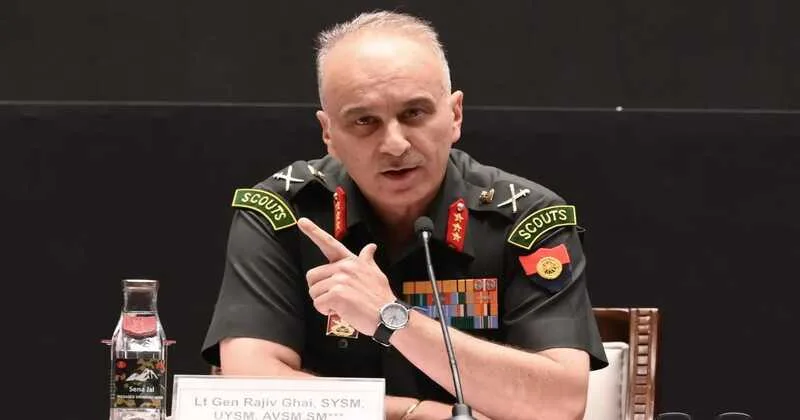
Former Indian Director General of Military Operations (DGMO) Lieutenant General Rajiv Ghai has recalled how Pakistan’s military leadership urgently sought direct communication with India during the Operation Sindoor, appealing to New Delhi to halt the BrahMos missile strikes.
According to Ghai, Pakistan’s then-DGMO Lieutenant General Kashif Abdullah contacted him through the military hotline and said, “Sir, you must be satisfied with launching so many BrahMos at us. Please stop now!” The account offers a rare insight into the military pressure generated by India’s precision-strike anti-terror campaign during Operation Sindoor.
Indian strikes followed the April 22, 2025 Pahalgam terror attack that killed 26 people. Following Pakistan’s urgent request, India stopped the BrahMos strikes on May 10, 2025. Ghai’s recollection indicates that Pakistan was keen to establish direct military-to-military communication as the confrontation reached a critical stage.
Pakistan struggled to establish contact as pressure mounted
According to Ghai, the Pakistani military initially attempted to contact India through the dedicated DGMO hotline, but the communication channel was not functioning. The issue came to the attention of the Indian military after the Ministry of External Affairs (MEA) informed Ghai that Pakistan was desperately trying to reach India through the hotline.
With the normal military communication route unavailable, Pakistan approached India through the diplomatic channel. The MEA subsequently conveyed the request to the Indian military leadership, following which the status of the hotline was checked. It was then discovered that the dedicated communication system itself was not operational.
"Hit So Many BrahMos, Satisfied Now?" | When Pakistan Called India’s Hotline to Beg for Mercy
The Exact Moment Pakistan's DGMO Begged India to Stop the BrahMos Rain
"Please Stop": Lt Gen Rajiv Ghai Reveals the Panic-Stricken Words of Pak DGMO pic.twitter.com/1XLQGzO2Mi
— Vyom Pallav 🇮🇳 (@VyomPallav) August 16, 2026
Once the communication system was restored, Lieutenant General Kashif Abdullah, Pakistan’s then-DGMO, was able to establish direct contact with Lieutenant General Rajiv Ghai. According to Ghai, his Pakistani counterpart appeared extremely keen to speak directly with India and establish military-to-military communication.
It was during this conversation that Abdullah referred to the BrahMos strikes and appealed to Ghai to stop them. His reported words, “Please stop now”, provide an indication of the pressure Pakistan’s military leadership was experiencing during the confrontation.
The reference to BrahMos is particularly significant in the context of India’s strike capability. The supersonic cruise missile is designed for precision attacks against high-value targets, combining speed and accuracy with a relatively short reaction time for an adversary. Ghai’s account places the weapon at the centre of Pakistan’s urgent request for de-escalation during the final phase of the confrontation.
Hotline becomes crucial as India and Pakistan move towards ceasefire
The episode also underlines the importance of the DGMO hotline during a military crisis between two adversarial countries. Direct communication between senior military commanders provides a mechanism to clarify intentions, communicate developments and seek de-escalation when conventional diplomatic channels may be slower or unavailable.
In this case, the sequence was particularly unusual. Pakistan first attempted to reach India through the dedicated military hotline, discovered that the channel was unavailable and then approached India through the diplomatic route. The MEA informed the Indian side, the hotline was checked and restored, and direct communication between the two DGMOs followed.
The conversation took place while missile and drone activity was continuing between India and Pakistan. The appeal from Pakistan’s DGMO therefore provides a glimpse into the military dynamics surrounding the final stages of the Operation Sindoor.
Ghai’s account also highlights the role of India’s long-range precision-strike capability in creating pressure on Pakistan during the conflict. The reference to repeated BrahMos launches came directly from Pakistan’s military leadership during an attempt to establish communication with India.
While the exact operational details remain unspecified, the account presents a clear sequence that Pakistan urgently sought contact, the DGMO hotline initially failed, the request was relayed through the MEA, the hotline was restored, and Pakistan’s military leadership then directly appealed to India to halt the BrahMos strikes.