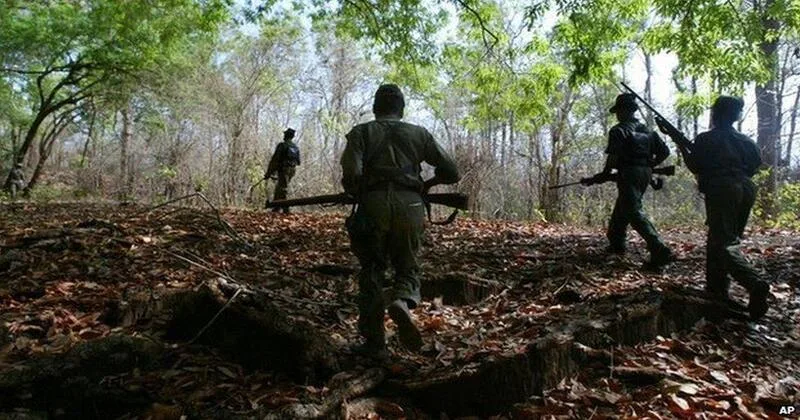
There are two types of people who become Naxalites: intellectuals who support radical leftism or Maoism are called urban Maoists, and ground-level troops who are poisoned by these intellectuals to fulfil their dreams by carrying out anti-humanitarian activities. To recruit ground soldiers for the Maoist armies, labourers or peasants in rural areas must first undergo widespread brainwashing in camps specifically designed for this purpose. Additionally, ground workers join the organisation through recommendations from other ground workers they are acquainted with.
Through networking, intellectuals or ideologues connected to Maoism join the purported cause. Universities, libraries, and the headquarters of communist political and student organisations are the best places to network. You become a communist by nature, by interest in the subject, by reading and discussing it in college, by discovering communist literature, by joining affiliated organisations, or by meeting like-minded people in any way. As a result, you tend to know things, such as how it operates, who runs it, and where to find those people, or if you are good at what you believe, those people find you. You are recruited after being put to the test in a few areas, including patience and dedication.
Clarification of Naxalism narratives by Amit Shah
Home Minister Amit Shah quoted in his Parliamentary speech, The result of left-wing ideology is Maoism. Poverty did not cause Maoism to spread; rather, Maoism caused poverty to spread. The Communist Party was founded to challenge our parliamentary system rather than to fight injustice. The days of Naxalite violence are long gone. The leader of the then-ruling party adopted left-wing ideology in order to win the 1969 presidential election, which is the root reason of Naxalism rather than a lack of progress. One of the Modi government’s greatest achievements is that Bharat is now free of Maoists. How can India possibly benefit from a Communist Party whose philosophy is derived from another nation? Maoists chose the Red Corridor because of the government’s limited power there rather than to fight discrimination. Advocates of left-wing ideology have not taken into account. They have selected “Mao” as their ideal instead of Bhagwan Birsa Munda, Shaheed Bhagat Singh, or Subhas Chandra Bose. This is the Modi administration; anyone who takes up arms will be held accountable. The shadow of the Red Terror had caused Bastar to lag behind in its progress. Bastar is growing now that the shadow of Red Terror is gone. One of the Modi government’s most significant and historic achievements is that India is now free of Maoists.
The PM Modi administration’s growth model and counterinsurgency tactics against Maoism
Bharat’s multimodal counter-Naxalism policy, which integrates community involvement, inclusive development, and security enforcement, has been incredibly successful in recent years. All Maoist affected districts are being reintegrated into the national mainstream, the movement has steadily waned, and violence has drastically decreased. Since Maoism is thought to be the biggest obstacle to the development of remote areas and tribal villages, the Bharatiya government has fulfilled its pledge to eradicate it by March 31, 2026. This is because Maoism prevents education, healthcare, connectivity, banking, and postal services from reaching these communities. Regions like Chhattisgarh, Jharkhand, Andhra Pradesh, Telangana, Maharashtra, and the Northeastern regions have been greatly impacted by red terrorism. State Chief Ministers and the Home Ministry, led by Amit Shah, collaborated to end the threat of Maoism. Amit Shah and his team successfully completed the most challenging task, demonstrating that even seemingly insurmountable tasks can be accomplished with the correct strategy and a nation-first mindset. It was a major struggle for the Modi government to abolish Maoism in under 12 years because Congress, Communists, and Urban Maoists fueled the anti-humanity drive of the Maoists.
Life in the Northeast and other impacted states has been suppressed by insurgency-related violence for decades. Development efforts were undermined by the prevalence of violence, extortion, and kidnappings. But since 2014, the story has changed due to a strong counterinsurgency and the creation of an impacted area strategy. Over 10,000 rebels have given up their weapons and assimilated into society throughout the past 12 years, and the government has concluded 12 peace agreements with significant militant groups.
In addition to bringing peace back, historic accords like the Bru-Reang resettlement deal and the Bodo Peace Accord offered financial assistance for the region’s reintegration into society. A 35-year conflict ended with the recent 2024 agreement with the NLFT and ATTF in Tripura. In addition to enhancing peace, these groundbreaking projects have increased community trust. This peace-focused approach has clearly resulted in a reduction of the Armed Forces Special Powers Act (AFSPA) throughout most of the Northeast.
Prime Minister Modi’s administration also carried out policy changes. The Northeast was reoriented from a far-off border to a vital gateway to Southeast Asia in 2015 with the shift from Look East to Act East Policy. Important projects like the Agartala-Akhaura rail link with Bangladesh and the Kaladan Multimodal Transit Transport Project are establishing cross-border connections to boost trade and transportation.
The cultural renaissance in the area has been equally important. The rich cultural history of Northeast Bharat, which was formerly disregarded, is now recognised on a national and international level. Initiatives like the Tribal Freedom Fighters Museum in Manipur, which honours Rani Gaidinliu, and the commemoration of Lachit Borphukan’s 400th birthday in Delhi have elevated local heroes to national prominence, while the creation of cultural centres like the North East Zone Cultural Centre has promoted regional festivals like Nagaland’s Hornbill and Manipur’s Sangai. The region’s sense of cultural pride has grown since the Moidams of Choraideo were included on the UNESCO World Heritage list. GI labels have increased the visibility and economic worth of local goods, including Muga Silk, Joha Rice, Tezpur Litchi, Kaji Nemu, and Boka Chaul. This revitalised cultural identity and improved infrastructure have led to a boom in tourism. Approximately 1.20 crore domestic tourists and 2.21 lakh foreign visitors visited the region in 2023 alone. Despite having plenty of natural resources, Northeast Bharat’s agriculture was formerly hindered by poor performance, but it is currently experiencing a remarkable transformation. Particular initiatives like the Mission Organic Value Chain Development for the North Eastern Region (MOVCDNER), which has converted over 1.73 lakh hectares to organic farming, have directly helped over 1.89 lakh farmers. As part of the “Formation and Promotion of 10,000 FPOs” effort, which encompasses 15,500 farmers in the area, 205 Farmer-Producer Organisations (FPOs) have been established to further empower these farmers. These FPOs increase access to both domestic and foreign markets, boost collective bargaining power, and enhance processing abilities. Under a unique program called as Special Central Assistance (SCA), the Government of Bharat offers financial aid to the most affected districts and districts of concern in the amounts of Rs. 30 crore and Rs. 10 crore, respectively, to close gaps in public infrastructure. In addition, different districts are given special programs according to their needs. The number of violent red terrorism occurrences has significantly decreased since it peaked in 2010 at 1936. Overall, fewer people have been killed throughout this period, both civilians and security personnel.
The Bharatiya government intends to totally develop red terrorism-affected areas by executing government projects at 100 per cent efficiency and has implemented a zero-tolerance policy against naxalism. The government created two legal frameworks to counteract left-wing extremism. First, put an end to all unlawful acts of violence and establish the rule of law in places afflicted by Naxalism. Second, to swiftly make up for the loss in regions where the protracted Naxalite movement prevented growth. A National Policy and Action Plan for red terrorism was approved in 2015 to address the red terrorism threat comprehensively. It proposes a multipronged approach that includes development projects, security measures, safeguarding the rights and entitlements of the local population, and more.
PM Narendra Modi launched the “Dharti Aaba Janjatiya Gram Utkarsh Abhiyan” from Jharkhand on October 2, 2024. This project will serve more than 1.5 crore people in maoist affected areas by providing personal amenities for full rural saturation in more than 15,000 villages. The government is improving 3-C connectivity, road, mobile, and financial connectivity in communities impacted by LWE.
Urban Maoism is still a big threat
The insurgency has been severely damaged both operationally and territorially by Bharat’s multidimensional battle against red terrorism. The environment in formerly affected areas has changed as a result of the government’s emphasis on a combination of security, development, and rights-based empowerment. The goal of a terrorism-free Bharat is accomplished with sustained political resolve, administrative dedication, and public involvement; yet, urban naxals remain a major threat to both Bharat and humanity.
According to Roman statesman Marcus Tullius Cicero, who was consul in 63 BCE, “A nation can survive its fools, and even the ambitious.” However, it cannot withstand internal disloyalty. An adversary at the gates is less powerful since he is well-known and flaunts his banner. However, the traitor roams freely among those inside the gate, his cunning murmurs resonating through all the alleys and even reaching the government’s own halls. Because the traitor doesn’t look like a traitor; he speaks in dialects that his victims are accustomed to, adopts their appearance and ideas, and plays on the baseness that all people harbour deep inside. He rots a nation’s soul, works covertly and undetected at night to undermine the city’s pillars, and infects the body politic to the point where it can no longer resist. A murderer is less frightening.” The similar problem of urban naxalism exists in Bharat. This poisonous way of thinking or ideology has caused tremendous harm to our nation and society. The battle against urban naxals must go on. (This article was first published on April 8, 2026)