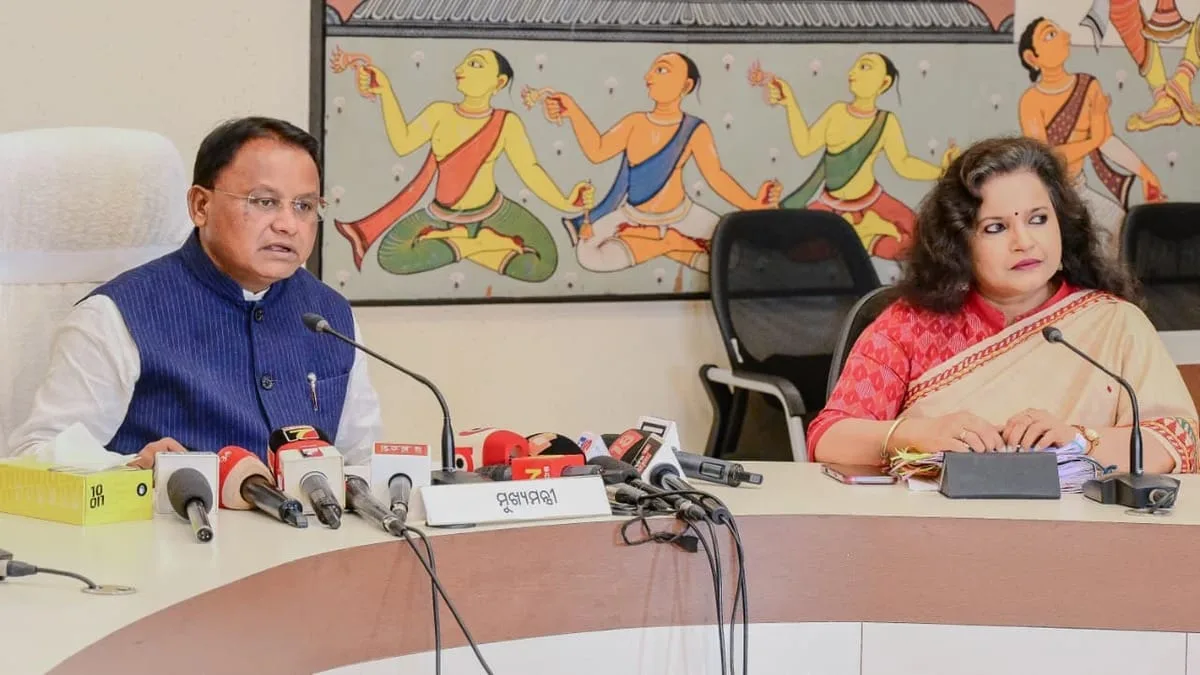
BHUBANESWAR: The Odisha Cabinet, chaired by Chief Minister Mohan Charan Majhi, passed a resolution on the evening of October 13th congratulating Prime Minister Narendra Modi on completing 25 years as head of government. The Cabinet also approved 16 proposals covering education, urban infrastructure, digital governance, water security, and other key sectors.
The Cabinet acknowledged Modi’s long tenure in public office and his contribution to India’s development, highlighting infrastructure expansion, industrial growth, technological advancement, social welfare and the vision of Viksit Bharat 2047. The resolution also recognised the Centre’s support for Odisha’s development and its role in advancing the state’s long-term economic and social objectives.
Separately, the Cabinet approved a series of measures aimed at improving public services and strengthening infrastructure across Odisha. Among the major decisions were the extension of free textbook benefits to approximately 28.7 lakh students, a Rs 500-crore urban stormwater drainage programme, the establishment of a disaster recovery-cum-data centre in Keonjhar at an estimated cost of Rs 176.83 crore, and a water storage project on the Tel river in Bolangir district.
Cabinet congratulates Modi on 25 years as head of government
Chief Minister Majhi said Modi completed 25 years as head of government on October 7, 2026. Before becoming Prime Minister in May 2014, Modi served as Chief Minister of Gujarat.
Congratulating the Prime Minister on the milestone, Majhi described the 25 years of continuous public service as a significant achievement in India’s democratic and administrative history. He said the tenure reflected a commitment to public welfare, national development and governance, adding that Modi had received sustained public support over the years.
ଆଜି ଅନୁଷ୍ଠିତ ରାଜ୍ୟ କ୍ୟାବିନେଟ୍ ବୈଠକରେ ଏକ ଐତିହାସିକ ସଂକଳ୍ପ ପାରିତ କରି, ସରକାରର ମୁଖ୍ୟ ଭାବେ ୨୫ ବର୍ଷର ନିରବଚ୍ଛିନ୍ନ ତପସ୍ୟା ଓ ନିଷ୍ଠାପର ରାଷ୍ଟ୍ରସେବା ପୂରଣ କରିଥିବା ଦେଶର ଯୁଗଦ୍ରଷ୍ଟା ପ୍ରଧାନମନ୍ତ୍ରୀ ଶ୍ରୀ ନରେନ୍ଦ୍ର ମୋଦୀଜୀଙ୍କୁ ସମଗ୍ର ଓଡ଼ିଶାବାସୀଙ୍କ ତରଫରୁ ଅଶେଷ କୃତଜ୍ଞତା ଓ ହାର୍ଦ୍ଦିକ ସାଧୁବାଦ ଜଣାଇଲୁ।
‘ସେବା… pic.twitter.com/nATCSdNF8A
— Mohan Charan Majhi (@MohanMOdisha) October 13, 2026
Highlighting the vision of Viksit Bharat 2047, the Chief Minister said empowering women, farmers, the poor and youth remained central to inclusive development. Referring to official estimates, he said more than 25 crore people had moved out of multidimensional poverty during Modi’s 12 years as Prime Minister.
Majhi also cited challenges such as the COVID-19 pandemic, terrorism and geopolitical instability, saying India had navigated difficult circumstances while maintaining economic stability and strengthening its international position.
Centre’s support to Odisha’s development
Majhi said Odisha had received special attention under Modi’s leadership. Since the formation of the BJP government in the state, the Prime Minister had visited Odisha eight times, providing guidance and support for development initiatives. He described Odisha as a key component of the Centre’s Purvodaya vision for accelerating the development of eastern India. Cooperation between the Centre and the state, he said, had supported infrastructure expansion, industrialisation, education, healthcare, technology and public welfare.
The Chief Minister expressed gratitude to Modi for his support and said continued coordination would help Odisha achieve its long-term development objectives.
Railway, road and aviation infrastructure
Highlighting railway development, Majhi said 2,236 kilometres of new railway lines had been constructed in Odisha since 2014, and the state had achieved 100 per cent railway electrification.
The Khurda Road–Balangir railway line, which had remained pending for more than three decades, was nearing completion, he said. Six Vande Bharat trains were connecting 17 districts through 25 stoppages, while 59 railway stations were being redeveloped under the Amrit Bharat Station Scheme.
On road infrastructure, Majhi referred to the sanction of Rs 8,308 crore for the 111-kilometre, six-lane Capital Region Ring Road. He also highlighted the proposed greenfield Odisha Coastal Highway, spanning more than 160 kilometres with an estimated investment of Rs 8,300 crore. The project aims to improve connectivity between Gopalpur and Digha through Ganjam, Puri, Jagatsinghpur, Kendrapara and Bhadrak districts.
The Chief Minister also cited the development of Jharsuguda Airport under the UDAN regional connectivity scheme. Commercial flight operations began there on September 22, 2018, improving air connectivity for western Odisha. These projects, he said, would strengthen regional connectivity, facilitate trade and support tourism and industrial development.
Ports and industrial development
Majhi highlighted several major maritime and industrial projects aimed at strengthening Odisha’s economic potential. These include a proposed deep-sea port at Bahuda Mouth in Ganjam district, involving Rs 21,500 crore, and a shipbuilding and ship-repair cluster in Kendrapara district, with a proposed investment of Rs 24,700 crore. He also referred to the development of the Bhubaneswar–Cuttack–Puri–Paradip Economic Region, expansion of the Paradip refinery, development of the Petroleum, Chemicals and Petrochemicals Investment Region, and a strategic petroleum reserve at Chandikhol.
Other initiatives include the modernisation and expansion of the Rourkela Steel Plant, expansion of Rourkela Airport, and the promotion of electronics manufacturing.
Majhi highlighted the green data centre and cybersecurity facilities established by the Reserve Bank of India in Bhubaneswar, along with the electronics manufacturing cluster at Infovalley. These initiatives, he said, were helping Odisha attract investment in electronics and develop an ecosystem for semiconductor-related industries. He also referred to efforts to produce fertiliser through coal gasification at Talcher, aimed at strengthening domestic production.
Education and technology infrastructure
The Chief Minister cited the establishment of the Indian Institute of Science Education and Research in Berhampur and the Indian Institute of Management in Sambalpur as important milestones in higher education.
He said these institutions could strengthen research, innovation and skill development while preparing young people for emerging economic opportunities.
Investment in data centres, cybersecurity and electronics manufacturing would complement traditional sectors such as mining, steel, petroleum and fertiliser production, helping diversify Odisha’s economy and attract technology-driven industries.
Vision Odisha 2036 and Viksit Bharat 2047
Majhi said the state government was working towards building a prosperous Odisha by 2036, marking 100 years since the state’s formation as a separate province. He said he had proposed to NITI Aayog the preparation of two complementary development roadmaps aligned with Viksit Bharat 2047. According to the Chief Minister, the proposal received support from NITI Aayog and the Prime Minister, leading to the preparation of Vision Odisha 2036 and Vision Odisha 2047.
The roadmaps aim to provide a long-term framework for economic growth, infrastructure development, social welfare and improved public services.
Majhi thanked the Cabinet members for passing the resolution congratulating Modi and expressed confidence that continued Centre-state cooperation would accelerate Odisha’s progress towards its development goals.
Odisha cabinet approves free textbooks for 28.7 lakh students, Rs 500-crore drainage plan
Chief Secretary Anu Garg briefed the media on the Cabinet decisions, stating that the 16 proposals related to 11 departments would be implemented in due course. She announced the decisions following the Cabinet meeting, stating that the proposals aimed to strengthen education, urban infrastructure, digital governance and water security across the state.
Free textbooks for 28.7 lakh students
The Cabinet approved extending free textbook benefits to students of Classes IX and X in government and government-aided secondary schools who are not already covered under the existing provisions for Scheduled Caste and Scheduled Tribe students.
The Odisha Cabinet, chaired by Hon’ble Chief Minister Shri @MohanMOdisha , approved 16 proposals across 11 departments at its 48th meeting. The decisions focus on strengthening public services, expanding opportunities and accelerating Odisha’s development. The Cabinet also passed… pic.twitter.com/dnyMLdhgx7
— CMO Odisha (@CMO_Odisha) October 13, 2026
The scheme will operate for five years, from 2025-26 to 2029-30, with an estimated outlay of Rs 284.07 crore, benefiting approximately 28.7 lakh students.
Chief Secretary Garg said the initiative aims to ensure equitable access to education, reduce the financial burden on economically weaker families, improve enrolment in government schools and reduce dropout rates. It is also expected to encourage students to continue their education from the elementary to the secondary level.
The School and Mass Education Department will introduce a mechanism to collect, verify and validate beneficiary data through field-level verification. Textbook procurement, printing, transportation and distribution will follow transparent and competitive procedures under applicable financial and procurement rules. The department will also ensure that textbooks reach schools before the commencement of each academic session.
The decision comes amid controversy over errors in textbooks supplied by the department. More than 1,600 mistakes, including spelling errors and incorrect names of eminent personalities, were reportedly identified in 55 textbooks.
The expansion of the scheme is expected to improve access to educational resources, while the reported errors have underscored the need for stronger quality-control mechanisms.
Rs 500-crore programme to tackle urban flooding
The Cabinet approved the Urban Storm Water Drainage Management and Improvement Programme (USWDMIP), with an allocation of Rs 500 crore from the state’s own resources over five years, from 2026-27 to 2030-31.
The programme will cover urban local bodies and selected block headquarters, focusing on improving drainage capacity and reducing waterlogging and localised flooding during heavy rainfall.
The proposed measures include desilting existing drains, constructing reinforced cement concrete stormwater drains, covering drains where necessary, restoring natural drainage channels and connecting them with suitable water bodies.
According to Garg, the initiative will improve the efficiency of urban drainage systems and address recurring waterlogging problems.
The programme is also expected to support groundwater recharge, improve public safety and environmental quality, and strengthen the resilience of urban settlements to climate-related challenges.
Keonjhar to get Rs 176.83-crore disaster recovery data centre
The Cabinet approved a disaster recovery-cum-data centre at Keonjhar at an estimated cost of Rs 176.83 crore. The facility will be established on the south campus of Dharanidhar University and serve as a geographically separate backup for the Odisha State Data Centre in Bhubaneswar.
The existing data centre hosts critical government applications, databases and digital platforms supporting government-to-government, government-to-business and government-to-citizen services.
The proposed facility will help restore essential digital services if the primary centre is affected by a technical failure, cyberattack, earthquake, cyclone or other major disruption. Garg said the two facilities were located in different seismic zones, providing an additional layer of protection for government data.
The project will include independent power supply, cooling systems, computing and storage infrastructure, connectivity, networking and cybersecurity arrangements. Secure data replication, backup mechanisms, centralised monitoring and cyber-recovery facilities are also planned.
The estimated cost comprises Rs 154 crore in capital expenditure and Rs 22.83 crore in operational expenditure over five years. Of the total, Rs 162.83 crore will be provided through the Fifth State Finance Commission grant-in-aid, with the remaining amount met by the Odisha Computer Application Centre from the State Data Centre maintenance budget.
The Cabinet approved the project’s award to Krystal Integrated Services Limited, which emerged as the lowest bidder in the tender process. The implementation period is nine months, followed by five years of operation and maintenance support after commissioning. The facility is expected to strengthen the continuity, security and reliability of government digital services.
Rs 105-crore water storage project in Bolangir
The Cabinet also approved a tender worth Rs 105 crore for an in-stream water storage project on the Tel River at Tustapali village in Bolangir district. The project aims to strengthen water security in the drought-prone district, where seasonal shortages and uneven rainfall pose recurring challenges.
The proposed infrastructure is expected to improve water availability and support better management of local water resources, contributing to the region’s long-term development.
Proposals cover 11 departments
The 16 approved proposals relate to 11 departments, including fisheries and animal resources development, industries, skill development and technical education, finance, electronics and information technology, agriculture and farmers’ empowerment, housing and urban development, revenue and disaster management, water resources, and school and mass education.
The decisions reflect the state government’s focus on improving public services and strengthening essential infrastructure. While the textbook scheme seeks to ease education-related expenses, the drainage programme addresses urban flooding, the Keonjhar facility strengthens digital resilience, and the Tel River project focuses on water security.