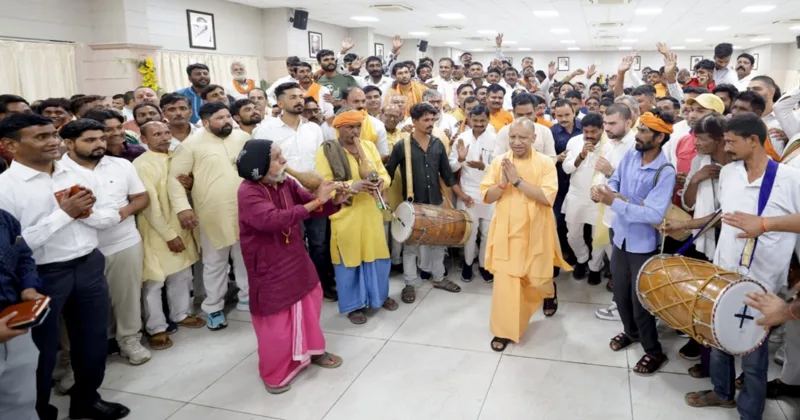
For nearly a century and a half, a British era law condemned entire communities to being born “criminal” simply by birth. On Thursday, at a thanksgiving gathering in Lucknow organised by nomadic communities, Chief Minister Yogi Adityanath declared that chapter closed for good, announcing that the Uttar Pradesh Nomadic Development Board, cleared by the state Cabinet, would restore to these communities the dignity that colonial rule had stripped away and that independent India had been slow to return.
“The nomadic community will no longer be forced to wander from place to place”, the Chief Minister said, addressing representatives who had gathered to thank the government after the Cabinet’s decision. “The double-engine government is fully committed to ensuring their right to a life of dignity, connecting them with every public welfare scheme of the government and securing their holistic development”. He described the Board as more than an administrative arrangement, calling it an instrument of justice for communities that had been neglected for generations.
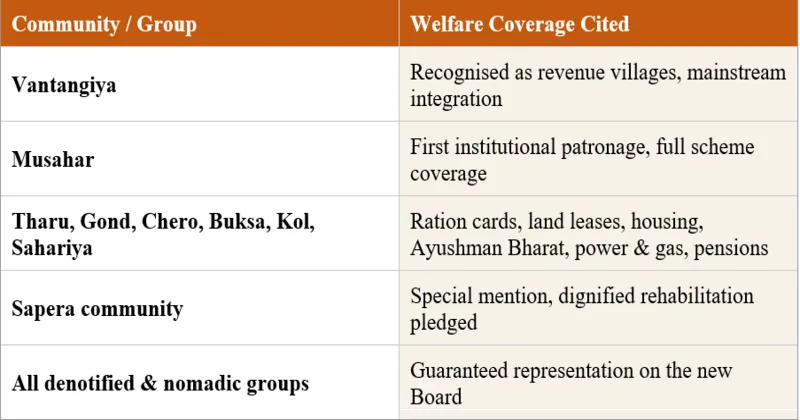
The Chief Minister situated the announcement within Prime Minister Narendra Modi’s 2014 pledge of Sabka Saath, Sabka Vikas, saying that vision was now reaching the last person in society. He said the Nomadic Development Board extends welfare benefits to every eligible individual without discrimination based on caste, region or language and that its structure would ensure representation from different nomadic and denotified groups so that their concerns reach the government directly.
From criminal tribes to freedom fighters: Due rights & dignity delivered by Yogi govt
The history behind the announcement runs deep. Adityanath recalled that under the Criminal Tribes Act of 1871, the British branded numerous communities as hereditary criminals, communities that had, in fact, played a leading role in resisting colonial rule. He said the stigma was imposed deliberately after the First War of Independence in 1857, as a means of destroying the social standing of groups that had defied the empire.
It took independent India’s own reckoning with that injustice, led by Dr Bhimrao Ambedkar, to have the label lifted and the communities reclassified as denotified rather than criminal. Even so, the Chief Minister noted, sustained efforts toward their comprehensive development did not follow for decades. He credited the Modi government with constituting the first national commission for these communities and said the state Board draws directly on that vision.
The Chief Minister reminded the gathering that he had first promised the Board a year earlier, at a convention where community representatives raised the demand on Denotified Community Day. “The process of constituting the Board has now begun,” he said, and would be completed soon, with representation built in for the many distinct nomadic and denotified groups scattered across the state.
Vantangiya, Musahar and other tribal communities brought in
Beyond the new Board, the Chief Minister pointed to what he called the first sustained effort to bring long-excluded communities such as the Vantangiya, Musahar, Tharu, Gond, Chero, Buksa, Kol and Sahariya into the ambit of government schemes. Vantangiya settlements, forest-dwelling hamlets that for decades existed outside revenue records, were granted the status of revenue villages, a step he said had allowed their residents to enter the mainstream for the first time. The Musahar community, he said, had previously had no institutional patron at all; it has since been brought under the full range of welfare schemes. The stated goal, the Chief Minister said, is full coverage: every eligible person under every applicable scheme.
Recognition Restored: Naming heroes after their own
He also drew a contrast with previous governments, arguing that communities the Congress and the Samajwadi Party had long overlooked were now being treated, in his words, not as a vote bank but as Janardan, an epithet for the divine present in the ordinary citizen. Recognition, he said, had gone beyond welfare delivery into public memory itself. He listed the statue of Nishadraj Guhya installed alongside Lord Ram at Shringverpur, the Maharaja Suheldev Vijay Memorial in Bahraich, new tribal museums, a university and medical college named for Maharaja Suheldev, women’s police battalions named after Veerangana Avantibai Lodhi, Uda Devi Pasi and Jhalkari Bai.
Medical college are named after Maharani Durgavati, as evidence that figures from marginalised communities are being written back into the state’s historical narrative. On the education front, he cited Ashram Paddhati Schools for Scheduled Caste and Scheduled Tribe children and the newer Atal Awasiya Vidyalayas for the children of labourers, both offering modern schooling alongside free boarding and lodging.
The Chief Minister set aside a special mention for the Sapera community, tracing its lineage to the tradition of Guru Gorakhnath and recalling that, during periods of foreign invasion when no modern means of communication existed, the community used devotional songs and traditional instruments to warn and mobilise the public. He acknowledged that many in the community still live a nomadic life and pledged the state’s commitment to its dignified rehabilitation.
Voices from the community
Minister of State for Social Welfare Aseem Arun, who holds independent charge of the department, called the Board’s formation a historic and visionary decision and said it would function as a bridge ensuring that welfare schemes administered across departments actually reach denotified and nomadic households. He announced that a special task force would follow the Board’s constitution to draft a comprehensive action plan covering education, healthcare, housing, livelihoods and social security, describing communities that were once itinerant as now becoming settled, with homes, electricity and livelihoods of their own.
The event itself carried the texture of the communities it honoured. Members of the Sapera community welcomed the Chief Minister with the traditional been and the hall rang with slogans in his support. Community representatives who spoke described decades of institutional neglect. One recalled working as flag-bearing labour under the British with little change after Independence and said recognition arrived only after 2014.
Another described a lifelong struggle, dating to a scholarship application in 1967, to secure a caste certificate for a community with no official record, a problem compounded by the same community being registered under different names in different regions. A third, involved in community advocacy for over three decades, called the current administration the most responsive he had encountered in his public life. Others credited Minister Arun personally for engaging with the community’s grievances and framed the Board’s creation as redress for young people who had faced hardship in the community’s name.
For a government that has built its political identity around the language of inclusion, the Nomadic Development Board is being positioned as a capstone rather than a standalone measure, one more link, as the Chief Minister put it, in a chain of welfare delivery that already runs through forest villages, tribal settlements and labourers colonies across the state.
Its real test will lie in the task force’s action plan and in whether the promised representation translates into effective, timely delivery for communities that have waited far longer than most for the state to notice them. For now, the symbolism of the announcement, made directly to the communities it concerns, in a hall filled with their own music and their own voices, appears calculated to signal that the wait, in the government’s telling, is finally over.