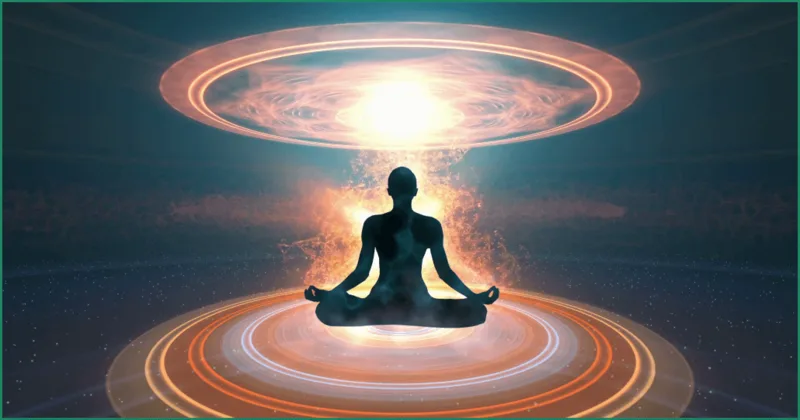
Among the four Purusharthas (Dharma, Artha, Kama and Moksha), Moksha occupies the highest place in Indian philosophy. It is understood as liberation from the cycle of birth and death and freedom from ignorance, attachment, and suffering. Physics, on the other hand, is a discipline concerned with matter, energy, space and time. At first glance, these domains appear unrelated, yet modern physics offers several conceptual frameworks that serve as powerful metaphors for understanding Moksha. While physics cannot prove or disprove spiritual liberation, it provides language and analogies that illuminate ancient philosophical insights.
The central objective of physics is to discover the fundamental laws governing the universe. Likewise, the pursuit of Moksha seeks to uncover the ultimate reality underlying the changing world of appearances. Both endeavours begin by questioning ordinary perception. What appears solid is mostly empty space, what appears permanent is in constant motion. Similarly, Indian philosophy teaches that worldly identities are transient, while the self remains eternal.
One of the most profound discoveries of twentieth century physics is that matter is not fundamentally solid. Atoms consist of a tiny nucleus surrounded by electrons occupying probability distributions rather than fixed orbits. More than 99.999999999 per cent of an atom is empty space. At an even deeper level, elementary particles are excitations of underlying quantum fields. Solidity emerges from electromagnetic interactions rather than from compact material objects.
This scientific picture resonates with the Upanishadic assertion that the material world is not ultimate reality. The distinction lies in interpretation, physics explains the physical constitution of matter, whereas Vedanta addresses the nature of consciousness. Nevertheless, both challenge the realism that equates sensory experience with absolute truth.
Einstein’s theory of relativity revolutionized our understanding of space and time. Space and time are no longer absolute backgrounds, but interconnected dimensions forming spacetime. Events that appear simultaneous to one observer may not be simultaneous to another. Motion, duration and distance depend upon the observer’s frame of reference.
This observer dependence provides an instructive analogy for spiritual realization. In ordinary life, individuals interpret reality from the limited perspective of the ego. Indian philosophy suggests that suffering arises because consciousness identifies itself exclusively with the body and mind. Moksha represents a transformation of the frame of reference, from the finite individual to the universal self. Just as changing the reference frame alters physical measurements without changing reality itself, spiritual awakening changes one’s experience of existence without altering the external universe.
Quantum mechanics further deepens this discussion by emphasizing probability rather than certainty. Prior to measurement, quantum systems are described by wave functions representing multiple possible outcomes. Although interpretations differ, quantum theory demonstrates that reality at microscopic scales differs profoundly from everyday intuition.
Some popular accounts attempt to equate quantum uncertainty directly with consciousness or mystical experience. Such claims exceed established scientific evidence. However, quantum mechanics legitimately reminds us that reality is subtler than classical intuition suggests. Ancient Indian philosophers similarly argued that ordinary sensory perception reveals only a partial understanding of existence. Both traditions encourage intellectual humility in confronting ultimate reality.
Another powerful analogy arises from entropy in thermodynamics. Every isolated physical system naturally evolves toward increasing entropy, reflecting the tendency toward equilibrium. Living organisms temporarily maintain order by continuously exchanging energy and matter with their surroundings.
Human life exhibits a parallel psychological process. The mind constantly accumulates desires, fears, attachments, and memories that create internal disorder. Spiritual disciplines such as meditation, selfless action and contemplation may be viewed metaphorically as reducing psychological entropy by organizing mental activity into coherent awareness. Moksha, in this metaphorical sense, corresponds to complete inner equilibrium where mental fluctuations no longer dominate consciousness.
Physics also teaches the principle of conservation. Energy cannot be created or destroyed, it merely changes form. Nuclear reactions, chemical reactions and mechanical processes all obey conservation laws. The forms change continuously, but the underlying quantity remains constant.
Indian philosophy similarly distinguishes between changing forms and unchanging reality. Bodies are born, mature, age and perish. Thoughts arise and disappear. Emotions fluctuate. Yet the witnessing consciousness is described as unborn, undying and immutable. Here the comparison must remain metaphorical, conservation of physical energy is not identical to the immortality of consciousness. Nevertheless, both emphasize continuity beneath transformation.
Wave phenomena provide another illuminating analogy. Ocean waves appear as individual entities, yet each wave is inseparable from the ocean itself. Likewise, electromagnetic waves differ in frequency but remain manifestations of the same electromagnetic field.
Advaita Vedanta employs an almost identical image. Individual beings appear separate because of limited perception, yet all are expressions of Brahman, the universal reality. Individuality resembles a wave temporarily distinguished from the ocean. Moksha is not the destruction of individuality, but the realization that one’s essential nature has always been identical with the infinite.
Quantum field theory extends this picture further. Modern physics regards particles as localized excitations of universal quantum fields permeating all space. Electrons everywhere arise from the same electron field, photons arise from the electromagnetic field. Diversity emerges from different excitations of common underlying fields.
Although quantum fields should not be confused with Brahman, the conceptual similarity is striking. Both describe multiplicity emerging from unity. Physics reaches this conclusion through mathematical formalism and experimental verification, while Vedanta arrives through philosophical inquiry and contemplative experience.
The phenomenon of coherence offers yet another metaphor. In lasers, millions of photons move in perfect phase, producing highly ordered and intense light. Ordinary light consists of incoherent waves with random phases.
Human consciousness often resembles incoherent light. Thoughts, desires, emotions and distractions scatter mental energy in many directions. Meditation, ethical living, disciplined inquiry and self-knowledge progressively increase coherence. A spiritually integrated personality resembles a coherent wave system whose energy is focused rather than fragmented. Moksha may therefore be viewed as the highest degree of existential coherence.
Cosmology also contributes to this dialogue. Modern astronomy reveals that humans occupy an exceedingly small place within a universe nearly 13.8 billion years old containing hundreds of billions of galaxies. This cosmic perspective naturally reduces egocentrism.
Indian philosophical traditions likewise encourage transcending the limited ego. The Bhagavad Gita repeatedly emphasizes performing one’s duties without attachment to personal gain. Cosmic perspective, whether obtained through astronomy or spirituality, fosters humility and interconnectedness.
According to Advaita Vedanta, Brahman alone is ultimately real, while the universe and the sense of individuality arise through Maya and Avidya (ignorance). The Mahavakyas तत् त्वम् असि (Thou art That) and अहं ब्रह्मास्मि (I am Brahman) affirm that the individual self (Atman) is identical with Brahman. Moksha is therefore not the attainment of a new state but the removal of ignorance that obscures this eternal truth.
A useful scientific metaphor is provided by quantum tunnelling. In classical mechanics, an electron with energy lower than a potential barrier remains permanently confined. Quantum mechanics, however, describes the electron as a wavefunction that extends into the barrier, giving it a finite probability of appearing beyond it without ever crossing the barrier in the classical sense.
Similarly, the human condition may be viewed as confinement within the potential well of Samsara, bounded by ignorance, ego, attachment, desire, fear, and karma. These limitations create the illusion of separation from Brahman, just as a potential barrier appears to imprison the electron. Vedantic disciplines such as self-inquiry, meditation, discrimination (viveka), devotion and ethical living gradually dissolve this ignorance.
Like quantum tunnelling, liberation does not involve physically overcoming an external obstacle, rather it is the realization that one’s true nature has always transcended the apparent barrier. Moksha is thus the recognition of the ever free Self, not the acquisition of a new existence.
Despite these fascinating parallels, important distinctions must be maintained. Physics is an empirical science grounded in observation, experimentation, mathematical modelling and falsifiable hypotheses. Moksha belongs to philosophy and spirituality, involving subjective transformation through ethical conduct, meditation, self-inquiry and experiential realization. Scientific instruments cannot detect liberation, just as meditation cannot replace laboratory measurements. Confusing metaphor with scientific proof weakens both disciplines.
The real value of connecting physics with Moksha lies not in claiming that science validates spirituality, but in recognizing that both seek deeper understanding beyond superficial appearances. Physics reveals hidden structures beneath matter, while Indian philosophy explores the nature of consciousness beyond thought and identity. Each expands human knowledge within its own methodological framework.
Ultimately, Moksha represents freedom, not from the laws of nature, but from ignorance, attachment and mistaken identity. Physics teaches that reality is more subtle, interconnected, and dynamic than common sense suggests. Indian philosophy teaches that the deepest freedom arises when consciousness recognizes its true nature beyond the transient world of names and forms.
Viewed together, physics and the philosophy of Moksha invite humanity to cultivate two complementary virtues, intellectual rigour in understanding the external universe and inner wisdom in understanding oneself. One explores the cosmos through mathematics and experiment, the other explores consciousness through inquiry and realization. Both remind us that reality is far richer than immediate appearances, and that the journey toward truth, whether scientific or spiritual, begins with the courage to question what seems obvious.