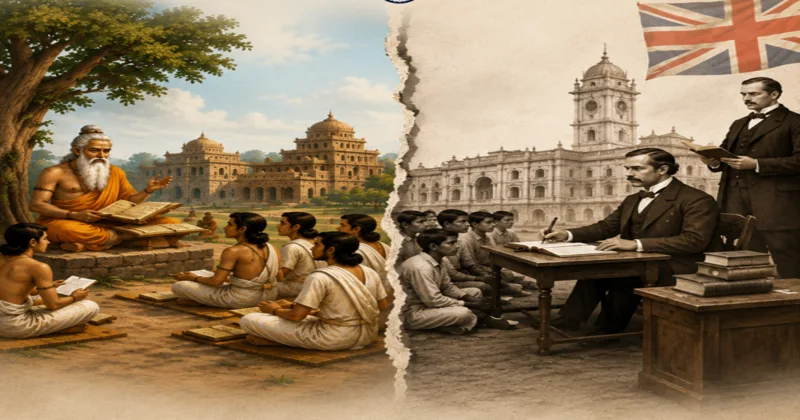
Indian traditional education system was never about basic literacy. It was a holistic ecosystem approach on character building, self-reliance, vocational mastery and profound philosophical inquiry. From world renowned ancient university centers like Takshashila, Nalanda, Vallabhi and Vikramashila to the vast network of decentralized village schools operating well into the early nineteenth century, India maintained an unbroken tradition of learning.
British colonial rule dismantled this self sustaining, community driven education network through a calculated strategy. The objective was not simply the economic extraction of India’s resources, but the severance of Indians from their civilizational roots and intellectual traditions replacing an autonomous society with a class of intellectually subservient subjects.
Undeniable proof in British archival records
A persistent colonial myth asserts that British rule brought modern education and enlightenment to an illiterate subcontinent. Archival records and official British surveys directly refute this claim. Historian Dharampal substantiated the extensive reach of indigenous learning in The Beautiful Tree (1983), drawing entirely on official British administrative surveys commissioned in the early nineteenth century:
The Munro Survey of Madras Presidency (1822–1826): Sir Thomas Munro, Governor of Madras ordered a comprehensive survey across the presidency. His final report documented over 12,498 active schools and academies serving nearly 1,88,000 students. Munro recorded that there was at least one school per 1,000 population. The survey revealed that more than 70% of students in elementary schools belonged to non Brahmin backward and marginalized castes, disproving the colonial narrative of strict educational exclusivity.
The Elphinstone Inquiries in Bombay (1824–1829): Mountstuart Elphinstone administration found functional schools in almost every village across Maharashtra and Gujarat. These schools operated autonomously, funded by voluntary community levies, village land shares and local mercantile endowments.
The Adam Reports in Bengal and Bihar (1835–1838): William Adam conducted a three stage survey for the Bengal Presidency and documented approximately 100,000 indigenous village schools across Bengal and Bihar, concluding that virtually every village had an active centre of elementary instruction.
Structure and social inclusivity of indigenous learning
The indigenous system was decentralized, adaptive and intimately linked with community life. At the elementary level, village pathshalas and maktabs operated in regional mother tongues. The curriculum was highly functional, teaching practical arithmetic, land surveying, agricultural accounting and commercial bookkeeping. Advanced learning was pursued in tols, chatuspathis and gurukuls, which focused on astronomy, mathematics, metallurgy, grammar, logic (Nyaya), jurisprudence and Ayurveda.
The entire system was self-funded through local social compacts. Villages maintained tax-free agrarian lands (agrahara, inam and temple endowments) specifically earmarked for the upkeep of scholars and students. Teachers occupied a respected social station and access to learning remained independent of centralized bureaucratic diktats.
Timeline of major British educational policies(1781–1947)
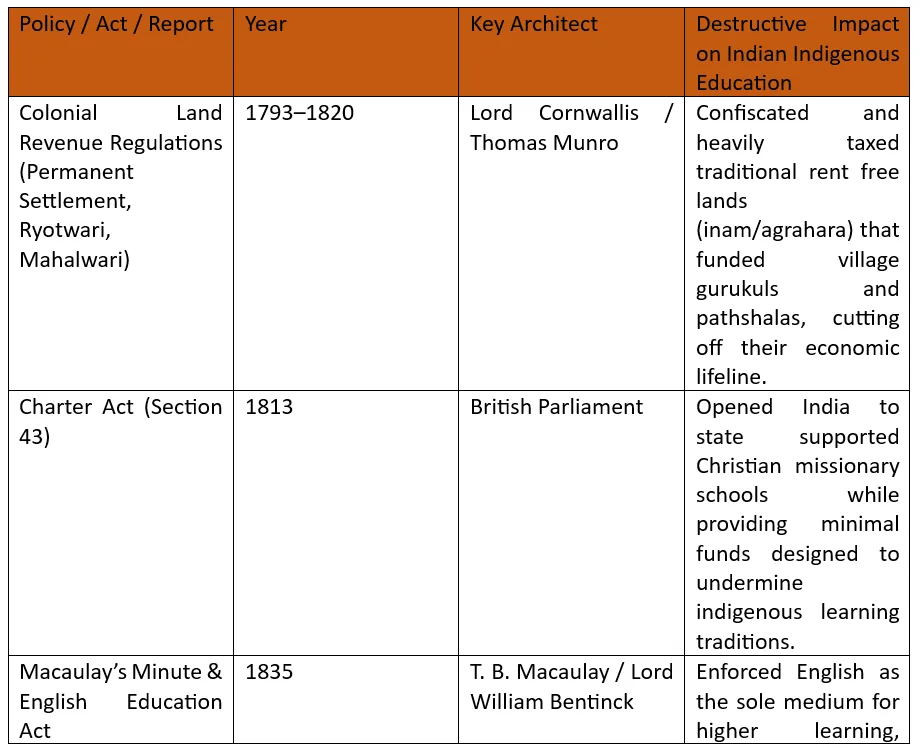
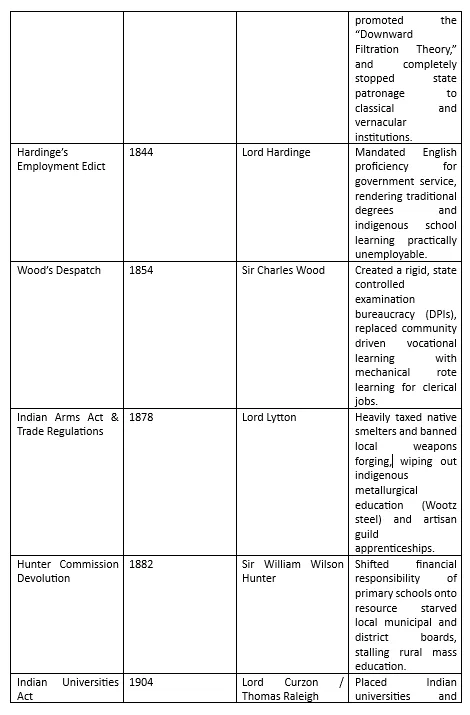
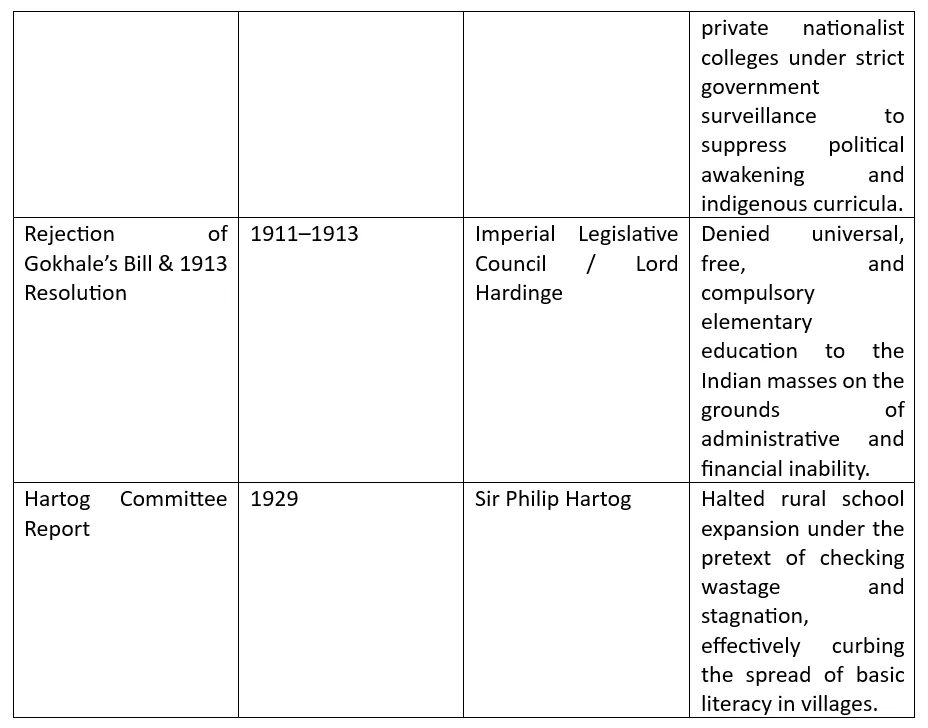
The transformation of India indigenous schooling into a centralized imperial apparatus progressed through a series of official charters, minutes, commissions and policy resolutions:
Critical imperial tactics in the destruction of indigenous education
1. Land revenue extortion and the destruction of village endowments
Upon consolidating territorial rule, the East India Company instituted predatory land revenue systems such as the Permanent Settlement, Ryotwari and Mahalwari frameworks. These regulations systematically abolished or heavily taxed the traditional rent free lands that had funded local schools for generations.
With village economies drained by exorbitant colonial taxation, local communities could no longer provide the stipends, grain shares and maintenance required by village masters. Deprived of their revenue base, hundreds of thousands of traditional schools decayed and shuttered within decades.
2. Missionary encroachment and the Charter Act of 1813
Under evangelical pressure, the Charter Act of 1813 lifted restrictions on Christian missionary activities in India and inserted Section 43, allocating an annual sum of ₹100,000 for education. This fund was deployed not to revitalize existing indigenous schools, but to finance English medium missionary institutions designed to undermine native faith systems and produce loyal intermediaries.
3. Macaulay Minute(1835): The epistemic assault
The decisive structural blow occurred on February 2, 1835, when Thomas Babington Macaulay, President of the General Committee of Public Instruction presented his infamous.
Macaulay openly dismissed the entirety of Asian knowledge systems, declaring:
“A single shelf of a good European library was worth the whole native literature of India and Arabia”.
Macaulay outlined a strategy of cultural alienation, stating his goal was to create:
“A class of persons, Indian in blood and colour, but English in taste, in opinions, in morals and in intellect”.
Macaulay formulated the Downward Filtration Theory, asserting that the colonial government should educate only a narrow, urban, upper class elite in English, who would then serve as cultural and administrative intermediaries between the British rulers and the broader population. Lord William Bentinck formalized this via the English Education Act of 1835, cutting off state funding for indigenous institutions and reallocating all resources exclusively toward Westernized, English medium education.
4. The 1844 Employment Edict: Devaluation of native learning
In 1844, Governor General Lord Hardinge issued a critical executive decree making proficiency in English a mandatory prerequisite for government employment. This single policy effectively invalidated the practical utility of indigenous schooling. Parents seeking economic viability for their children had little choice but to pull them from traditional pathshalas and enrol them in colonial Anglo vernacular institutions, consigning classical and indigenous learning to systematic obsolescence.
5. Wood Despatch (1854) and rigid bureaucratization
Authored by Sir Charles Wood, the 1854 Despatch laid the foundation for an imperial educational bureaucracy. It established provincial Departments of Public Instruction (DPI) and founded affiliating universities in Calcutta, Bombay and Madras in 1857 on the model of the University of London.
While expanding institutional capacity on paper, Wood Despatch subordinated education entirely to state controlled curricula, rigid grading and mechanical memorization. The focus of learning shifted from moral character and practical skill to acquiring examination certificates for low-level clerical posts in the colonial administration.
Suppression of indigenous sciences, medicine and metallurgy
The colonial state suppressed not only indigenous humanities and languages, also advanced Indian scientific and technical practices:
Ayurveda and surgical traditions: Long before Western adoption, Indian practitioners had developed sophisticated techniques in rhinoplasty (plastic surgery), bone-setting, and variolation (smallpox inoculation). In October 1794, the British Gentleman’s Magazine published a detailed account of a successful nasal reconstruction performed by a potter-surgeon in Pune, which directly influenced modern Western plastic surgery. After 1835, the British administration delegitimized traditional Vaidya and Hakims, withdrawing institutional patronage and recognizing only Western allopathy.
Metallurgical sciences: Indian metallurgical prowess was renowned worldwide for producing corrosion-resistant iron such as the Delhi Iron Pillar and high-carbon crucible Wootz Steel, the basis of Damascus blades. The colonial administration dismantled this sector by imposing heavy taxes on native smelters, restricting access to charcoal-rich forests and enacting the Indian Arms Act of 1878, which effectively outlawed indigenous forging and manufacturing traditions.
The statistical reality of colonial de-skilling
Decennial census reports and colonial records clearly reflect the resulting collapse in literacy and technical skill:
Literacy collapse: In the 1881 Census of India, overall literacy was recorded at a dismal 3.5 per cent, with female literacy below 0.3 per cent. By 1941 total literacy had crawled to merely 16.1 per cent.
Budgetary neglect: Throughout the Raj, state expenditure on education rarely exceeded 1.5 per cent of total imperial revenues. In the 1930, per capita education spending in British India stood between 8 and 12 annas (₹0.50 to ₹0.75) annually compared to over ₹30 per capita in Britain.
Technical stagnation: In 1946–47 on the eve of independence, technical and engineering colleges across the entirety of British India enrolled fewer than 5,000 students combined.
Nationalist counter-initiatives for autonomous learning
In response to this intellectual subjugation, Indian reformers and national leaders launched an extensive counter-movement to build independent national institutions:
Swami Dayanand Saraswati and the Arya Samaj: Championed the revival of the ancient Vedic Gurukul system, leading to the establishment of Gurukul Kangri in Haridwar (1902) and the Dayanand Anglo-Vedic (DAV) network to synthesize classical heritage with modern science.
The Swadeshi Movement (1905–1906): Following the Partition of Bengal, Indian leaders boycotted government-controlled educational institutions. Satish Chandra Mukherjee, Rabindranath Tagore and Sri Aurobindo established the National Council of Education in 1906 (the precursor to Jadavpur University) and Santiniketan (1901) to provide mother-tongue-based, holistic learning.
Mahamana Pandit Madan Mohan Malaviya: Founded Banaras Hindu University (BHU) in 1916 to merge Indian indigenous cultural wisdom with modern science, engineering and technology.
Decolonizing the Indian Mind
The dismantling of Indian indigenous education system was not an accidental byproduct of imperial rule, it was a strategy of cultural and intellectual displacement. By replacing community-supported village schools with an alienated, urban-biased examination bureaucracy, the British administration created an elite detached from Indian civilizational ethos and left the broad population without basic educational resources.
Recovering from this legacy requires structural decolonization. Initiatives such as the National Education Policy (NEP), which emphasize learning in regional mother tongues, the integration of traditional Indian knowledge systems and hands-on vocational skill-building, represent vital steps toward undoing two centuries of colonial epistemic disruption and restoring Indian self-reliance.