On 9 August, World Tribal Day or World Indigenous Peoples’ Day is observed in many countries around the world. The United Nations has made this day an occasion for global awareness of the rights, culture, identity and dignity of communities that have faced colonial rule, displacement, violence and cultural suppression. For many indigenous communities in America, Canada, Australia, New Zealand, Latin America and Africa, this day is associated with the memory of their history, suffering and struggle.
In India, the perspective on this day is relatively different. This is not because India is insensitive to the problems of tribal society or to the struggles of indigenous communities around the world, but because India’s historical and cultural development has been different from the Western colonial experience. In India, tribal communities have generally never been viewed as a separate and defeated community standing outside Indian civilisation; rather, they have traditionally been regarded as an ancient, vibrant and important stream of it. For this reason, on August 9, the most important question in India becomes whether the division between ‘indigenous’ and ‘non-indigenous’ is historically appropriate here.
The historical background of World Indigenous Peoples’ Day
In many countries around the world, indigenous communities paid the greatest price for colonial expansion. When European powers established their rule in America, Australia, Africa and Latin America, the lands, resources and political rights of local communities were taken over. In many places, genocide, forced displacement, cultural suppression and religious conversion were interconnected processes.
With the expansion of European colonialism in America, the population of local communities declined drastically. War, disease, dispossession from land and forced displacement pushed indigenous societies there into deep crisis. America’s ‘Trail of Tears’ is a major example of this tragedy, when thousands of indigenous people were removed from their traditional lands and sent to distant areas. A large number of people died during this journey.
In Australia, Canada and New Zealand too, policies were adopted to remove local communities from their lands, separate children from their families, and suppress their languages and traditions. In Africa and Latin America as well, colonial rule weakened local political systems and economic structures. Therefore, World Indigenous Peoples’ Day is also a day of remembrance, justice and demands for rights for these societies.
Understanding these historical events is essential, because without them the modern political and humanitarian context of the term ‘indigenous’ cannot be clearly understood. The term is used for communities whose lands were taken over by external colonial powers and who were pushed to the political, economic and cultural margins of their own lands.
Why is India’s experience different?
India too was a victim of colonial rule, but India’s civilisational development was not shaped by a relatively recent European colonisation in the way that America or Australia was. Indian society developed through a complex and continuous process spanning thousands of years. Numerous groups, languages, traditions and ways of life have contributed to it.
There were certainly conflicts in Indian history, changes of political power also took place and social inequalities existed as well. However, simply dividing society into two clear categories, ‘indigenous’ and ‘outsider’, makes historical realities excessively simplistic. Within India’s social structure, forest-dwelling, rural, urban, farming, pastoral, artisan and trading communities have long remained connected through interaction, exchange and cultural interrelationships.
Tribal Society: An important stream of Indian culture
The presence of forest-dwelling and tribal communities in Indian literature, folk traditions and religious narratives is extremely significant. The devotion of Shabari in the Ramayana, the close relationship with Nishadraj Guha, the cooperation of Sugriva and Hanuman and characters such as Ghatotkacha and Ulupi in the Mahabharata are part of India’s cultural memory. These episodes can also be viewed as symbols of the diversity of Indian society and its interrelationships.
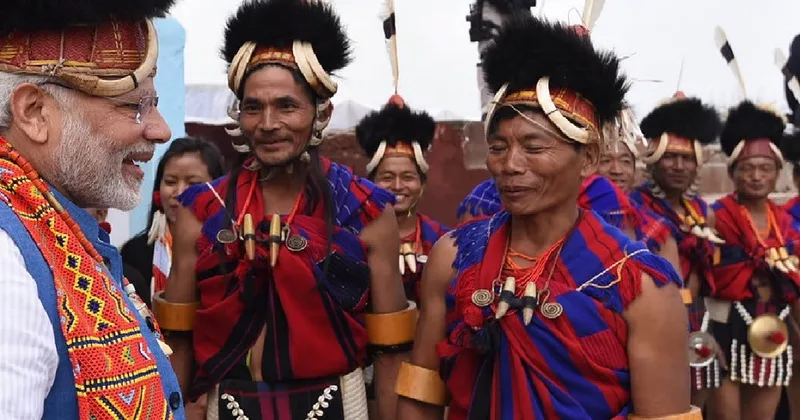
Tribal society has further enriched Indian culture through a nature-based way of life, community cooperation, folk arts, music, dance, medicinal knowledge and traditions of environmental conservation. Their festivals, folk songs, paintings and oral histories are invaluable treasures of India’s cultural diversity. Gond painting of Madhya Pradesh, Bhil art, the Baiga tradition, the Sarna way of life in Jharkhand, community systems in the North-East and the folk cultures of western India demonstrate that tribal society is a living and creative part of Indian culture.
Contribution to struggle and nation-building
The role of tribal society in India’s freedom struggle and anti-colonial movements has been extremely important. Tribal uprisings took place in different parts of the country against the forest policies, taxation system, land acquisition and administrative interference of British rule. Birsa Munda’s Ulgulan, the Santhal Rebellion, Tantya Bhil’s struggle, the valour of Rani Durgavati, the movement of Alluri Sitarama Raju, the resistance of Rani Gaidinliu and the contribution of national heroes such as Umaji Naik are invaluable treasures of Indian history.
The constitution showed the way towards protection
The Indian Constitution contains special provisions for the protection and development of Scheduled Tribes. The Fifth and Sixth Schedules concern the administration of tribal areas, local self-government and the protection of cultural interests. The system of reservation in education, employment and political representation for Scheduled Tribes has also been in place since the early years of the Constitution.
The Panchayats (Extension to Scheduled Areas) Act, 1996 or PESA Act, which extends provisions relating to panchayats to Scheduled Areas, gives importance to the role of the Gram Sabha and local decision-making processes. Similarly, the Forest Rights Act, 2006, sought to provide legal recognition to the rights of traditional forest dwellers and Scheduled Tribes relating to forest resources. The objective of these laws is to provide opportunities for development while protecting the identity, traditions and community rights of tribal society.
The significance of Tribal Pride Day
In 2021, the Government of India decided to observe the birth anniversary of Bhagwan Birsa Munda on November 15, as Tribal Pride Day. This initiative is an important step towards honouring the role of tribal society in the freedom struggle, cultural contribution and nation-building. It should be understood here that Tribal Pride Day does not mean portraying one community as superior to another. Its objective is to establish that contribution in public memory.
Honouring Birsa Munda, Rani Durgavati, Tantya Bhil, Rani Gaidinliu and other national heroes is an honouring of the shared heritage of the whole of India. From this perspective, 9 August should not be used to erect such a political wall between ‘indigenous’ and ‘non-indigenous’ that runs contrary to the spirit of equal citizenship enshrined in the Indian Constitution.
A balanced perspective on conversion and political allegations
There has long been debate in India over religious activities and conversion in tribal areas. In some regions, religious organisations have established influence through education, healthcare and service activities. In some places, allegations of pressure, inducement or deception for the purpose of conversion have also emerged. Such allegations should be investigated impartially, and if the law has been violated, action should also be taken.
Rights alongside unity
For India, the meaning of Indigenous Peoples’ Day cannot be to accept Western countries’ historical concepts exactly as they are. India’s circumstances are different and its constitutional framework provides equal rights to all citizens. Since ancient times, India’s civilisational truth has existed through coexistence. Here, tribal society stands not on the periphery of the Indian nation, but as an integral part of its historical and cultural structure. Its traditions enrich India’s collective memory. Therefore, 9 August does not hold significance in India from the perspective of the honour, rights and pride of tribal society. In India, tribal society, like all other sections of society, is also a part of the harmonious stream of the nation.