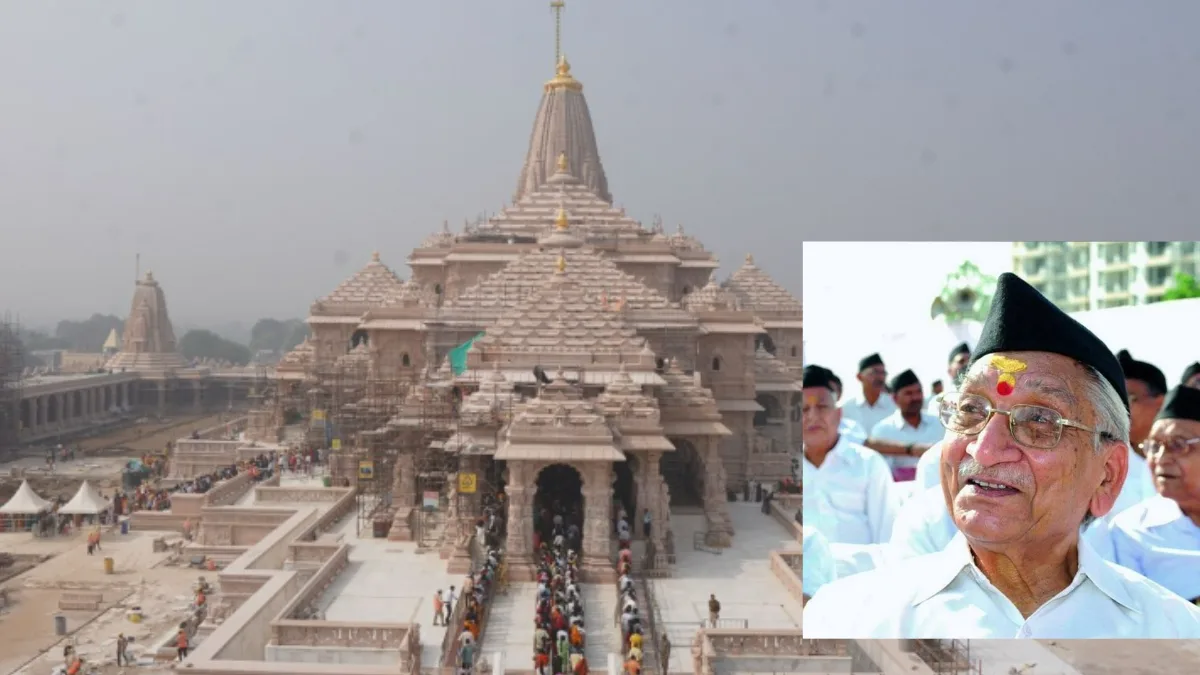
Ashok Singhal served in leadership roles in the Vishwa Hindu Parishad (VHP) from 1980 until 2011. His contribution to Hindu society and to the Ram Mandir movement in Ayodhya is well known. Though he is no longer with us, his work and achievements speak for themselves.
His interviews, public statements and work on the Ram Janmabhoomi movement offer clues to how he saw Ayodhya developing beyond the temple itself.
Five aspects, in particular, stand out: Ayodhya as a spiritual centre, its identity as a mokshapuri, the wider pilgrimage tradition around the city, the architectural work undertaken with Chandrakant Sompura, and the grand temple that Singhal repeatedly spoke about.
1. Spiritual Centre
Singhal saw Ram Janmabhoomi as more than a place where a Ram temple would be established. For him, Ayodhya itself had a larger spiritual significance.
In a 2010 interview with India Today, Singhal described Ayodhya this way:
“Ayodhya is not only the birth place of Lord Ram but it is also a big holy place.”
What stands out in that description is that Singhal was speaking about Ayodhya as a holy place in its own right, not simply as the location of the temple.
For Singhal, therefore, Ram Janmabhoomi was tied to a larger spiritual idea, with the Ram Mandir at its centre.
2. Mokshapuri
Three years later, Singhal spoke more directly about what he wanted Ayodhya to become.
The New Indian Express reported him saying:
“The VHP wants to make Ayodhya a mokshapuri.”
The word mokshapuri carries the idea of a sacred city associated with spiritual liberation. By using the term, Singhal was placing Ayodhya within a much larger religious tradition, rather than speaking only about the temple itself.
That idea also resonates with the older Hindu tradition of the Sapta Puri, the seven sacred cities traditionally associated with moksha:
“Ayodhya Mathura Maya Kasi Kanci Avantika |
Puri Dvaravati caiva Saptaita Moksadayikah ||”
The verse traditionally identifies Ayodhya, Mathura, Maya (Haridwar), Kashi (Varanasi), Kanchipuram, Avantika (Ujjain) and Dwaravati (Dwarka) as sacred cities associated with liberation.
There is no indication in the cited interview that Singhal was directly explaining this verse. But his use of mokshapuri sits comfortably within the older Hindu understanding of Ayodhya as one of India’s sacred cities.
3. Kosi Parikrama
The pilgrimage traditions surrounding Ayodhya form another part of the city’s religious identity.
Three circuits are commonly associated with Ayodhya:
5-kosi Parikrama — the shorter circumambulatory route around Ayodhya.
14-kosi Parikrama — a larger circuit covering a wider area around the city.
84-kosi Parikrama — a much more extensive pilgrimage circuit associated with the wider sacred geography surrounding Ayodhya.
These traditions predate Singhal and were not created by him. What is relevant here is his public support for the 84-kosi pilgrimage.
In August 2013, India Today/PTI reported Singhal’s support for the pilgrimage. He said it could not be stopped and that saints from across the country would come to Ayodhya.
The 84-kosi pilgrimage belongs to the broader religious tradition of Ayodhya and is associated with the wider pilgrimage landscape around the city. Various traditional accounts also connect the pilgrimage with spiritual merit and liberation.
The important point for understanding Singhal is simpler: he publicly supported the continuation of this pilgrimage tradition and saw it as part of Ayodhya’s religious life.
His Ayodhya vision, therefore, was not limited to the land on which the temple would stand. The wider pilgrimage landscape mattered too.
4. Chandrakant Sompura and the Nagara Style
That wider vision also had an architectural dimension, and this is where Chandrakant Sompura enters the story.
In a 2019 interview with The Week, Sompura said that VHP leader Ashok Singhal commissioned him in 1989 to design the Ram temple. He recalled being taken to the Ayodhya site and measuring it in paces because he could not use a measuring tape there due to security restrictions.
Sompura later gave a similar account to NDTV. He said that in 1988 Singhal had begun thinking about how the temple should be designed and that, through G.D. Birla, he was taken to Ayodhya to prepare a plan.
The architectural tradition selected for the project was the Nagara style of temple architecture.
The original plan was not the final design. Sompura explained that as a larger area became available, the project was expanded, with additional mandapas and another level incorporated into the later design.
The temple that eventually emerged decades later was therefore larger and more elaborate than the original proposal. But it retained its connection to the architectural project that had begun during Singhal’s time.
This part of the story is important because it shows that the proposed temple had taken shape not only as a movement objective, but also as a defined architectural project.
5. Grand Ram Mandir
Singhal’s 2010 India Today interview offers some of the clearest evidence of the kind of temple he was talking about.
Asked about the temple, Singhal said:
“Years back we had prepared a model of temple which is in Nagar style. Sixty per cent of the stones have been finished for that.”
In the same interview, he said that the saints had decided that the temple should be constructed using those prepared stones.
The reference to a model and to stones already prepared gives a more concrete picture of what Singhal meant when he spoke of a grand Ram Mandir. It was not simply an idea for a temple at some future date. There was already a design and a programme of stone preparation behind it.
The work was visible at the Ram Janmabhoomi Nyas Karyashala as well.
In 2013, India Today reported from the workshop in Ayodhya that workers were carving stone components, while sandstone pillars and marble columns were stacked around the premises. The report said Anu Bhai Sompura supervised the work and that Ashok Singhal regularly visited the workshop.
For years, then, the proposed temple existed in three forms at the same time: as an idea, as an architectural model and as a project involving actual craftsmanship.
Conclusion
Taken together, Singhal’s documented statements and work point to a broader vision for Ayodhya: a grand Nagara-style Ram Mandir at the heart of a sacred city, Ayodhya envisioned as a mokshapuri, and its wider pilgrimage traditions forming an important part of its spiritual and cultural identity. His association with the temple’s architectural planning with Chandrakant Sompura, along with the preparation of temple stones and carved pillars, shows how the vision moved beyond an idea towards a concrete architectural project.
These five strands do not come from a formal five-point plan drawn up by Singhal. They emerge from his own statements and from the work carried out around the temple project. His vision offers a way of understanding what Ayodhya meant to him beyond the construction of the Ram Mandir.