In Indian politics, perhaps even words are now being decided according to vote-bank considerations. Whether a word exists in the Constitution or not, what its historical and cultural context is, and whether it carries a spirit of social integration or division have become less important than how much political benefit can be derived from it. The moment Union Home Minister Amit Shah used the term ‘Vanvasi’ in reference to the tribal community, Congress MP Sukhdeo Bhagat and the Opposition seem to have found a new political weapon.
There have been protests, statements and allegations in the Parliament complex that calling tribal people ‘Vanvasi’ weakens their identity. But just a moment. Here is a straightforward question for those raising these objections: the very Constitution under which you took your oath and are creating a commotion in Parliament- have you actually read it properly?
Because the clear constitutional designation used by the Indian Constitution for tribal communities is ‘Scheduled Tribes’. Article 342 provides for this constitutional identification and notification. The Fifth and Sixth Schedules contain special provisions relating to the protection and administration of tribal areas. In other words, constitutional rights do not come from a political slogan; they come from the Constitution.
If Someone Is Called ‘Vanvasi’, How Has the Constitution Changed?
The Opposition should be asked: if a tribal community is called ‘Vanvasi’, which constitutional provision concerning its rights has been abolished? Has Article 342 been repealed? Has the list of Scheduled Tribes been changed? Has the Fifth Schedule been abolished? Have reservations and constitutional protections been withdrawn? It must be said that the answer to none of these questions is ‘yes’. Then what is all this uproar about?
It should be understood here that, in its original meaning, the term ‘Vanvasi’ is not a word intended to demean any community. It expresses an identity connected with the geographical setting and way of life of a society living in forest regions. Just as a person living in a city is called a ‘Nagarvasi’ and someone living in a village is called a ‘Gramvasi’, calling a society living in forest areas ‘Vanvasi’ is linguistically correct. The available material also connects the term with a symbiotic way of life with nature and forest culture.
The Forest You Are Turning into a Symbol of Backwardness Is a Source of Pride in Indian Culture
The real problem perhaps does not lie in the word ‘Vanvasi’, but in the outlook that regards the ‘forest’ as synonymous with backwardness. In Indian civilisation, the forest has traditionally been a realm of renunciation, penance, spiritual practice and dialogue with nature. Bhagwan Ram’s exile in the forest is a great chapter in India’s cultural memory. The episodes of Nishadraj Guha and Mata Shabari are symbols of social affection and respect. When the term ‘Aranyavasi’ is used, it too has traditionally been a term of great respect.
In other words, whether one says ‘Vanvasi’ or ‘Aranyavasi’, both have the same meaning. Whether it is the contribution of the Bhil community to Maharana Pratap’s struggle or the sacrifices of tribal heroes in the freedom struggle, it must be said that India’s history is incomplete without the valour of the Vanvasi community. Then why such haste to describe the word ‘Vanvasi’ as an insult?
A New Wall of Identity for Political Convenience?
The truth is that what emerges here from the views of these MPs is that their real concern appears to be not the word itself, but its political use. The ‘tribal community’ is an integral part of India’s social structure. It has its own traditions, languages, cultural memories, heroes and a distinctive worldview rooted in nature. This distinctiveness must be respected. But it appears that they believe that, in the name of respect, if we construct an ‘Adivasi’ narrative, it will be easier to separate these simple and innocent brethren from other sections of society. But they forget that the tribal community understands the difference between respect and separation, and the other sections of Indian society also know the truth of this.
Respecting the distinctive identity of the tribal community does not mean erecting a wall of ‘indigenous versus outsiders’ between it and the rest of Indian society. The available material emphasises this point precisely: dividing Indian society into such artificial categories can be detrimental to social harmony.
Congress MP Sukhdeo Bhagat, along with other Congress leaders and others, should understand that India’s history is not an exact replica of the colonial experiences of America or Australia. Therefore, the concepts of ‘Indigenous’ or ‘Aboriginal’ developed there cannot be mechanically imposed upon Indian social structures. In reality, these terms are linked to the political use of colonial narratives.
Do Not Turn Genetic Science into a Political Slogan Either
It would be good if Sukhdeo Bhagat and other Congress MPs studied the subject, so that they could understand that available material on India’s genetic diversity and history places Rakhigarhi, Ancestral North Indian (ANI)- Ancestral South Indian (ASI) and genetic studies of various Indian communities in the context of India’s long-term demographic continuity. This means that although all the people of India may be divided into different castes, classes and faiths, their ancestors are the same and their DNA is also interconnected. Therefore, the broader message is that Indian society cannot scientifically be divided into the framework of ‘outsiders versus indigenous people’.
Should MPs Not Attend a Class on the Constitution Before Protesting in Parliament?
If Sukhdeo Bhagat wants to question the Home Minister, he has every right to do so. In a democracy, questioning the government is the duty of the Opposition. But it is also the duty of the Opposition to ensure that its questions are based on facts. If the use of the term ‘Vanvasi’ is being described as an attack on tribal rights, it should be explained which constitutional right has been affected. Which law has been violated? Which protection has been withdrawn? Simply making an emotional allegation over a word cannot constitute constitutional reasoning. Parliament is the highest forum for serious debate, not an arena for the politics of words.
Provoking the Tribal Community Is Easy; Addressing Its Real Questions Is Difficult
What does India’s tribal community need most today? Does it need a debate over ‘Adivasi versus Vanvasi’? Or does it need concrete political commitment on education, healthcare, employment, skill development, land rights, forest rights, livelihoods and better basic facilities? Will the future of a tribal youth be determined by whether Parliament calls them ‘Adivasi’ or ‘Vanvasi’?
Certainly not. Their future will be determined by whether they receive education and employment, whether their rights are protected, and whether their culture and traditions are respected. Therefore, political parties should compete over the real issues confronting the tribal community instead of provoking its emotions.
Respect Identity, But Do Not Divide India into Categories
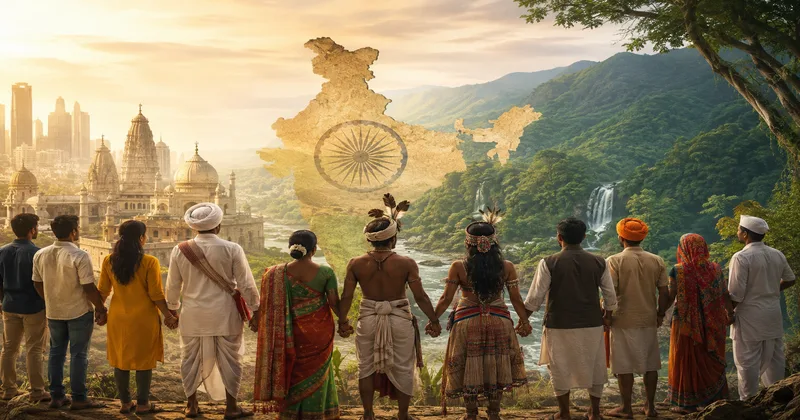
Respecting the tribal community with its distinctive identity is India’s responsibility. But dividing Indian society into political categories of ‘indigenous’ and ‘non-indigenous’ in the name of such respect would be a dangerous direction. Nagarvasi, Gramvasi and Vanvasi may, in reality, be different forms of India’s diverse social structure, but the nation is one. Remember, cultural diversity is the strength of Indianness. Diverse faiths, beliefs and philosophies are not our divisions but our distinctiveness. Embracing each one and bringing forth India’s vast strength should be the shared objective of us all.
Now Let the Vanvasi Community Decide Who Has the Political Right to Define Its Identity
In such a situation, the most important thing is that the tribal community itself should reflect on what is good for it. If the term ‘Vanvasi’ expresses respect, affinity and its historical relationship with nature for a community, then describing it as an insult and creating a political storm over it is not wise. In such circumstances, the most appropriate advice for Opposition leaders is this: oppose Amit Shah, criticise the government, question its policies; but do not turn the sentiments of the tribal community into political ammunition. Open the Constitution, read the facts, and then ask questions in Parliament.
Because the tribal community needs respect, not political exploitation. It needs rights; give it those rights, not a divisive narrative. And one final point: India does not need a new battle of ‘indigenous versus outsiders’. Rather, if anything is needed, it is for all of us, Nagarvasis, Gramvasis and Vanvasis, to move forward together with one voice, one pace, one rhythm and one beat, united in the making of a harmonious and powerful nation, India, so that it may become a global power and make its presence felt in every direction.