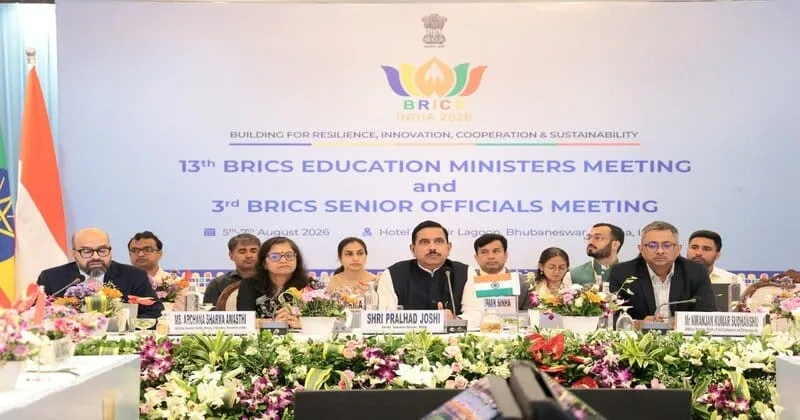
Bhubaneswar: At the 13th BRICS Education Ministers’ Meeting held in Bhubaneswar, Union Minister for Education Pralhad Joshi reaffirmed India’s strong commitment to a people-centric and humanity-first approach to educational cooperation within BRICS. The meeting concluded on a significant note with the adoption of the 13th BRICS Education Ministers’ Declaration, underscoring a shared vision for inclusive and future-ready education systems.
Chaired by Joshi, the meeting brought together education ministers, senior officials, and delegates from BRICS member countries including Brazil, Russia, China, South Africa, Indonesia, Iran, Ethiopia, and the United Arab Emirates. The deliberations focused on strengthening collaboration in education to address emerging global challenges and opportunities.
Education as a Driver of Inclusive Growth
Addressing the gathering, Shri Pralhad Joshi emphasised that education remains the cornerstone of inclusive growth and shared prosperity. He stated that education systems must continuously evolve to meet the aspirations of future generations while remaining firmly grounded in human values.
Referring to India’s upcoming BRICS Chairship in 2026, themed “Building for Resilience, Innovation, Cooperation and Sustainability,” the minister highlighted the need for education systems that are adaptive, resilient, and forward-looking. He stressed that learners, teachers, and researchers must remain at the centre of policymaking and international cooperation.
The minister expressed confidence that the discussions and outcomes of the meeting would translate into meaningful and actionable collaborations among BRICS nations.
India’s “Humanity First” Approach to Education
Reiterating India’s guiding principle of “Humanity First,” Shri Joshi underscored the importance of designing education policies that prioritise human development, ethical values, and inclusivity. He highlighted that empowering learners, promoting research and innovation, and enhancing academic collaboration are central to India’s vision.
Addressed the opening ceremony of the 13th BRICS Education Ministers' Meeting in Bhubaneswar, Odisha, under India's BRICS Presidency.
Education Ministers and delegates from BRICS nations came together to advance our shared vision of "Building for Resilience, Innovation,… pic.twitter.com/PwYd56hMPd
— Pralhad Joshi (@JoshiPralhad) August 7, 2026
He further noted that while nations may differ in their traditions and experiences, their progress remains interconnected. Drawing from India’s civilizational values such as “Vasudhaiva Kutumbakam” (the world is one family), he emphasised the importance of global solidarity in shaping the future of education.
Emphasis on Innovation and Resilient Education Systems
Highlighting the role of innovation, the minister stated that continuous advancement is essential for education systems to remain relevant in a rapidly changing world. He pointed out that resilience in education frameworks is equally critical, ensuring that systems can withstand disruptions while continuing to deliver quality learning.
India's #BRICS Chairship is guided by the theme of Resilience, Innovation, Cooperation and Sustainability, each of which holds special relevance for education. Our education systems must withstand disruptions, embrace continuous innovation, foster deeper cooperation and build… pic.twitter.com/GLAvNIISxY
— Pralhad Joshi (@JoshiPralhad) August 7, 2026
He also emphasised sustainability as a key pillar, noting that educational institutions must be designed to address both present and future needs. Collaboration among BRICS nations, he said, would play a vital role in strengthening academic ecosystems and fostering innovation-driven growth.
Preserving Traditional Knowledge Alongside Modern Education
A distinctive aspect of the discussions was the focus on integrating traditional and indigenous knowledge systems with modern education. Shri Joshi highlighted that the rich cultural and civilizational heritage of BRICS nations provides a unique opportunity to preserve and promote traditional knowledge.
He stressed that innovation and heritage are not mutually exclusive but complementary, and that both must be leveraged to create holistic education models. India also proposed guiding principles to strengthen academic collaboration in this area, which received positive attention from member nations.
Strengthening Global Partnerships in Education
The meeting served as a platform to deepen cooperation among BRICS countries in the education sector. Delegates collectively acknowledged education as a key driver of global well-being, economic development, and social progress.
From meaningful dialogue to shared outcomes…
Watch the highlights from the 13th BRICS Education Ministers' Meeting, which concluded with the adoption of the 13th BRICS Education Ministers' Declaration, reinforcing cooperation in education across BRICS nations.#BRICS2026… pic.twitter.com/l9oJbSicGK
— Ministry of Education (@EduMinOfIndia) August 7, 2026
Discussions emphasised expanding partnerships in research, academic exchanges, and knowledge sharing. The role of education in addressing global challenges such as technological disruption, inequality, and sustainability was also widely recognised.
Adoption of the 13th BRICS Education Ministers’ Declaration
The most significant outcome of the meeting was the adoption of the 13th BRICS Education Ministers’ Declaration, which reaffirms education as a central pillar of BRICS cooperation. The declaration outlines a comprehensive and forward-looking roadmap across five priority areas identified under India’s Chairship.
Firstly, member countries agreed to strengthen Early Childhood Care and Education (ECCE) and foundational literacy and numeracy (FLN), ensuring universal and inclusive access to quality early learning and promoting school readiness through appropriate digital tools.
Secondly, the declaration highlights the importance of expanding cooperation in skill development and Technical and Vocational Education and Training (TVET). It recognises the role of the BRICS TVET Cooperation Alliance and supports India’s initiative to undertake an International Skill Gap Study to align workforce capabilities with evolving global demands.
Thirdly, the declaration places strong emphasis on enhancing research, innovation, and start-up ecosystems. Member nations agreed to promote joint research initiatives, encourage the ethical and human-centred use of artificial intelligence in education, and strengthen collaboration among higher education institutions and innovation networks.
Fourthly, progress on Mutual Recognition of Qualifications (MRQ) was identified as a priority to facilitate greater academic mobility and international cooperation. Continued deliberations on a formal framework are expected to advance this objective.
Finally, the declaration underscores the importance of capacity building for academic leadership and institutional development. Initiatives such as faculty exchanges, scholarship programmes—particularly in STEM fields—and the development of a BRICS University ranking system were encouraged.
In addition, the declaration welcomed India’s initiative on strengthening academic collaboration in traditional and indigenous knowledge systems, suggesting its inclusion as a thematic focus within the BRICS Network University.
The adoption of the declaration reflects a shared commitment among BRICS nations to build inclusive, resilient, and future-ready education systems. It sets the stage for deeper collaboration and sustained engagement in the years ahead.
The 13th BRICS Education Ministers’ Meeting thus marks a pivotal step in strengthening global education cooperation, with the adopted declaration serving as a blueprint for collective progress and shared prosperity.
India will continue to host BRICS Ministerial Meetings across various sectors during its Chairship, culminating in the 18th BRICS Summit, scheduled to be held in New Delhi on September 12–13, 2026.