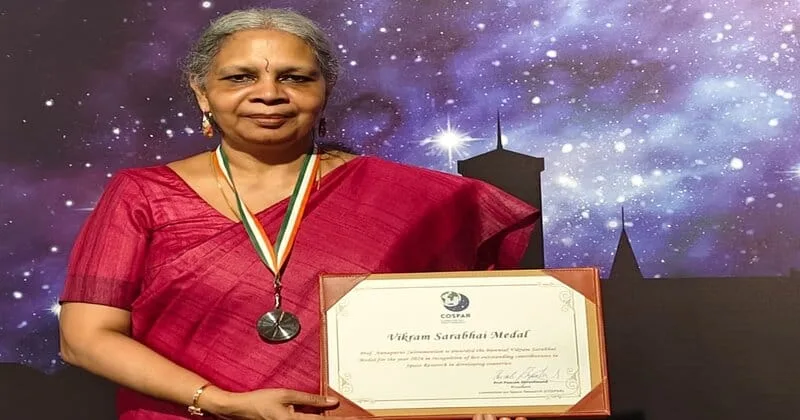
New Delhi: Professor Annapurni Subramaniam, one of India’s most distinguished astrophysicists, has been awarded the COSPAR Vikram Sarabhai Medal 2026, becoming the first Indian woman scientist and only the fourth Indian to receive the prestigious international honour.
She received the medal during the 46th COSPAR Scientific Assembly in Florence, Italy, in recognition of her outstanding contributions to space research in developing countries. She is also only the third woman globally to receive the award.
Currently, Professor Subramaniam serves as the Director of the Indian Institute of Astrophysics (IIA), Bengaluru, and heads the Centre for Nano and Soft Matter Sciences (CeNS). Over a career spanning more than three decades, she has played a pivotal role in advancing India’s astronomy and space science ecosystem through research, scientific leadership, and mentoring.
A Childhood Fascination with the Night Sky
Born in Palakkad, Kerala, Professor Subramaniam’s fascination with astronomy began during her school years. She would wake before sunrise during summers to observe the night sky, where the glowing band of the Milky Way particularly captivated her. Curious about why it appeared in the same region of the sky every morning, she searched for answers despite having no one around her who could explain the phenomenon. That childhood curiosity eventually shaped her career.
After completing her Master’s degree in Physics, she pursued astronomy through a collaborative programme involving the Indian Institute of Science (IISc), Indian Institute of Astrophysics (IIA), ISRO, and the Raman Research Institute. She joined the Indian Institute of Astrophysics as a Research Fellow in 1990.
Nearly three decades later, in 2019, she created history by becoming the first woman Director of the Indian Institute of Astrophysics.
Major Contributions to Astronomy and Space Science
Professor Subramaniam’s research covers a wide range of astrophysical fields, including:
* Star clusters and stellar populations
* Nearby galaxies
* Classical Be stars
* Blue straggler stars
* Young stellar objects
* The Magellanic Clouds
* Ultraviolet astronomy
Her work has significantly improved scientific understanding of stellar evolution and the life cycles of stars. She has authored nearly 175 scientific papers, supervised 15 PhD scholars, and mentored numerous young researchers in astronomy and astrophysics.
Key Role in AstroSat and Future Space Missions
One of Professor Subramaniam’s most significant contributions has been to AstroSat, India’s first dedicated space observatory launched in 2015. As the Calibration Scientist for the Ultraviolet Imaging Telescope (UVIT) aboard AstroSat, she led the telescope’s in-orbit calibration and performance verification, helping ensure its scientific success.
Building on this work, she now serves as the Principal Investigator of INSIST (Indian Spectroscopic and Imaging Space Telescope), India’s proposed next-generation ultraviolet-optical space telescope. She has also played a crucial role in the Thirty Metre Telescope (TMT) project—one of the world’s largest international astronomy collaborations—with the Indian Institute of Astrophysics serving as India’s coordinating centre.
About the COSPAR Vikram Sarabhai Medal
The COSPAR Vikram Sarabhai Medal is among the highest international honours in space science. Instituted in 1990, it commemorates Dr Vikram Sarabhai, the founder of India’s space programme and ISRO. The medal is jointly awarded every two years by the Committee on Space Research (COSPAR) and ISRO to scientists from developing countries for exceptional contributions to space research.
With the 2026 award, Professor Subramaniam joins an elite list of Indian recipients:
* U. R. Rao (1996) – Former ISRO Chairman
* Gurbax Singh Lakhina (2014) – Space plasma physicist
* Anil Bhardwaj (2024) – Director, Physical Research Laboratory (PRL)
Leadership in India’s Scientific Community
Beyond her research, Professor Subramaniam has held several key leadership positions. Along with serving as Director of the Indian Institute of Astrophysics, she heads the Centre for Nano and Soft Matter Sciences (CeNS) in Bengaluru. She is a Fellow of the Indian Academy of Sciences and the National Academy of Sciences, India, and a life member of both the International Astronomical Union (IAU) and the Astronomical Society of India.
She has also:
* Chaired the Membership Committee of the International Astronomical Union
* Served as Chief Editor of the Journal of Astrophysics and Astronomy (2019–2024)
* Currently serves as Scientific Editor of Research in Astronomy and Astrophysics
Awards and Recognition
Professor Subramaniam has received numerous honours for her contributions to science, including:
* Rashtriya Vigyan Puraskar – Vigyan Shri (2024) for Space Science and Technology
* NDTV Science Icon of the Year (2024)
* Future Forward Female Award by CNBC-News18
* Devi Award
* Vanitha Ratna Award (2023) from the Government of Kerala
* Recognition among India Today’s Top 100 Women Achievers (2023)
Outside the laboratory, Professor Subramaniam is a trained violinist who grew up in a family deeply rooted in Carnatic music. She has often credited her musical upbringing with nurturing creativity, discipline, and analytical thinking. She also enjoys creating traditional kolam (rangoli) designs, describing the daily practice as a “morning puzzle” that stimulates her mind before beginning scientific work.
Inspiring the Next Generation
From a young girl fascinated by the mysterious glow of the Milky Way to becoming one of India’s foremost astrophysicists, Professor Annapurni Subramaniam’s journey reflects decades of scientific excellence, perseverance, and leadership.
Her recognition with the COSPAR Vikram Sarabhai Medal 2026 not only marks a personal milestone but also highlights India’s growing stature in global astronomy while inspiring future generations, especially women, to pursue careers in space science and astrophysics.