NEW DELHI: India is seeking to strengthen its maritime infrastructure, shipping capacity and alternative trade corridors as geopolitical tensions, disruptions at critical chokepoints and shifting global trade patterns expose vulnerabilities in the international maritime system, government officials and industry leaders said at the opening of ‘Sagarmanthan: The Great Oceans Dialogue 2026’ in the national capital.
The third edition of the three-day dialogue, which started on October 8 and is jointly hosted by the Observer Research Foundation (ORF) and the Ministry of Ports, Shipping and Waterways (MoPSW), has brought together more than 1,200 ministers, policymakers, industry leaders and scholars from over 70 countries under the theme “Blue Geographies, New Aspirations: Trade, Technology, and Trust at Sea.”
The discussions on the opening day centred on a maritime landscape being reshaped by geopolitical tensions, supply-chain disruptions, climate change and the concentration of global shipbuilding capacity. For India, the developments have also coincided with an expansion of its own maritime infrastructure and ambitions to play a larger role in global trade.
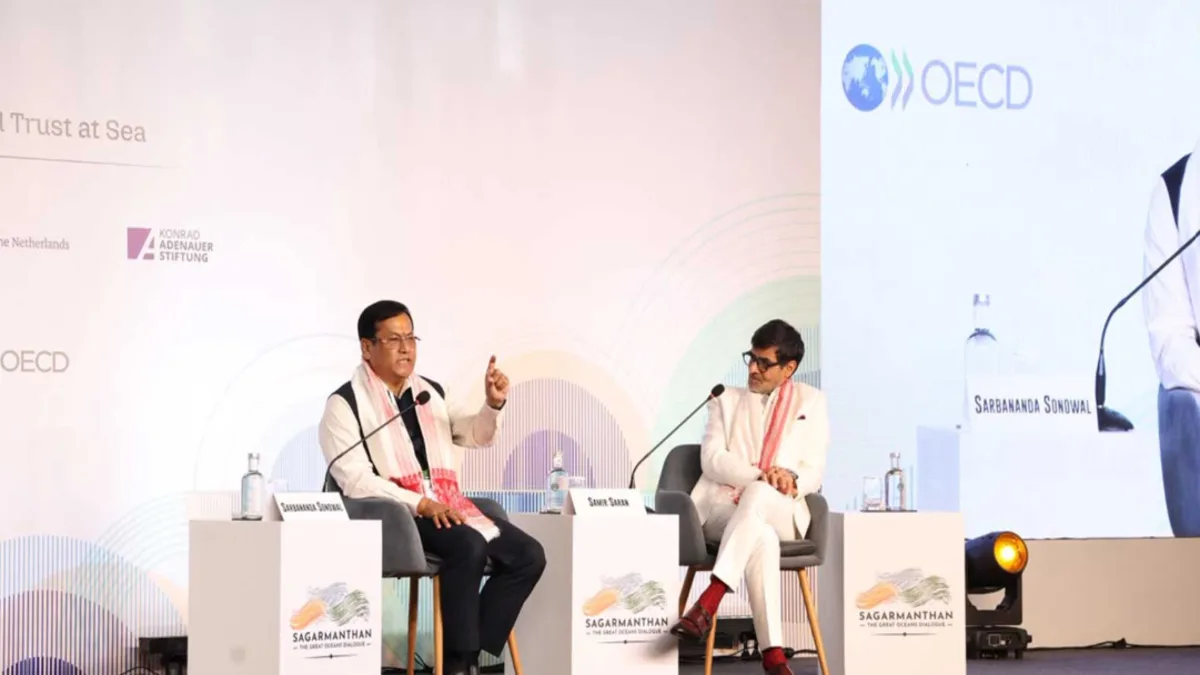
Minister of Ports, Shipping and Waterways Sarbananda Sonowal said India’s maritime transformation was being supported by investments in ports, shipbuilding clusters and maritime training. He also linked the government’s approach to the Maritime India Vision 2030 and Maritime Amrit Kaal Vision 2047.
“This is an assembly of people who believe in the power of the seas and the oceans, and in the bonds of friendship they create,” Sonowal said.
He added that the government’s maritime programmes were aimed at expanding the sector’s capacity and developing a skilled workforce for India as well as the wider global economy.
The urgency of strengthening maritime resilience was underscored by Shantanu Thakur, Minister of State for Ports, Shipping and Waterways, who pointed to the vulnerabilities created by geopolitical tensions at major maritime chokepoints.
“The oceans are central to global growth, prosperity, security and sustainability. At the same time, geopolitical tensions at critical chokepoints, climate change and shifting trade patterns are creating new uncertainties. The recent Strait of Hormuz crisis has reminded us that when maritime routes are disrupted, the effects are felt everywhere else,” Thakur said.
The disruption of established routes has made diversification an increasingly important consideration for companies and governments.
Rizwan Soomar, Chief Executive Officer and Managing Director, DP World – Subcontinent, Central Asia, Levant and Egypt, said businesses were moving away from an exclusive focus on efficiency towards building redundancy into their supply chains.
“Resilience in supply-chain continuity is now at the centre of a company’s operating model. The shift we have seen over the last four or five years is from ‘just-in-time’ to ‘just-in-case’—it is no longer only about the most optimal routing, but about having Plan B and Plan C as part of the process. Alternate trade corridors need to be institutionalised, commercialised and operationalised even in good times, so that they can be leveraged when challenging times arise and businesses can continue moving goods and supplying the factories and consumers that depend on them,” he stated.
India’s own maritime infrastructure was a major focus of the opening day’s discussions. Vijay Kumar, Secretary, Ministry of Ports, Shipping and Waterways, pointed to the expansion in cargo handled by India’s major ports over the past decade, alongside improvements in port efficiency.
“For India, these challenges come at a particularly important moment, as we witness a structural transformation reshaping our own maritime economy. In the last decade, cargo handled by our major ports has risen from 581 million tonnes in 2014-15 to more than 915 million tonnes in 2025-26. Ship turnaround time has been reduced by over 50 per cent. Once completed, the Vadhavan Port will be among the ten largest in the world,” he said.
The remarks come as India seeks to expand its port capacity and strengthen its position in international supply chains.
The country’s maritime strategy is also increasingly tied to the development of shipbuilding, logistics and maritime skills, with officials arguing that greater domestic capacity can contribute to resilience beyond India’s own trade requirements.
The issue of concentration in global maritime infrastructure was also raised during the inaugural ministerial plenary, Tides of Trust: Ports, Partnerships, and the Making of a New Maritime Century.
Former Australian Prime Minister and Global President and Chief Executive Officer of Asia Society Kevin Rudd said countries across the Indo-Pacific were looking at maritime infrastructure through the lens of long-term economic resilience.
“Countries in the Indo-Pacific are looking at long-term economic resilience. Here, investing in shipbuilding and port infrastructure is central, given the concentration and monopoly control risks,” Rudd said.
For India, the maritime challenge also has a security dimension. Chief of the Naval Staff Admiral Krishna Swaminathan said threats to commercial shipping could not be separated from wider national-security concerns.
“We don’t look at threats to maritime commerce as separate threats. They are intrinsically linked to national security. The nature of global commerce means threats in one part of the world can emerge in others too. Global commons are becoming contested, congested, and competitive, underlining their link to national security,” he said.
Beyond security and supply-chain resilience, the dialogue highlighted the transformation of shipping as the industry faces pressure to reduce emissions while maintaining the movement of global trade.
The first day saw the launch of the India–EU Green Shipping Corridor, held in association with RMI, as well as discussions on sustainable blue economies with the Organisation for Economic Co-operation and Development (OECD).
Other sessions examined India’s maritime links with Korea, the India–Middle East–Europe Economic Corridor (IMEC) and the broader potential for alternative trade routes connecting major markets.
The emphasis on new corridors reflects a wider shift in maritime planning, with governments and companies seeking alternatives that can reduce exposure to disruptions at individual chokepoints while strengthening connections between ports, manufacturing centres and consumer markets.
Samir Saran, President of the Observer Research Foundation, said the scale of the challenge made cooperation essential.
“The ocean is perhaps the world’s most important shared infrastructure. No country can secure the seas alone. No country can decarbonise shipping alone. No country can build resilient maritime supply chains alone,” he said. “That is why Sagarmanthan matters.”
The discussions at Sagarmanthan 2026 are set to continue over the next two days, with sessions covering maritime security, green shipping, shipbuilding, the blue economy, the future of global trade and the role of the Global South in shaping the evolving maritime order. (With inputs from ANI)