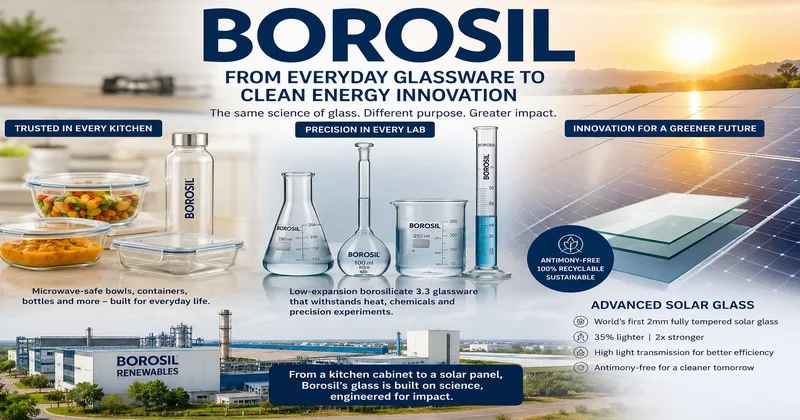
New Delhi: Borosil is widely known for its microwave-safe bowls, containers, bottles and other glassware found in homes across the country. But the Borosil story goes far beyond the kitchen. Behind the household brand is a decades-old expertise in speciality glass that has expanded into laboratory equipment, scientific glassware and, importantly, high-performance solar glass. Through Borosil Renewables, the group has developed technologies aimed at solving some of the most demanding materials challenges in the solar industry.
Ask 100 Indians what Borosil makes & 99 will tell you about the microwave safe glass bowl sitting in their kitchen cabinet.
They have no idea that the same company quietly engineered a high precision materials breakthrough that powers global cleantech supply chains :))
In 2010,… pic.twitter.com/Boj9hhN2sg
— Parimal (@Fintech03) August 2, 2026
The story is particularly striking because the company began its journey in 1962 with a focus on scientific glass. Today, the broader Borosil group operates through separate listed businesses, with Borosil Limited handling consumer and life-science products and Borosil Renewables manufacturing solar glass.
From laboratory glass to solar technology
The name Borosil itself comes from borosilicate glass, a speciality material prized for its resistance to thermal shock and chemical attack.
That expertise became the foundation for the company’s laboratory-glass business. Borosil says its 3.3 low-expansion borosilicate glass is designed to withstand thermal shock, high temperatures and chemical exposure, making it suitable for demanding laboratory applications. Its product portfolio includes beakers, burettes, condensers, cylinders, distillation apparatus, pipettes and volumetric flasks.
The same understanding of how glass behaves under heat, stress and changing temperatures would eventually become important in a completely different industry: solar energy.
In 2010, Gujarat Borosil established India’s first solar-glass production line at Bharuch in Gujarat, with a capacity of 180 tonnes per day. That was significant because solar modules require a very different kind of glass from ordinary architectural or household glass.
Why solar glass is a high-precision material
The glass covering a solar panel is not simply a transparent protective sheet. It has to protect delicate photovoltaic cells from the environment while allowing as much sunlight as possible to reach them. Optical transmission, iron content, surface characteristics, mechanical strength and long-term durability therefore become critical.
Even small optical losses matter because the ultimate objective is to maximise the amount of sunlight reaching the photovoltaic cells. This is where specialised solar glass comes in.
Borosil says it developed solar glass with very low iron content to improve glass efficiency and has focused heavily on technologies that improve optical performance while maintaining structural strength.
One of the company’s most notable developments came in 2017. Borosil says Gujarat Borosil produced the world’s first fully tempered 2mm solar glass. The achievement addressed a difficult engineering challenge: how to reduce the thickness and weight of solar-module glass without compromising mechanical strength and durability. Traditional solar modules commonly used thicker glass. Moving to a fully tempered 2mm product offered a major weight advantage.
According to Borosil, its 2mm fully tempered glass is around 35% lighter than traditional 3.2mm glass and is twice as strong as heat-strengthened glass. The company says the thinner format can make modules easier to handle, transport and install while also offering long-term durability. That may sound like a simple reduction in thickness. It is anything but. Glass becomes more challenging to engineer as it gets thinner because the material still has to withstand mechanical stresses, temperature variations and the harsh outdoor conditions experienced by solar modules.
A solar panel can spend decades exposed to intense sunlight, rain, wind and temperature fluctuations. Its protective glass therefore needs to balance optical performance with strength and reliability. The 2mm development was an attempt to achieve exactly that balance.
The antimony-free innovation
Borosil’s innovation did not stop at making solar glass thinner. In 2014, Gujarat Borosil announced what the company describes as the world’s first antimony-free solar glass. The resulting product, later branded NoSbEra, was developed to eliminate antimony from the glass formulation. This matters because antimony compounds have traditionally been used in certain glassmaking processes, while concerns exist around their environmental and health impacts.
Borosil says its antimony-free glass eliminates the substance while maintaining high optical performance. The company also points to testing by the Institut für Solartechnik SPF in Switzerland, which it says showed no photo-degradation and high efficiency for its antimony-free glass.
The development illustrates a broader trend in modern manufacturing: the goal is no longer merely to produce a functional material, but to make it stronger, more efficient and environmentally preferable.
The laboratory connection
Perhaps the most fascinating part of the Borosil story is that solar-glass innovation is not completely disconnected from the company’s original business. The connection is glass science. For decades, Borosil has supplied laboratories with precision glassware designed for environments where ordinary glass is inadequate.
Laboratory glassware needs to withstand thermal shock, resist chemicals and maintain dimensional stability. Borosil’s 3.3 low-expansion borosilicate glass was developed precisely for these requirements. And precision matters especially when measuring liquids.
A volumetric flask, burette or pipette isn’t simply a glass container. Its dimensions and calibration determine how accurately a scientist can measure a substance. Borosil says its volumetric glassware is manufactured from 3.3 low-expansion borosilicate glass and uses computer-controlled processes and precision calibration. Its Class A range can also carry individual accuracy certification and traceability information.
The company says it is India’s largest manufacturer of the complete range of volumetric glassware and exports laboratory products to more than 50 countries. So the beaker sitting on a laboratory bench and the glass protecting a solar cell may look like entirely different products. Technologically, however, they share an underlying discipline: controlling the behaviour of glass.
The surprising evolution of a household name
Borosil’s history makes the transformation even more interesting. The company began in 1962 with scientific glassware. Its consumer journey later took it into household glass products, and by 2000, as microwave cooking became increasingly popular, Borosil had become closely associated with heat-resistant microwave cookware.
Then came the solar push. In 2010, Gujarat Borosil established its solar-glass manufacturing line in Bharuch. In 2013, it introduced anti-reflective coating technology. In 2014, it developed antimony-free solar glass. And in 2017, it achieved its 2mm fully tempered solar-glass breakthrough. The corporate structure subsequently changed.
Following a 2020 restructuring, the solar-glass business became part of Borosil Renewables, while Borosil Limited continued with the scientific, industrial and consumer businesses. Today, Borosil Renewables describes itself as a major solar-glass manufacturer, with manufacturing operations in India and Germany following its acquisition of Interfloat Corporation.
From a kitchen cabinet to the clean-energy supply chain
This is what makes Borosil’s story worth noticing. For the average consumer, glass is an everyday material. A bowl, flask or bottle is simply something designed to hold food, water or chemicals. For an advanced materials manufacturer, however, glass is an engineered product. Its chemical composition, iron content, thermal expansion, thickness, strength, surface texture and optical properties can all be manipulated to serve highly specialised purposes. That is the hidden bridge between Borosil’s laboratory glassware and its solar-glass business. The company didn’t suddenly move from making kitchen bowls to making clean-energy technology. It built on decades of knowledge about glass, how it responds to heat, chemicals, mechanical stress and light, and applied that expertise to increasingly demanding industrial applications. The result is a fascinating example of how an apparently ordinary material can become a critical component of high-tech infrastructure.
The Borosil product in your kitchen may be designed to survive a microwave. Its solar-glass technology is designed to survive decades outdoors while helping photovoltaic modules capture sunlight efficiently. But underneath them is the same fundamental science: the engineering of glass.
And that may be the most surprising thing about Borosil, the familiar glassware brand sitting quietly in Indian homes has also become part of a much larger story about speciality materials, solar manufacturing and India’s attempt to build deeper capabilities in the clean-energy supply chain.