
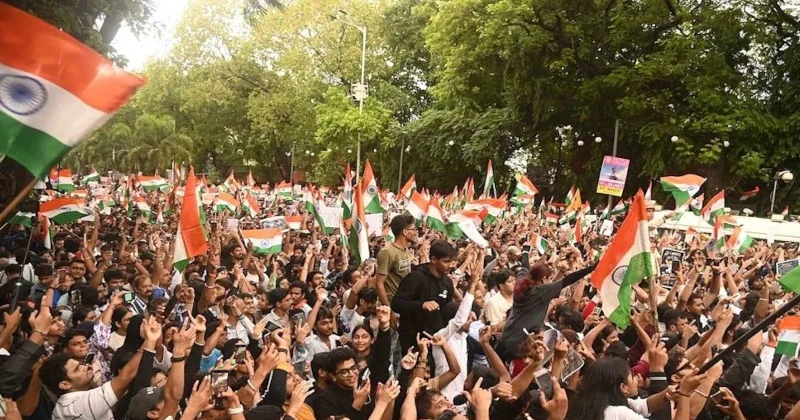
For nearly two months, a small but highly visible protest dominated television screens, digital platforms, and social media timelines. Images of slogan-shouting crowds, abusive placards, vandalised public property, and attacks on institutions were repeatedly projected as the voice of India’s youth. The implication was unmistakable: this was Generation Z speaking. But was it?
A handful of protesters, amplified by cameras and algorithms, cannot become the representative face of an entire generation. Nor can a few days of orchestrated outrage define millions of young Indians who are quietly transforming the nation through discipline, innovation, and excellence.
This is where the national conversation needs correction.
The overwhelming majority of Bharat’s Gen Z is not standing behind barricades abusing constitutional institutions. They are standing on podiums, in laboratories, classrooms, startups, sports arenas, and research centres, carrying the aspirations of a rising civilisation.
Consider India’s recent performances on the global stage.
At the international athletics meet in Glasgow, young Indians once again demonstrated that perseverance triumphs over noise. Sharmila Dhankar and Dilip Mahadu Gavit clinched gold medals, while Gyaneshwari Yadav, Muthupandi Raja, Sarvesh Kushare, Gulveer Singh, Murali Sreeshankar, Mohammed Basil, and Valluri Ajaya Babu brought home silver medals. Bindyarani Devi and Shilpa K. Shyla added bronze medals to India’s tally.
None of them sought attention through disruption. They earned respect through years of sacrifice. Their tears flowed not in anger, but in pride as the Tricolour was raised before the world.
The same story unfolded at the International Mathematical Olympiad. Abel George and Aarav Gupta secured gold medals, while Kanav Talwar, Sanjana Chacko, Bairav Murugan, and Shreya Shantanu won silver. These young minds did not trend on social media because they shouted the loudest. They succeeded because they solved problems that demanded extraordinary intellect and relentless dedication.
The success story extends even further.
Chess continues to produce global icons like D. Gukesh, R. Praggnanandhaa, R. Vaishali, and Divya Deshmukh, proving that Indian strategic thinking is flourishing on the world stage.
Athletes such as Neeraj Chopra, Lakshya Sen, Antim Panghal, Palak Gulia, and the emerging generation of sporting talent have become symbols of discipline, resilience, and national pride.
Beyond sports lies an even more remarkable transformation.
Young Indians are building artificial intelligence systems, designing satellites, developing robotics, contributing to defence technologies, creating semiconductor ecosystems, and launching space-tech startups. They are becoming scientists, innovators, entrepreneurs, coders, and researchers who are strengthening Bharat’s technological sovereignty.
This is the real face of Generation Z.
It is a generation that is globally competitive yet deeply aspirational. It is digitally fluent but increasingly determined to create rather than merely consume. It seeks excellence, not anarchy; innovation, not destruction.
Unfortunately, the modern media ecosystem often rewards spectacle over substance.
Television cameras instinctively gravitate towards conflict. Social media algorithms amplify outrage because outrage generates engagement. A few hundred individuals shouting slogans receive disproportionate attention, while thousands of students preparing for civil services, engineering breakthroughs, sporting excellence, or scientific research remain invisible.
This creates a dangerous distortion. Repeated often enough, the exception begins to appear as the norm. A fringe begins to masquerade as an entire generation.
Such framing is unfair not merely to Gen Z, but to Bharat itself.
Every generation has its fringe elements. Democracies will always witness protests, disagreements, and dissent. But vandalism, abuse of national institutions, disrespect towards the armed forces, and deliberate attempts to manufacture chaos cannot be romanticised as youthful idealism.
Nor should such behaviour become the defining image of India’s young citizens.
The future of Bharat is not being written by those who mistake disruption for achievement or social media virality for public service.
It is being written by students burning the midnight oil before examinations, by young innovators in laboratories, by entrepreneurs building globally competitive enterprises, by athletes standing on victory podiums, by soldiers in training academies, and by researchers creating technologies that will shape the twenty-first century.
These are the young Indians carrying equations, medals, patents, startups, satellites, and the Tricolour. They deserve to become the face of Generation Z. India does not suffer from a youth crisis. It suffers from a narrative crisis.
Our cameras too often remain fixed on the gutter while an entire generation is quietly reaching for the stars.
If Bharat wishes to understand its future, it must stop mistaking the loudest voices for the largest voices. The real story of India’s Gen Z is not one of nihilism or disorder. It is a story of confidence, competence, and civilisational resurgence.
That is the generation which will build Viksit Bharat.