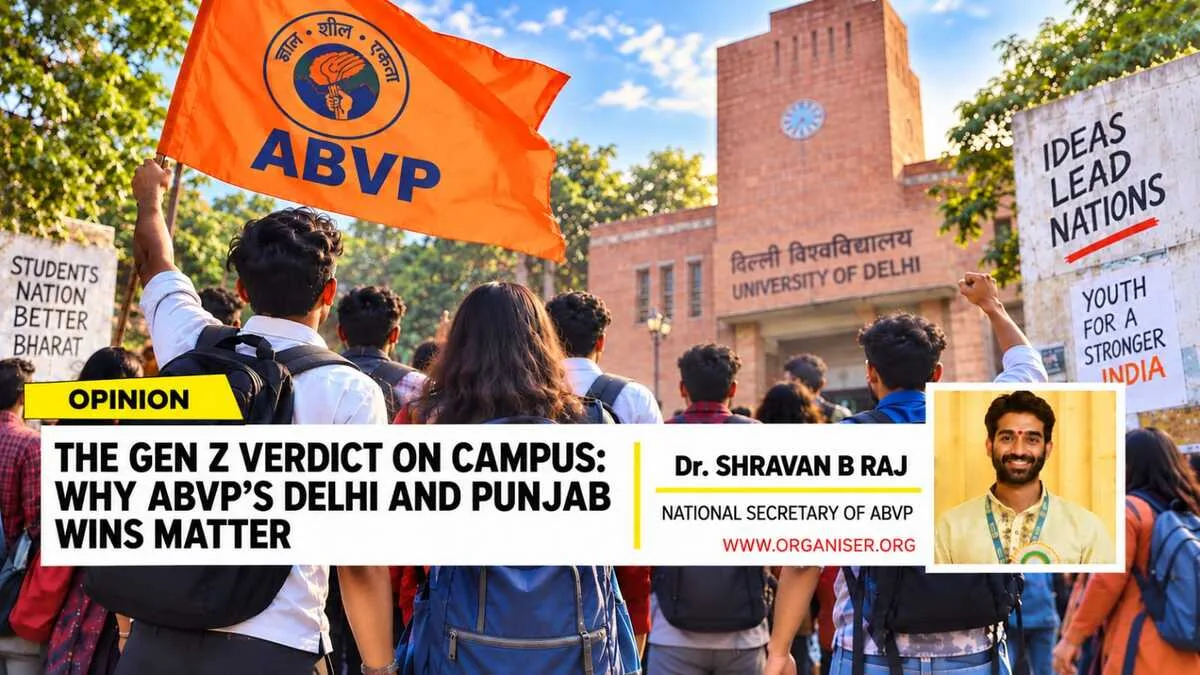
NEW DELHI: There is perhaps no better forum than campus elections for understanding the political pulse of the younger generation in India. Beyond large-scale national campaigns and trends on Western-dominated social media platforms, it is in university ballot boxes that the country’s student community records its political preferences. It is for this reason that the victories secured by the Akhil Bharatiya Vidyarthi Parishad (ABVP) at the University of Delhi and, earlier, at Panjab University cannot, in the present context, be reduced to the outcome of ordinary campus elections.
The ABVP’s electoral success came at a time when a strong political narrative was being advanced that India’s student community had turned against the organisation, particularly in the aftermath of the student protest held at Jantar Mantar a few weeks earlier. Against this backdrop, the organisation’s ability to secure victories in two prominent universities assumes wider political significance.
From Punjab to Delhi
Soon after the CJP-led agitation, the Panjab University student elections were held on August 31. ABVP’s Ankit Bidhan was elected President. In the results announced on September 1, Bidhan secured 3,149 votes, while Adil Brar, the candidate of the Association of Students for Alternative Politics (ASAP), which was associated with the Aam Aadmi Party (AAP), received 2,637 votes. Gurman Singh Sidhu of the Congress-affiliated National Students’ Union of India (NSUI) finished third with 2,263 votes. For the ABVP, this marked a second consecutive victory.
A similar outcome was witnessed in the Delhi University Students’ Union (DUSU) elections, whose results were announced on September 19. ABVP’s Yash Dabas was elected President with 24,576 votes, defeating NSUI’s Vijay Shankar Meena, who secured 22,523 votes. ABVP’s Riya Chhabdi was elected Secretary with 21,650 votes, while Lakshya Raj Singh won the Joint Secretary’s post with 16,615 votes.
The Vice-President’s post was won by independent candidate Deepanshu Shokeen with 30,615 votes. In effect, the ABVP secured three of the four central posts at Delhi University. NSUI, which had won one of the central positions in the previous election, failed to secure any of the four central posts this time.
Jantar Mantar and the CJP
The victories in Punjab and Delhi raise an important question: can the political outlook of India’s younger generation be adequately understood merely by observing social-media campaigns and street protests led by opposition political groups? The developments that happened between June and September 2026 suggest that the answer is not straightforward.
On June 6, 2026, a major student and youth protest was held at Jantar Mantar in New Delhi under the leadership of the Cockroach Janata Party (CJP). The protest focused on alleged irregularities in the 2026 National Eligibility cum Entrance Test (NEET) and broader concerns relating to the examination system. Among the principal demands raised by the protesters was the resignation of Union Education Minister Dharmendra Pradhan.
The protest was led by CJP founder Abhijit Dipke. Sonam Wangchuk also joined the agitation through a hunger strike. The CJP’s demands included the resignation of the Union Education Minister and financial assistance for the families of those who had died by suicide following the alleged NEET paper leak.
At this stage, opposition parties and leaders, including those from the Congress and left organisations, extended their support to the agitation. By July, the protest had acquired a more explicitly political character. The march towards Parliament on July 20 turned violent, with reports of individuals described as criminal elements joining the demonstration.
On July 23, Sonia Gandhi, Rahul Gandhi and Priyanka Vadra participated in programmes associated with the protest. Consequently, what had initially been presented as a student-centred educational issue increasingly evolved into a broader political confrontation with the Union government.
When the Gen Zs made their position clear
It is at this point that a more complex understanding of student politics in 2026 becomes necessary. The CJP’s Jantar Mantar protest was initially perceived by many as a corrective force addressing genuine concerns among students. However, various left-wing, Maoist and Congress-aligned student organisations subsequently became active participants in the agitation.
The argument advanced by these groups was that the protest represented opposition to the government and the ABVP. This interpretation was reinforced by highlighting the participation of political workers associated with opposition parties who, according to the argument, participated in the agitation under the broader identity of student protesters.
The subsequent campus elections in Delhi and neighbouring Punjab, however, provide a different electoral picture. The victories of the ABVP suggest that nationalism, national unity and patriotism have not disappeared from the political consciousness of India’s younger generation.
The results indicate that opposition to examination irregularities and faith in national identity can coexist among students. The electoral outcome can also be interpreted as indicating that students are not necessarily willing to adopt positions against the country merely because such positions may align with the interests of domestic or international political actors.
From this perspective, the electoral results underline a demand for correcting deficiencies within the country’s administrative and institutional systems rather than rejecting the national framework itself. The results may also be read as evidence that a section of the younger generation perceives political objectives within left- and Congress-affiliated student organisations as taking precedence over student welfare.
One example frequently cited in this context is the student agitation in Jharkhand. Beginning on July 25, students launched protests over alleged irregularities in the JPSC and JSSC examinations. On August 10, thousands of young people marched peacefully towards the state assembly in Ranchi. The police attempted to disperse the protesters using tear gas, water cannons and batons.
The agitation was temporarily suspended after the Jharkhand government agreed on August 19 to cancel certain examinations. The Jharkhand agitation was directed against the JMM-Congress government. Protesters burned effigies of Chief Minister Hemant Soren and Rahul Gandhi. Yet many of the political faces visible during the Delhi protest were conspicuously absent from the Jharkhand agitation.
The politics of double standards and the response at the ballot box
The contrasting responses to the Jantar Mantar and Jharkhand protests expose what can be described as a political inconsistency in the opposition’s approach to student issues. Opposition parties, including the Congress, as well as left-wing student organisations, extended substantial support to the student agitation at Jantar Mantar and used it as a platform for a broader political campaign against the Union government.
In Jharkhand, however, when students took to the streets over examination irregularities while the Congress was part of the governing coalition, a comparable level of political mobilisation was not evident.
Although the Jharkhand agitation continued for several days after it began on July 25, opposition parties did not elevate it into a national political campaign on a scale comparable to the Jantar Mantar protest. Instead, when questions arose that could potentially inconvenience the ruling INDI Aliance, the issue was largely approached as an administrative matter requiring a governmental solution.
This contrast may have contributed to a perception among sections of the younger generation that student protest at Jantar Mantar was presented as expressions of democratic dissent when they serve particular political interests, while receiving less political attention when it happened in Jharkhand.
The argument, therefore, is that students increasingly recognised the political dimension of the Jantar Mantar mobilisation rather than viewing it exclusively through the lens of student welfare. Following the CJP agitation, the political criticisms articulated by CJP leader Abhijit Dipke, as well as Sonam Wangchuk’s public distancing from the political objectives attributed to the CJP and its leadership, further complicated the political narrative surrounding the protest.
The electoral results in Delhi and Punjab can consequently be interpreted as the response of students through the ballot box to the political positions advanced by NSUI and left-wing student
organisations.
The DUSU election results also represented a setback for the left-wing student alliance of AISA and SFI. The voting figures provide one measure of the level of electoral support received by these organisations. AISA presidential candidate Ananya Rathore secured 5,377 votes, only around 1,000 votes more than NOTA, which received 4,310 votes. For the Vice-President’s position, AISA-SFI candidate Akshat Shikhar received 2,383 votes, while NOTA secured 4,359 votes.
For the Joint Secretary’s position, SFI candidate B. Parijath received 5,837 votes, whereas NOTA received 7,389 votes. Thus, in these contests, the number of students choosing the NOTA option exceeded the number voting for the respective SFI-supported candidates. These figures indicate the electoral difficulty faced by left-wing organisations in translating their claims of representing student interests into corresponding levels of electoral support.
The Message from campus politics
A reading of campus politics in 2026 therefore points towards a generation that is not necessarily willing to be mobilised through what it perceives as merely anti-national political narratives. When the Jantar Mantar protest, the Jharkhand student agitation, and the ABVP’s victories in Punjab and Delhi are considered together, a more complex picture emerges. It is that of a young generation willing to question problems within the country while simultaneously maintaining an attachment to nationalism and patriotism.
The electoral outcomes also point towards a student community that increasingly seeks to evaluate political organisations and their claims based on its own experiences rather than accepting political narratives at face value. That, ultimately, is the broader political significance of these campus election results: India’s students are not disengaged from questions of governance and public accountability, but neither are their concerns necessarily reducible to the political narratives advanced by competing ideological formations.
The ballot box, in this reading, becomes more than an instrument for choosing student representatives. It becomes a measure of how the younger generation negotiates the relationship between student welfare, political accountability, nationalism and democratic participation.