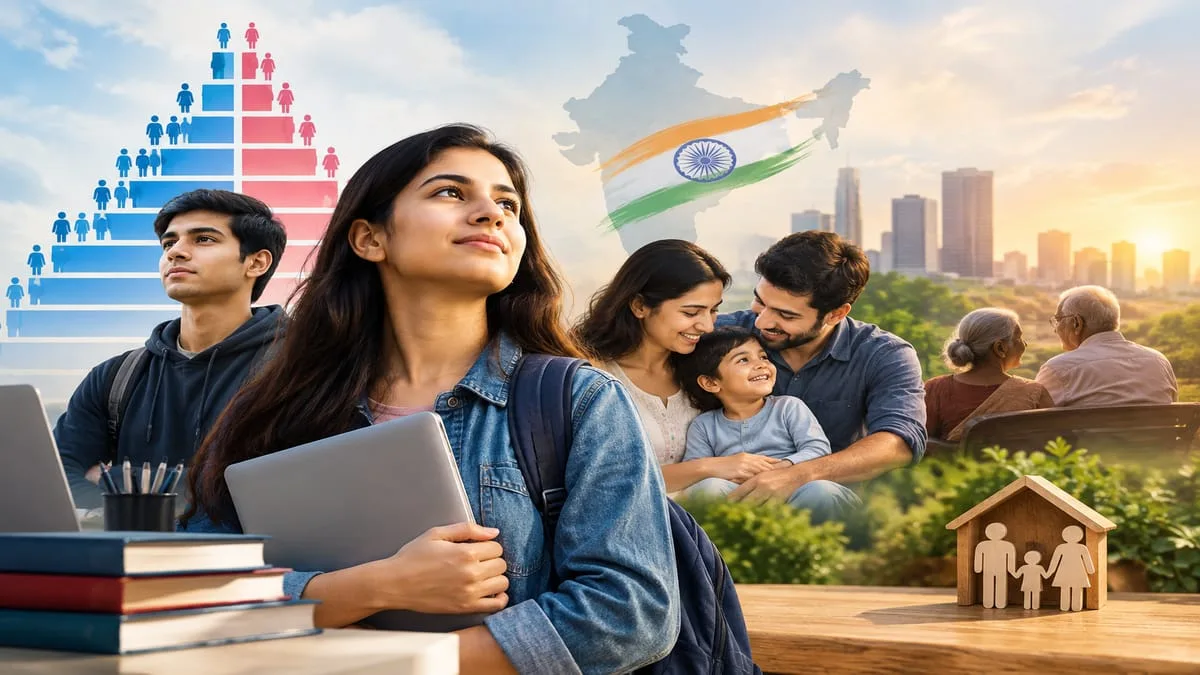
We have been living with warnings about the hazard of a “population explosion.” Paradoxically, however, the ground has shifted beneath our feet, with the national Total Fertility Rate (TFR) dipping below the replacement level of 2.1. India today stands at the cusp of a demographic paradox. With a national average of 1.9, TFR with states like UP and Bihar still maintaining a favourable replacement level, the picture in most parts of Bharat is quite alarming. In urbanised states like Kerala, Punjab, Delhi, and Maharashtra, the numbers are significantly lower, matching the dangerous trend of countries like Japan, South Korea, Japan and Western Europe.
At the centre of this problem lies Gen Z (those born between 1997 and 2012), who are very ambitious, digital natives, confident, but lacking in the traditional Indian concept of family responsibility. Especially for young women who are primarily driven by education and career building, the priority of having a family and children gets a backseat. This is not to reduce a woman’s identity to motherhood, but to record a biological and social reality, i.e the function of bearing progeny rests largely with women. Therefore, the population, which is the future strength and vitality of any nation, depends significantly on their choices. That does not mean that girls’ traditional role as child-bearer and rearer should not undergo an evolution in the social psyche; certainly, a profound shift in priorities, economics, and values is a sign of social development, but to secure India’s future, society must understand this drift and address it with sensitivity, not reorientation. If Gen Z opts out of family formation en masse, India will face a future of lonely elderly citizens, a weakened social security net, and a dwindling economy.
There are three main causes of a change in the attitude of Gen Z away towards traditional family structures. First, there is an unprecedented focus on education and career. Having witnessed their parents (especially mother) suffer from economic constraints, job scarcity, and intense competition, Gen Z has developed a social survival instinct. They tend to view marriage and children not as the starting point of adulthood, but as the finishing line, to be crossed only after education is complete and career stabilised. As a result of that, marriage is pushed to the late twenties or early thirties or even a resolution not to marry (and live in live-in), and childbearing to an age and stage with medical complications or denials. Second, the cost of living in Indian metros has skyrocketed. Education, housing, and healthcare are expensive. This leads to financial anxiety, influencing Gen Z’s rationality to limit family roles and responsibilities. Pragmatic questions: “How can I afford a child when I am still paying for my own education? How can I guarantee a future for someone else when my own is volatile?” Third, the digital globalisation of values has recalibrated the definition of success. Social media glorifies individual freedom in the form of solo travel, self-care, and personal growth. Living away from parents to find “mental peace” or choosing a “child-free” lifestyle is often portrayed as modern and progressive. While these are valid personal choices, especially in a democratic society, the snowballing effect has redefined responsibility from “a collective, family-centric duty” to “an individual-centric pursuit of happiness”.
The societal cost of shrinking families
A nation cannot sustain itself only on economic growth, as population is the fundamental element of existence. Schools, hospitals, farms, and the defence forces require young hands and minds. When fertility rates remain low for decades and the demographic pyramid inverts, history teaches us that nothing proves effective in protecting the human race from fear of extinction. Japan and South Korea are cautionary examples. Both Asian giants possess immense wealth and infrastructure, but they are ageing rapidly, with a shrinking workforce struggling to support a growing elderly population. India still has a demographic dividend, but the window is narrowing.
Sensitisation, not pressure
If every educated and career-oriented young woman views ‘motherhood’ as a hindrance to her career progression or personal freedom, the societal foundation will get disturbed. We do not intend to say that we should force women back into the kitchen, but to elevate motherhood to its rightful place as a pillar of nation-building. As any discourse invoking guilt amongst the young generation about “dying traditions” would have a rebounding effect, the solution lies in modernisation, support, and honest conversation. A reorientation is required at the social level, as the whole concept of Gen Z, which is basically a Western concept, is inadequate to comprehend and describe the nature and potential of the youth of Bharat. Younger Generation for Bharat (YGB) is the right nomenclature to highlight the contribution of youth that future Bharat is looking for. YGB should be sensitised about the great expectations that their motherland has.
First, the narrative needs to be built that education and career are not inimical to the family space; rather, they are the foundation for a more stable and mature family. Society should realise that an educated mother can build a stronger family; a financially independent woman can provide a better upbringing. YGB should be encouraged to work harder and achieve more, with the understanding that these achievements make them more resourceful to support the next generation. Second, educational institutions must integrate ‘family life skills’ into the curriculum. Students should be taught that managing a balance between household responsibilities and work-life is vital in life. Third, the state and society must make family life convenient for young mothers by providing them social support, world-class maternity and paternity benefits, affordable and safe childcare facilities, flexible work models for young parents, and housing incentives for young couples.
Finally, the young generation needs to be counselled that, rather than falling into the career and children as an “either-or” trap, they should take inspiration from showcase role models who have balanced both. YGB, the most educated and capable generation in India, is a national asset. However, as an asset is only valuable if it is reinvested, their talent should be linked back to the continuity of family and society. YGB must be encouraged to see family not as a burden to be avoided, but as the ultimate act of hope for the future.