Recently, a conference was held to discuss how dementia occurs and how it can be prevented. Scientists studied 39,000 individuals, all of whom were elderly, attempting to compare the brain’s age with a person’s actual physical age. The gap between the two is termed the “brain gap.” Experts and scientists believe that analyzing this metric can help predict the onset of dementia. The brain begins forming right from the embryonic stage; so how does a disparity arise between the chronological age of the human and their brain? The scientific community must find an answer.
This observation was made at the beginning of an article titled ‘Does learning multiple languages prevent dementia?’ published in the Kondattam supplement of the Dinamani daily dated September 20, 2026.
The purpose of this piece is to delve further into what those scientists concluded at that conference. The study categorically stated that individuals who know multiple languages possess a younger brain. Those who speak two languages delay brain aging by six years; those who know four languages delay it by a remarkable 13 years!
A study of 86,000 people across 27 European countries concluded that speaking more than one language reduces the risk of developing dementia by 30 percent. The underlying truth is that excessive neural connections, known as “cognitive reserve” (brain reserve), mitigate the risk of this memory-loss condition.
Learning a new language not only expands one’s vocabulary but also enhances problem-solving abilities. However, researchers note that this essentially delays the visible onset of dementia. Proponents of the cognitive reserve theory argue that as the brain establishes new cellular connections, it successfully retains its capabilities as one ages. This process boosts blood circulation, delivering essential oxygen and nutrients to the required regions of the brain.
Powell Alexander Janulus from Canada is a renowned polyglot; born in 1939, he has mastered 42 languages. Ziad Fazah, born in Liberia in 1954, knows 59 languages; now residing in Brazil, he frequently astounds audiences on live shows by conversing effortlessly with native speakers in their respective languages.
It is recorded that Sir John Bowring, who served as the Governor of Hong Kong from 1854 to 1859, knew 200 languages and could speak 100 of them. Ultimately, as author S. Nagarajan noted in his Dinamani article, learning one or two more languages in addition to one’s mother tongue is highly welcome and beneficial.
Before integration, the nation of India comprised 565 princely states. Each possessed its own distinct language, ethnicity, art, culture, tradition, and civilization. Rulers unwilling to relinquish their crowns, independent durbars, and private armies stood in defiance against the central government of independent India. However, the then Home Minister and Deputy Prime Minister, Sardar Vallabhbhai Patel – the Iron Man of India – approached them with a compassionate yet resolute heart, bringing the Indian nation under a single umbrella and ensuring it emerged as a democratic republic. The sovereignty of the nation was unequivocally secured.
Pakistan, the theocratic Islamic nation carved out of India, claimed to be a single entity despite the vast geographical divide between West Pakistan and East Pakistan (present-day Bangladesh). Yet, their languages were different! Their ethnicities were different! Even among Muslims, there was a Sunni-Shia divide. They were completely contradictory and distinct in every aspect. It was an unnatural union forged purely out of compulsion.
The Bengali Language Movement spanned from 1947 to 1956. The most crucial turning point and climax of this historic struggle were the massive protests in Dhaka in February 1952. Following the creation of Pakistan in 1947, its government announced in 1948 that Urdu would be the sole official language, completely disregarding Bengali – the language spoken by the absolute majority.
In response, students and the general public in East Pakistan erupted in outrage. People took to the streets across villages and cities. Defying state bans, Dhaka University students organized a massive, peaceful protest rally on February 21, 1952. In the ensuing police firing, several students sacrificed their precious lives for their mother tongue. This marked the first instance in world history where people laid down their lives for a language!
As a result of these relentless struggles, the Pakistani government finally bowed down and officially recognized Bengali as a state language in 1956. This very language movement nurtured the national consciousness of Bangladesh, laying the foundational bedrock for their liberation from Pakistan and emergence as an independent nation in 1971. To commemorate the supreme sacrifice of these students, UNESCO declared February 21 as International Mother Language Day.
Anna, who founded the DMK in 1949, passionately recounted the Bangladesh language struggle from stages across Tamil Nadu. He spoke of the student uprising and the people’s devotion to their language, his fiery rhetoric sparking immense fervor among the gathered masses. College students, reading about the neighboring Dhaka University student revolution in the papers and listening to Anna’s speeches, became fiery embodiments of linguistic pride.
The student agitations in Tamil Nadu were the direct fallout of the ruling Congress party at the Centre and Prime Minister Jawaharlal Nehru not knowing how to tactfully handle the language issue—it was not an inherent hatred for the Hindi language itself! During the Congress era in Tamil Nadu, right up to 1967, schools possessed Hindi teachers.
The policy was simple: those who wished to learn Hindi were free to do so. There were no compulsory exams, and it was understood that there was no harm in learning it. When Anna assumed office as Chief Minister, he declared the two-language policy as the State Government’s stance; however, he did not launch crusades against the Central Government’s Dakshina Bharat Hindi Prachar Sabha in T. Nagar, Chennai, or other private Hindi language institutes. Anna possessed the intellectual foresight to understand that in an evolving, globalized world, achieving proficiency in more than one language is both inevitable and necessary.
Ignoramuses are unaware that countless Tamil scholars of Tamil Nadu – such as Maraimalai Adigal, U.V. Swaminatha Iyer, Maha Vidwan Meenakshi Sundaram Pillai, and ‘Thamizh Thendral’ Thiru. V. Kalyanasundaram – were highly erudite polyglots who mastered Tamil, Telugu, Malayalam, Kannada, Hindi, Marathi, Urdu, and English. It is precisely because the Congress political stalwarts of that era, from Tamil Nadu all the way to the Delhi durbar, spoke Hindi fluently that the heavy industries established back then continue to thrive in Tamil Nadu today. The Congressmen of that era were not predominantly involved in colossal, money-draining scams like the 2G spectrum; such milestones were achieved much later by the likes of A. Raja.
Today’s India, a nation of 1.48 billion people, has forged diverse development agreements with roughly 40 nations globally. Among these, the Central Government has accorded paramount importance to the education sector. The NEET examination system was introduced specifically to ensure a uniform standard in medical education across India. By establishing a unified benchmark of competence, it is proving that rapid progress in healthcare, modernization, and the prevention of regional pandemic disparities can indeed be achieved.
Similarly, to ensure that uniform educational competence, innovations, and discoveries effortlessly reach every citizen, the democratically elected Central Government envisions establishing Central educational institutions across all 750 districts of India.
Except in Tamil Nadu, Navodaya schools and PM SHRI schools have been successfully established in every Indian state. While giving primary importance to their respective mother tongues, students in these schools also thoroughly master English and one of the 22 recognized Indian languages, enabling them to march proudly on the global stage.
For the children of the poor, the economically weaker sections, SC, STs, backward, most backward classes, the oppressed, and tribal communities, the Central Government’s Navodaya and PM SHRI schools provide everything completely free of charge—food, accommodation, books, and uniforms. One must not forget that with highly qualified teachers, modern sanitation facilities, sports infrastructure, yoga training, advanced laboratories, and well-stocked libraries, the quality of these institutions far surpasses that of private schools!
“What is the difficulty for you in identifying land for Navodaya schools? What is the necessity to oppose it? This goes against federalism. When the Central Government introduces a policy, and every state says ‘we cannot accept it’, what will become of the federal structure?” The Supreme Court expressed this severe displeasure on September 17, 2026, condemning the Tamil Nadu Government’s stubborn refusal to accept Jawahar Navodaya Vidyalayas.
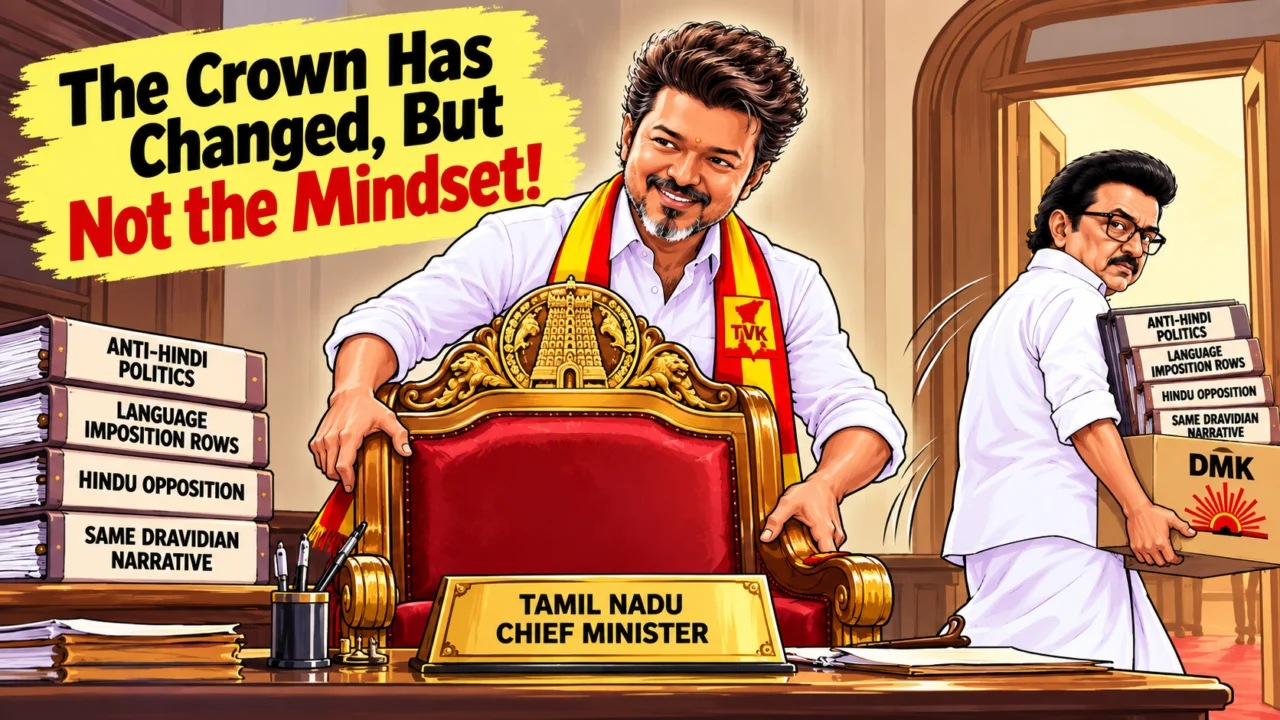
The consequence of the Stalin government blatantly ignoring the interim order issued last year (December 15, 2025) to identify land for Central Government Navodaya schools in every district resulted in his crushing defeat in the Kolathur constituency and the ultimate loss of state power! Is the current Chief Minister Joseph Vijay going to blindly follow Stalin’s disastrous path? Or will he return to the path of the people? Only time will tell.
While acknowledging that “The standard of education in Tamil Nadu remains high compared to other states, and Navodaya schools will in no way diminish Tamil Nadu’s educational standards,” the Supreme Court bench issued a stern warning: “India is a nation inclusive of all states. You might oppose Navodaya schools today; but what will happen if every state starts opposing Central Government policies tomorrow? It has been 9 months since we issued the order, yet you haven’t identified the land for the schools. We thought there would be a change in the state government’s mindset after the regime change in Tamil Nadu. But it doesn’t seem like the mindset has changed at all! Therefore – first, change your attitude!”
The two-language policy was merely a reflection of Arignar Anna’s specific political era. There is not an iota of language imposition in today’s India; education firmly remains on the Concurrent List. The two-language policy is actively implemented in schools run by the Tamil Nadu government, and equal respect is afforded to the Tamil language in schools run by the Central Government. Will the Tamil language face extinction simply because students learn an additional language? Has the mother tongue of any state been marginalized or destroyed in the Central Government schools that have been functioning across other Indian states for the past 40 years?
It would be wise for Chief Minister Joseph Vijay, who rightfully rejected Periyar’s atheistic ideologies, to also accept timely, modern upgrades to the two-language policy introduced by Anna 59 years ago, thereby respecting the true aspirations of today’s students. The noble Mahatma Gandhi’s strict non-violence and satyagraha are not entirely viable defense strategies today – if we relied solely on them, Pakistan would plunder and tear us apart! Tamil Nadu stands uniquely tall in education in India primarily because the ancient Gurukulam and Thinnai (porch) schooling systems have existed here since the very dawn of the Tamil civilization. No incompetent political opportunists have the right to claim credit for this legacy. Those who orchestrated multi-crore scams in educational funds, and those who appointed middlemen to extort between ₹100 crore to ₹500 crore to extend recognitions and approve additional infrastructure for 177 private schools, need not shed crocodile tears now. The people of Tamil Nadu are in no mood to forgive you!