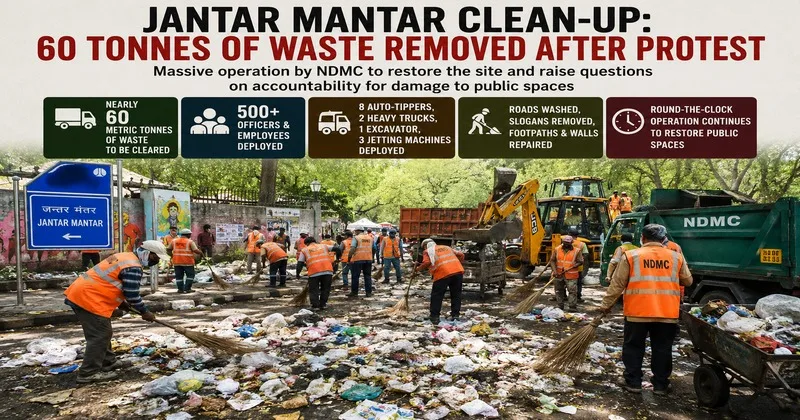
New Delhi: The conclusion of the Cockroach Janta Party’s (CJP) protest at Delhi’s Jantar Mantar may have marked the end of a political agitation, but it also signalled the beginning of another massive exercise—restoring one of the capital’s busiest public spaces. As the New Delhi Municipal Council (NDMC) deployed hundreds of workers and heavy machinery to clear nearly 60 metric tonnes of waste, the episode has once again highlighted an often-overlooked consequence of large public protests: the financial and civic burden of cleaning up after they end.
Sixty metric tonnes of waste thrown and left behind by CJP at Jantar Mantar after protest.
Massive deployment of human and machine resources by NDMC to clean the waste. pic.twitter.com/HJshTpok9o
— Megh Updates 🚨™ (@MeghUpdates) July 26, 2026
A Massive Restoration Exercise
The NDMC launched a large-scale clean-up operation immediately after protesters dispersed on Saturday following the resignation of Education Minister Dharmendra Pradhan over the NEET paper leak controversy.
Jantar Mantar Protest site is almost cleared pic.twitter.com/OCfNnS155D
— Megh Updates 🚨™ (@MeghUpdates) July 26, 2026
NDMC Vice Chairman Kuljeet Singh Chahal, accompanied by senior officials, reached the protest site soon after the demonstration concluded and supervised restoration work through the night. Officials from the Health & Sanitation, Civil Engineering and Horticulture Departments coordinated an extensive operation involving more than 500 officers and employees.
The exercise extended well beyond simple garbage collection. Civic workers undertook road washing, removal of protest slogans from public walls, repair of damaged footpaths and kerbstones, restoration of green belts and landscaping, and cleaning of adjoining roads. The operation covered Jantar Mantar as well as Tolstoy Marg, Sansad Marg, Jai Singh Marg and parts of Connaught Place, reflecting the widespread impact of the gathering.
Mountains of Waste Left Behind
According to NDMC officials, nearly 60 metric tonnes of mixed waste was expected to be removed from the protest site and surrounding areas. Officials said around 40 metric tonnes had already been cleared by Saturday night, while another 12 metric tonnes were removed on Sunday morning. The remaining waste was expected to be lifted during the day.
The waste included discarded food packets, plastic bottles, paper cups, banners, cloth material, construction debris, stones and other solid waste generated during the course of the protest. Even before the protest concluded, municipal authorities had observed a sharp rise in daily waste generation. On July 24 alone, approximately 27 metric tonnes of waste was collected, almost double the 15 metric tonnes removed a day earlier.
Jantar Mantar: A few stray dogs are still there but it's mostly clear… pic.twitter.com/QXNKz2tWue
— Mr Sinha (@Mrsinha) July 26, 2026
To handle the enormous volume, the NDMC deployed eight auto-tippers, two heavy trucks, an excavator, three pressure jetting machines, mechanical road sweepers and dozens of sanitation workers working in shifts throughout the night.
The Hidden Cost of Public Demonstrations
The images of sanitation workers clearing mountains of garbage have drawn attention to a question that surfaces after almost every major public gathering: Who pays for restoring public spaces?
Municipal bodies function with finite manpower and limited budgets. When hundreds of sanitation workers and engineers are diverted to a large clean-up operation, routine civic services across other parts of the city may also be affected. Public funds are spent not only on collecting waste but also on repairing damaged infrastructure, repainting walls, washing roads and restoring parks and landscaped areas. Unlike temporary inconveniences caused by traffic diversions, these restoration exercises often continue long after protests conclude, requiring substantial deployment of labour, machinery and public resources. The cost is ultimately borne by civic agencies funded through taxpayers’ money unless specific mechanisms exist to recover expenses from organisers or those responsible for damage.
Garbage strewn across roads, damaged pavements, defaced public walls and destroyed green spaces create an additional burden for municipal workers who must restore these areas before they can be used again by the public.
The events at Jantar Mantar raise several policy questions that have surfaced repeatedly after large demonstrations across India. Should organisers of protests involving thousands of participants be required to submit waste-management plans before obtaining permission? Should organisers be held financially liable when civic agencies incur extraordinary expenditure because of littering or vandalism? Should volunteers associated with protest groups participate in post-event clean-up efforts as part of civic responsibility? These are questions that extend far beyond any single protest or political organisation.
The clean-up operation also highlighted the role played by municipal workers who often work through the night under difficult conditions. Sanitation workers, engineers, machine operators and horticulture staff laboured continuously to clear waste, wash roads, remove graffiti and restore damaged public spaces so that normal civic life could resume quickly. Such operations rarely receive the same public attention as the protests themselves, despite involving enormous logistical coordination and physical effort.
As NDMC workers complete the restoration of Jantar Mantar, the incident leaves behind a question that goes beyond politics: Should the responsibility for cleaning and restoring public spaces after large protests continue to fall entirely on civic agencies and taxpayers, or is it time to evolve a framework that makes organisers and participants more accountable for the civic footprint of mass demonstrations?