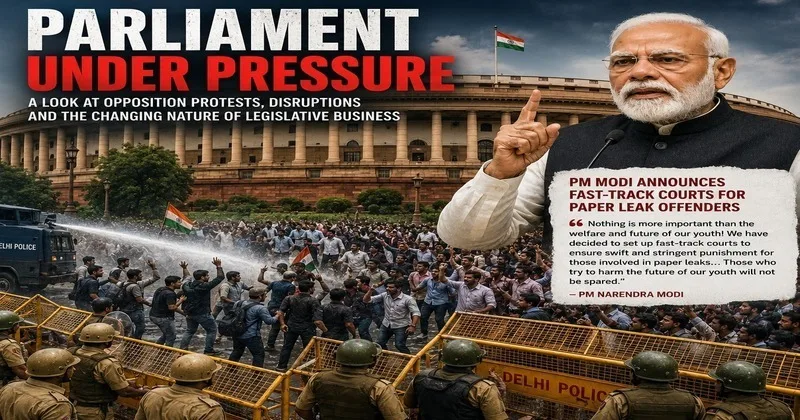
New Delhi: The Centre’s assurance that Parliament will discuss the alleged NEET-UG paper leak and hold a meeting with activist Sonam Wangchuk has temporarily lowered tensions. However, the larger story extends far beyond one session. Over the last several years, Parliament has increasingly become a battleground where the Opposition has relied on protests and disruptions to force discussions on politically sensitive issues, while the government has accused it of obstructing legislative business.
A New Parliamentary Pattern
India’s Parliament has witnessed a steady rise in confrontational politics since 2021. Instead of debates occupying the centre stage, slogan-shouting, walkouts, adjournments and protests inside and outside the Houses have become common features of almost every major session. The opposition argues that disruptions are often the only way to compel the government to discuss issues it seeks to avoid. The government counters that Parliament already provides procedural mechanisms for debate and that repeated disruptions undermine democracy by preventing legislative work.
2021: Pegasus and Farm Laws
During the 2021 Monsoon Session, the Opposition staged sustained protests demanding discussions on the Pegasus spyware allegations, the farmers’ agitation against the three farm laws, and rising fuel prices. The protests led to repeated adjournments and disruptions in both Houses. Despite the interruptions, Parliament continued with legislative business and several Bills were passed during the session. The prolonged standoff between the government and the Opposition made the session one of the most disrupted in recent years, with legislative proceedings and debates taking place amid frequent protests.
2022: Inflation and Price Rise
During the 2022 Monsoon Session, Parliament witnessed frequent disruptions as the Opposition sought discussions on several issues of national importance. These included rising inflation, the imposition of GST on certain essential commodities, and the Agnipath recruitment scheme.
Opposition MPs staged protests in both Houses, leading to repeated adjournments during the initial days of the session. The disruptions affected the scheduled business on several occasions. Subsequently, both the Lok Sabha and the Rajya Sabha held discussions on inflation. Even after the debate, protests continued over other issues raised by the Opposition. Despite the interruptions, Parliament continued to take up legislative and official business during the session.
2023: Manipur Dominates Parliament
The 2023 Monsoon Session witnessed repeated disruptions as Opposition parties pressed for an extensive discussion on the ethnic violence in Manipur and sought a detailed statement from Prime Minister Narendra Modi. The government maintained that it was prepared to discuss the issue through established parliamentary procedures and subsequently facilitated discussions in Parliament. However, frequent slogan-shouting, protests and adjournments affected the functioning of both Houses, with the government contending that repeated disruptions hindered legislative business.
During the Winter Session, attention shifted to the security breach inside Parliament on December 13, 2023, when two individuals entered the Lok Sabha chamber during proceedings. The incident prompted the government to strengthen security measures across the Parliament complex and initiate a review of security protocols. Amid continued disruptions and protests in both Houses, more than 140 Opposition MPs were suspended under parliamentary rules for alleged misconduct and obstructing proceedings. The government maintained that the action was taken to uphold parliamentary discipline and ensure the smooth functioning of the legislature, while legislative business continued despite the political standoff.
2024: Elections, NEET and Accountability
Following the 2024 Lok Sabha elections, Parliament reconvened amid an intensified political atmosphere. The alleged NEET-UG paper leak emerged as one of the key issues raised by the Opposition during the session. Opposition parties sought a detailed discussion on the examination process and its impact on students. They also demanded greater accountability in the conduct of national-level entrance examinations and called for the resignation of Union Education Minister Dharmendra Pradhan.
The issue led to repeated protests and adjournments in both Houses during the initial days of the session. The government agreed to hold a discussion on the matter in Parliament while maintaining that the issue should be debated through established parliamentary procedures. The session highlighted the importance of education-related concerns in parliamentary proceedings, with both sides expressing their views during debates and discussions.
2025: Operation Sindoor and Border Issues
The 2025 Monsoon Session began with frequent disruptions during its opening week as the Opposition sought discussions on several key national issues. These included national security, Operation Sindoor, the Pahalgam developments, and aspects of India’s foreign policy. Opposition members raised these matters in both Houses, leading to repeated adjournments in the initial days of the session.
Parliamentary proceedings were affected as protests continued over demands for dedicated discussions. The government maintained that important issues could be taken up through established parliamentary procedures. As the session progressed, structured debates on several matters were scheduled, and normal legislative business gradually resumed.
2026: NEET and Sonam Wangchuk
The current Monsoon Session has also witnessed intense protests outside Parliament, with demonstrations in Delhi over education-related issues drawing national attention. What began as a protest centred on concerns over examinations and education policy soon escalated into clashes between demonstrators and security personnel, turning the agitation into a major political and law-and-order issue.
On July 19, protesters attempted to march towards Parliament while the Monsoon Session was underway. As the Parliament complex is a high-security zone during sessions, Delhi Police deployed multiple layers of security and erected barricades to restrict movement. According to police, sections of the crowd attempted to breach these barricades, leading to confrontations. The clashes resulted in stone-pelting, damage to public property and injuries to more than 100 police personnel, while several police vehicles, buses and barricades were also damaged.
The protest was organised under the banner of the Cockroach Janata Party (CJP) and was initially presented as a movement highlighting student concerns, particularly issues relating to examinations. However, the incident soon sparked a political debate over the nature and composition of the protest. Several political commentators and reports alleged that the mobilisation involved organised political workers and activist groups in addition to students. These allegations remain contested, and no official investigation has conclusively established the extent of participation by any particular organisation.
Opposition’s Strategy
The protest witnessed the participation of workers and supporters from several opposition parties and affiliated organisations, including the Samajwadi Party (SP), Aam Aadmi Party (AAP), the Azad Samaj Party, and Left-affiliated student organisations from institutions such as Jawaharlal Nehru University (JNU), Delhi University, and Jamia Millia Islamia.
Following the violence, authorities launched investigations into the planning, coordination and funding of the protest. Investigative agencies are examining CCTV footage, social media content, digital communications and other evidence to identify individuals allegedly involved in the clashes and damage to public property. Officials are also assessing the financial loss caused by the vandalism and have indicated that action will be taken against those found responsible in accordance with the law.
PM Modi announces fast-track courts for paper leak offenders
Amid intensifying protests against the Centre over the NEET paper leak issue, Prime Minister Narendra Modi on Thursday emphasised the importance of the youth’s future, announcing that fast-track courts will be set up to ensure swift and stringent punishment for those involved in paper leaks.
Nothing is more important than the welfare and future of our youth!
We have decided to set up fast-track courts to ensure swift and stringent punishment for those involved in paper leaks. Have directed the concerned authorities and officials to take all necessary steps in this…
— Narendra Modi (@narendramodi) July 23, 2026
In a post on X, PM Modi stated that those involved in compromising the future of the youth “will not be spared,” adding that relevant authorities have been directed to take all necessary measures.
“Nothing is more important than the welfare and future of our youth! We have decided to set up fast-track courts to ensure swift and stringent punishment for those involved in paper leaks. Have directed the concerned authorities and officials to take all necessary steps in this regard. This continues our series of steps for safeguarding the interests of students. Those who try to harm the future of our youth will not be spared,” PM Modi wrote.