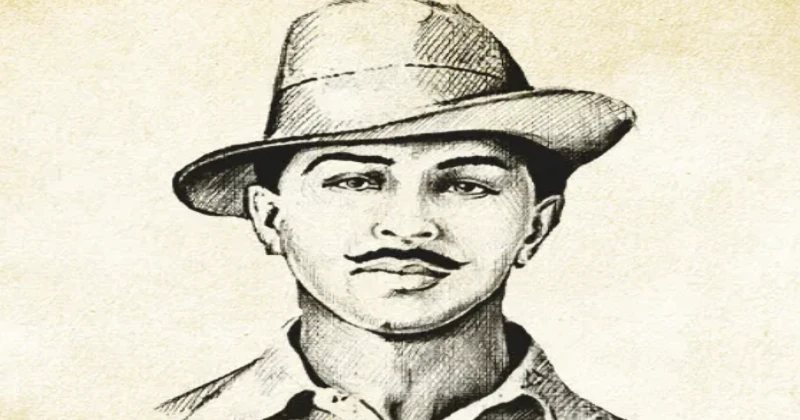
In the fragrance of the soil, a name becomes immortal,
When the nation calls its heroes, even blood takes a solemn vow.
The noose of death turned into flowers when Mother India smiled,
And the brave Bhagat offered his life with a smile, like her devoted child.
Neither the fear of death nor the attachment to life,
Every breath and every resolve was devoted to Mother India.
That young man set out to change the course of history,
At an age meant for play,
He chose instead
The path of sacrificing his life for the motherland.
He departed, but his ideas remained;
He fell silent, but his roar still echoes.
His body perished, but in history
His immortal call lives forever
Inquilab Zindabad!
Victory to Mother India!
Bhagat Singh: Not Just a Name, But an Idea
The history of India’s freedom struggle is filled with countless stories of sacrifice. Among the many brave souls who laid down their lives for the nation, there are a few names that transcend the boundaries of time and continue to inspire generations.
Shaheed-e-Azam Bhagat Singh is one such immortal name. Bhagat Singh’s life was short, but his influence was extraordinary. In just a few years of his life, he accomplished what could have taken generations to achieve.
He was not merely a revolutionary. He was a thinker, an avid reader, a writer with a strong journalistic spirit, a champion of social transformation and, above all, a young intellectual who viewed India’s freedom as inseparable from human liberation and social justice.
His life teaches us that patriotism is not merely a matter of emotion. Patriotism is sacrifice, responsibility, thought and the resolve to place the interests of the nation above personal interests when the situation demands it.
A Childhood Dedicated to the Motherland
Bhagat Singh was born into a family where patriotism was an integral part of life. Several members of his family were associated with India’s freedom movement. From an early age, he witnessed and experienced the atrocities of British rule. The Jallianwala Bagh massacre left a deep impression on his young mind.
It is widely believed that this tragic event strengthened his determination to fight against British rule.
For Bhagat Singh, India was not merely a geographical territory. India was his mother, his identity, his self-respect and the supreme purpose of his life. That is why, at a very young age, he decided that his life would not be devoted to personal comfort and happiness, but to the service of the nation.
Youth and the Path of Revolution
When Bhagat Singh entered his youth, India’s freedom movement was taking a new direction.
On one side was the non-violent mass movement, while on the other, revolutionary organisations were challenging British rule. Bhagat Singh chose the revolutionary path, but his revolutionary thinking was not limited merely to weapons and violence. He was a deep thinker. He reflected seriously on society, politics, economics, religion, exploitation and freedom. He believed that merely driving the British out of India would not be enough.
In an independent India, exploitation, inequality and injustice would also have to be eliminated. In his vision, true freedom meant a society in which every individual had dignity, equality and opportunity.
“Inquilab Zindabad”: Not Just a Slogan, But an Idea of Transformation
Bhagat Singh’s name became immortal with the slogan: “Inquilab Zindabad!”
But for him, revolution did not simply mean a change of political power. Revolution meant:
Change in thought.
Change in the system.
Change in society.
A struggle against injustice.
Freedom from exploitation.
And the establishment of human dignity.
From this perspective, Bhagat Singh’s revolutionary ideas remain relevant even today. For the present generation, revolution does not mean violence.
- It can mean positive transformation.
- Integrity against corruption,
- Education against ignorance,
- Scientific thinking against superstition,
- Social harmony against discrimination,
- Opportunities against poverty,
- And constitutional struggle against injustice
These are the true forms of revolution in our times.
The Assembly Bombing and Bhagat Singh’s Message
The incident involving Bhagat Singh and Batukeshwar Dutt throwing bombs in the Central Legislative Assembly is one of the most widely discussed episodes in the history of India’s freedom struggle. It is important to understand that the objective of the act was not to kill anyone. The revolutionaries deliberately used bombs of limited intensity to avoid widespread loss of life.
Their purpose was to make their voice heard by a deaf and oppressive government. After the incident, they did not flee. They willingly courted arrest. This was part of their political message. They wanted to turn the courtroom and the prison into platforms for communicating their ideas. Their objective was to make the people understand that India’s freedom was not merely the demand of a few leaders; it was the aspiration of millions of Indians.
The idea that remained alive behind prison walls
For Bhagat Singh, prison was not merely a place of confinement. It also became a place of study and reflection.
He read numerous books in prison and continued to write and develop his ideas. He studied history, politics, socialism, philosophy and revolutionary thought from around the world. His writings clearly demonstrate that he was not merely an emotional revolutionary, but a deeply intellectual personality.
His essay “Why I Am an Atheist” reflects the depth of his thinking. In it, he explored questions related to faith, reason and independent human thought. His intellectual freedom offers an important message to today’s youth:
Ask questions. Use reason. Read. Think.
And do not accept an idea unthinkingly merely because it has been passed down through tradition.
The Courage to Embrace Death
One of the most remarkable aspects of Bhagat Singh’s life was his attitude toward death. He did not view death as something to be feared. When he came to know that his life would end on the gallows, he did not surrender to fear. His life had risen above individual existence and merged into a larger purpose. He had dedicated his life to the motherland.
However, it is important to understand that Bhagat Singh was not in love with death. He understood the value of life. He knew that life was essential for bringing about change. The meaning of his martyrdom is not the glorification of death, but the spirit of making the highest sacrifice for a noble cause.
For the youth, his message is clear:
Make your life meaningful by dedicating it to a purpose greater than yourself.
Martyrdom: When Death Became History
On March 23 1931, Bhagat Singh, Rajguru and Sukhdev were executed. They were extremely young. At an age when most young people dream about their personal futures, these young revolutionaries sacrificed their present for the future of the nation. Their martyrdom shook the entire country. From villages to cities, from the young to the elderly, people across India spoke about their sacrifice.Their bodies perished, but their ideas became immortal.
An attempt was made to silence their voices, but that voice continues to echo even today: Inquilab Zindabad!
Bhagat Singh’s Patriotism: Relevant Today, Tomorrow and for Generations to Come
Bhagat Singh’s patriotism is not merely a story of the past. It remains equally relevant today.
In the present era, patriotism does not mean only fighting on the battlefield.
Today, patriotism means:
- Doing one’s work honestly.
- Paying taxes honestly.
- Respecting the law.
- Being sensitive toward the weaker sections of society.
- Protecting the environment.
- Strengthening democracy.
- Respecting constitutional values.
- Eliminating discrimination and hatred.
- Promoting knowledge and science.
- Protecting public property and national resources.
- And understanding one’s duties along with one’s rights.
This can be considered the true modern interpretation of Bhagat Singh’s patriotism.
Bhagat Singh’s Greatest Message for the Youth
Bhagat Singh is a hero of the youth. But limiting him merely to posters, photographs and slogans would be an injustice to his ideas. Bhagat Singh wanted young people to read, think and question. He wanted them to understand the problems of their time. He wanted them to raise their voices against injustice. He wanted young people to become agents of social transformation.
Today’s generation faces many new challenges.
In the digital age, there is an overwhelming flow of information, but the need for wisdom and discernment is greater than ever.
Social media is filled with countless opinions, but the importance of independent thinking has become even greater. The greatest message that today’s youth can learn from Bhagat Singh is this:
- Do not accept any idea blindly.
- Read, understand, reason and then make your own decision.
Bhagat Singh Will Continue to Guide Future Generations
Time changes.
Generations change.
Technology changes.
Politics changes.
But certain values never become outdated.
Freedom.
Justice.
Equality.
Self-respect.
Patriotism.
And the struggle against injustice.
These are the values that will continue to make Bhagat Singh an inspiration for generations to come.
If today’s youth remembers Bhagat Singh only through his pistol and the gallows, they will understand only a small part of his personality.
To understand Bhagat Singh, one must understand his books.
- One must read his writings.
- One must study his ideas.
- One must understand his social philosophy.
- One must embrace his scientific outlook.
- And, most importantly, one must connect the patriotism in his heart with one’s own actions and responsibilities.
A New Pledge of Patriotism
When we remember Bhagat Singh today, we must resolve that patriotism will not remain confined to celebrations and slogans.
We will place the national interest in our lives.
We will make knowledge our weapon.
We will make truth our path.
We will respect the Constitution and democracy.
We will work for equality and social harmony.
We will promote scientific thinking instead of superstition.
We will respect the diversity of our nation.
We will protect nature.
And we will ensure that our lives are not limited merely to personal success, but also contribute meaningfully to society and the nation.
A Final Tribute: Bhagat Singh Is Immortal
Bhagat Singh was sentenced to death, but his ideas could never be executed.
His body could be destroyed, but his dreams could not.
His voice could be suppressed, but his ideas could not.
His life was short, but his dream was immense.
That dream was of an independent, just, equal and self-respecting India.
As we remember the great heroes of India’s freedom struggle on occasions of national remembrance, the martyrdom of Bhagat Singh reminds us that nation-building does not happen only through the sacrifices of heroes of the past; it also depends upon the sense of duty of the present generation.
Therefore, this is the message for today’s youth:
Let there be a book in your hands,
A dream in your eyes,
Ideas in your mind,
Integrity in your actions,
The nation in your heart,
And a purpose in your life that goes beyond personal success
To the progress of society and the nation.
This is the true tribute to Bhagat Singh.
Let us not merely remember his sacrifice
Let us bring his ideas into our lives.
Let us not merely chant his name
Let us contribute to building the India he dreamed of.
Let us transform his idea of “Inquilab” not into violence,
But into a symbol of knowledge, reason, justice and positive transformation.
Because
Bhagat Singh is not merely a chapter of the past.
He is a living force in India’s youth consciousness
And an inspiration for the India of tomorrow.
As long as a young person in India stands against injustice,
As long as a student lights the torch of knowledge and reason,
As long as a citizen places the national interest above selfish motives,
As long as a young person dreams of making the country better—
Bhagat Singh will remain alive.
His martyrdom is immortal.
His patriotism is immortal.
His ideas are immortal.
And his name will forever remain immortal in the consciousness of India’s youth.
Inquilab Zindabad! Long Live Shaheed-e-Azam Bhagat Singh!