Jallianwala Bagh Tragedy Anniversary: Legacy of sacrifice
July 21, 2026
  • Read Ecopy
  • Circulation
  • Advertise
  • Careers
  • About Us
  • Contact Us
Android AppiPhone AppArattai
Organiser
  • ‌
  • Bharat
    • Assam
    • Bihar
    • Chhattisgarh
    • Jharkhand
    • Maharashtra
    • View All States
  • World
    • Asia
    • Europe
    • North America
    • South America
    • Africa
    • Australia
  • Editorial
  • International
  • Opinion
  • RSS @ 100
  • More
    • Op Sindoor
    • Analysis
    • Sports
    • Defence
    • Politics
    • Business
    • Economy
    • Culture
    • Special Report
    • Sci & Tech
    • Entertainment
    • G20
    • Azadi Ka Amrit Mahotsav
    • Vocal4Local
    • Web Stories
    • Education
    • Employment
    • Books
    • Interviews
    • Travel
    • Law
    • Health
    • Obituary
  • Subscribe
    • Subscribe Print Edition
    • Subscribe Ecopy
    • Read Ecopy
  • ‌
  • Bharat
    • Assam
    • Bihar
    • Chhattisgarh
    • Jharkhand
    • Maharashtra
    • View All States
  • World
    • Asia
    • Europe
    • North America
    • South America
    • Africa
    • Australia
  • Editorial
  • International
  • Opinion
  • RSS @ 100
  • More
    • Op Sindoor
    • Analysis
    • Sports
    • Defence
    • Politics
    • Business
    • Economy
    • Culture
    • Special Report
    • Sci & Tech
    • Entertainment
    • G20
    • Azadi Ka Amrit Mahotsav
    • Vocal4Local
    • Web Stories
    • Education
    • Employment
    • Books
    • Interviews
    • Travel
    • Law
    • Health
    • Obituary
  • Subscribe
    • Subscribe Print Edition
    • Subscribe Ecopy
    • Read Ecopy
Organiser
  • Home
  • Bharat
  • World
  • Operation Sindoor
  • Editorial
  • Analysis
  • Opinion
  • Culture
  • Defence
  • International Edition
  • RSS @ 100
  • Magazine
  • Read Ecopy
Home Bharat

Anniversary of Jallianwala Bagh Massacre: From bloodshed to national awakening; Turning point in freedom struggle

Records of the British Raj admit that 200 people were injured and 379 people were martyred in this incident, of which 337 were men, 41 were minor boys, and one was 6-week-old

WEBDESKWEBDESK
Apr 13, 2026, 07:00 am IST
in Bharat, World, India, Punjab
Follow on Google News
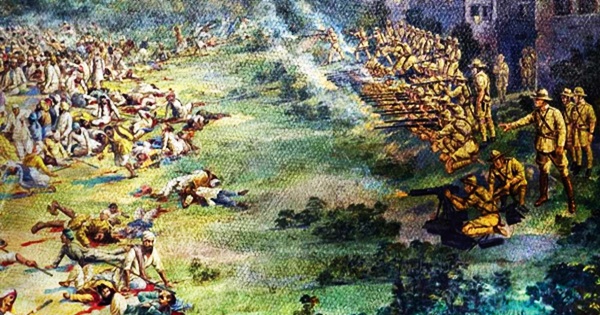
The soldiers surrounded the garden and started firing on unarmed people without giving any warning and a total of 1650 rounds were fired in 10 minutes

The soldiers surrounded the garden and started firing on unarmed people without giving any warning and a total of 1650 rounds were fired in 10 minutes

FacebookTwitterWhatsAppTelegramEmail

On April 13 2019, exactly a century, that is, even after 100 years, when we Indians, Jallianwala Bagh incident occurred in Amritsar on the Baisakhi day of April 13 1919, we will remember how many innocent countrymen did not know that day (13-04-1919) Was martyred, and on the same day, the whole of Punjab’s land was moaned, in which Colonel Reginald Edward Harry Dyer, an officer of the British army who was made temporary brigadier general (Who ordered the Indian soldiers recruited by the British Government to shoot) and this Dyer was responsible for this massacre.

When the group gathered in that garden was fired, then there was no way for the people to escape from there. Countless people, including men, women and young children, were martyred. On the plaque in the garden, it is written that 120 bodies were found only from the well. Curfew was imposed in the city, as a result of which the injured could not be taken for treatment. People succumbed painfully there. The Deputy Commissioner’s Office of Amritsar has a list of 484 martyrs, while the Jallianwala Bagh has a list of 388 martyrs. Records of the British Raj admit that 200 people were injured and 379 people were martyred in this incident, of which 337 were men, 41 were minor boys, and one was a 6-week-old.

Why did the incident of Jallianwala Bagh happen?

The Rowlatt Act (Black Law) was enacted by the British Government of India in March 1919 to crush the national movement emerging in India. This law was made on the basis of the recommendations of the Sedison Committee headed by Sir Sydney Rowlett.

According to this law, the British government had the right to lock any Indian in jail without prosecuting them in court. Under this law, the offender’s right to know the name of the person filing the case against him was also abolished. Countrywide strikes, processions and demonstrations started in protest against this law. Gandhiji called for a comprehensive strike.

On April 13, a crowd gathered in Jallianwala Bagh to protest the arrest of Saifuddin Kichlu and Satyapal. It was the day of Baisakhi, and a meeting was held at Jallianwala Bagh, where some leaders were going to give speeches. There was a curfew in the city, yet hundreds of people came to see the fair and visit the city with their families on the occasion of Baisakhi, after hearing news of the meeting. The soldiers surrounded the garden and started firing on unarmed people without giving any warning. A total of 1650 rounds were fired in 10 minutes. There was no way to escape. Some people jumped into the only well in the field to save their lives, but it, too, was also buried with corpses.

Jallianwala Bagh was once the property of a man named Jalali. Gurudev Ravindra Nath Tagore returned his knighthood as a protest against this massacre. When this murder case was happening in Jallianwala Bagh, Udham Singh was present there, and he was also shot. He then decided to avenge it. On March 13 1940, Udham Singh shot and killed Dyer, convicted of the incident at Caxton Hall, London. Udham Singh was hanged on July 31 1940.

After the Jallianwala Bagh scandal, the whole of India is patriotic together:

The people’s courage for independence was not defeated, even after such a horrific event. In fact, after this incident, the desire to gain independence began to take on greater vigour among the people. Although the present means of communication and mutual communication could not have been imagined in those days, this news spread like wildfire all over the country. The desire for freedom, not only in Punjab but also across the whole country, began to be voiced by children. Thousands of Indians of that era were determined to liberate the country by planting the soil of Jallianwala Bagh with their foreheads. Till then, Punjab had been different from the rest of India, but this incident completely merged Punjab with the Indian independence movement.

In memory of those killed at Jallianwala Bagh, it was decided to build a memorial here. In 1920, a trust was established, and the site was purchased. The memorial was inaugurated by the then President of India, Rajendra Prasad, on April 13, 1961, in the presence of Jawaharlal Nehru and other leaders. Bullet holes are also visible on walls and nearby buildings at this time. The well into which many people jumped to protect themselves is a protected monument inside the park. Bhagat Singh was 12 years old when the Jallianwala Bagh massacre took place, and this incident had a profound impact on his thinking. On receiving this information, Bhagat Singh walked 12 miles from his school to Jallianwala Bagh.

Topics: AmritsarColonel Reginald Edward Harry DyerUdham SinghThe Rowlatt ActMahatma GandhiBhagat SinghPunjabJallianwala Bagh
Share27TweetSendShareSend
✮ Subscribe Organiser YouTube Channel. ✮
✮ Join Organiser's WhatsApp channel for Nationalist views beyond the news. ✮
Previous News

India rejects China’s attempt to rename regions in Arunachal Pradesh; Says, false claims cannot alter reality

Next News

Keralam: Anant Ambani funds restoration of Malappuram Mandirs linked to Tipu campaigns and 1921 Malabar rebellion

Related News

Batukeshwar Dutt

Batukeshwar Dutt Death Anniversary: The revolutionary who fought for India’s freedom & then for his own dignity

Prime Minister Modi addresses public gathering in Punjab

Punjab: Centre committed to the development of state despite no BJP government, says PM Modi

Punjab's politics is still shaped by the legacy of the 1980s and 1990s, even as governance and development dominate elections

The Politics of Memory in Punjab: Why the legacy of the 1990s continues to influence elections & governance

July 6 & 7, 1987 | Punjab to Haryana: 48 hours of Khalistani terror that shook India

Representative image (This is an AI generated image)

Ahmedabad Riots 1946: Revisiting Gandhi’s controversial “if few lakhs are killed’ remark

Prime Minister Narendra Modi: A sincere effort to translate Gandhi’s philosophy of antyodaya into practice

Load More

Latest News

Viral social media posts falsely claimed that India's first hydrogen-powered train suffered a technical failure

Fact Check: Routine servicing of India’s Hydrogen train misconstrued as indigenous tech failure in viral video

ABVP demands immediate INSPIRE SHE scholarship release, flags delay affecting thousands of science students

A CJP protest in Delhi turned violent, injuring police personnel, damaging government property, and triggering an investigation

CJP Protest in Delhi Turns Violent: Police injured, government property damaged; Investigation underway

Britain's market opens wider as India's textile sector gains a long-awaited competitive edge

India-UK CETA: Duty-Free access set to double textile exports, adding $1.6 billion, challenging China and Bangladesh

Representative Image

Pune Horror: 4 Muslim men Farhan, Fazal, Rehan & Sahil arrested for year long rape and blackmail of college student

Congress supremo Rahul Gandhi

If Rahul Gandhi backed Sonam Wangchuk, why did he never visit the CJP protest at Jantar Mantar?

Senior IPS officer G S Rao

Tripura govt appoints G S Rao as in-charge DGP after Anurag Dhankar found dead at police headquarters

Dipke was at NCP-SP leader Anish Gawande's house when Delhi Police detained him

Who is Anish Gawande? NCP (SP) spokesperson at whose house CJP founder Abhijeet Dipke was staying during Delhi protest

When Indira Gandhi government killed hundreds of Sadhus and Gau rakshaks

Do you know, Indira Govt killed thousands of sadhus & Gaurakshaks? Revisiting Jantar Mantar to Parliament march of 1966

Over 50 police and paramilitary personnel sustain injuries in the violence.

CJP protest breaches barricades, sparks violent clashes in Delhi; Over 118 police personnel hurt

Load More
  • Privacy
  • Terms
  • Cookie Policy
  • Refund and Cancellation
  • Delivery and Shipping

© Bharat Prakashan (Delhi) Limited.
Tech-enabled by Ananthapuri Technologies

  • Home
  • Search Organiser
  • Bharat
    • Assam
    • Bihar
    • Chhattisgarh
    • Jharkhand
    • Maharashtra
    • View All States
  • World
    • Asia
    • Africa
    • North America
    • South America
    • Europe
    • Australia
  • Editorial
  • Operation Sindoor
  • Opinion
  • Analysis
  • Defence
  • Culture
  • Sports
  • Business
  • RSS @ 100
  • Entertainment
  • More ..
    • Sci & Tech
    • Vocal4Local
    • Special Report
    • Education
    • Employment
    • Books
    • Interviews
    • Travel
    • Health
    • Politics
    • Law
    • Economy
    • Obituary
  • Subscribe Magazine
  • Read Ecopy
  • Advertise
  • Circulation
  • Careers
  • About Us
  • Contact Us
  • Policies & Terms
    • Privacy Policy
    • Cookie Policy
    • Refund and Cancellation
    • Terms of Use

© Bharat Prakashan (Delhi) Limited.
Tech-enabled by Ananthapuri Technologies