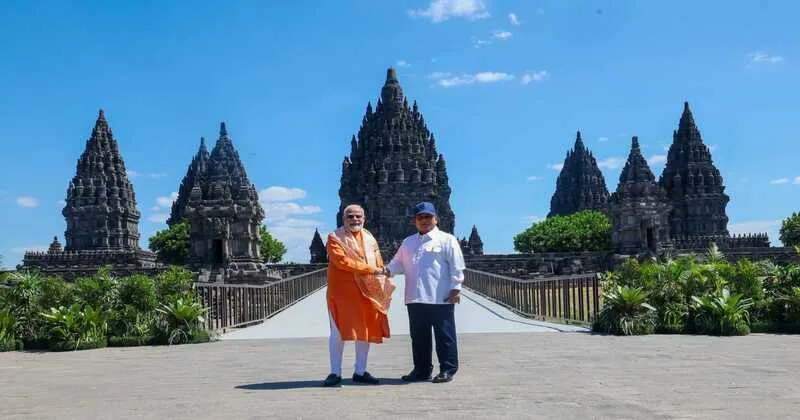
Prime Minister Narendra Modi’s visit to the Prambanan Mandir complex in Yogyakarta with Indonesian President Prabowo Subianto marked the revival of a civilisational partnership that stretches back nearly two millennia through maritime trade, religion, architecture, literature and cultural exchange.
The two leaders jointly inaugurated the Prambanan Temple Restoration Project, under which India’s Archaeological Survey of India (ASI) will assist Indonesia in conserving one of the world’s greatest Hindu Mandir complexes. Coming a day after both countries exchanged a Letter of Intent for the restoration initiative, the visit highlighted how heritage has become an important pillar of contemporary diplomacy alongside defence cooperation, trade and strategic engagement.
Standing before Indonesia’s largest Hindu Mandir, Modi praised Indonesia for preserving the monument across centuries and expressed confidence that more Indians would visit the sacred complex after the restoration work is completed. His visit symbolised India’s growing role not only as a strategic partner in the Indo-Pacific but also as a civilisational partner reconnecting with a shared historical legacy.
A mandir that preserves a shared heritage
The Prambanan Mandir Compound, a UNESCO World Heritage Site located around 17 kilometres northeast of Yogyakarta, represents one of the finest surviving examples of Hindu architecture outside the Indian subcontinent. Constructed during the ninth century under the Sanjaya dynasty of Central Java, the complex is dedicated to the Trimurti, Shiva, Vishnu and Brahma, with the towering Shiva Mandir rising nearly 47 metres above the surrounding plain.
The majestic Prambanan Temple! pic.twitter.com/pRS2S9X5gm
— Narendra Modi (@narendramodi) July 8, 2026
The Mandir’s elaborate stone carvings narrate episodes from the Ramayana and other Hindu traditions with remarkable artistic sophistication. The relief panels depict Rama, Sita, Hanuman and Ravana in a distinctly Javanese artistic style while retaining the narrative essence of the Sanskrit epic. The complex demonstrates that Indian ideas were never transplanted mechanically into Southeast Asia. Instead, they were adapted creatively, giving rise to a uniquely Indonesian expression of Hindu civilisation.
The restoration project launched during Modi’s visit therefore, carries significance beyond archaeology. It represents the joint preservation of a shared civilisational inheritance that belongs equally to Indonesia and India.
Maritime networks created the first bridge
Long before modern diplomacy or nation-states emerged, the Bay of Bengal connected eastern India with Southeast Asia through thriving maritime trade routes. Archaeological discoveries, inscriptions and literary sources indicate that Indian merchants regularly sailed from ports such as Tamralipti in Bengal, Kalingapatnam and Palur in present-day Odisha, Arikamedu in Tamil Nadu and Muziris in Keralam towards the Indonesian archipelago.
The ancient mariners depended on predictable monsoon winds, allowing them to cross the Bay of Bengal and establish commercial settlements across Southeast Asia. They carried textiles, beads, spices, ivory, metalwork and religious ideas while returning with camphor, cloves, sandalwood, gold and forest products.
Among these maritime centres, Kalinga occupies a particularly important position in India’s historical engagement with Indonesia. The famous Bali Jatra festival in Odisha continues to commemorate these overseas voyages. Every year, miniature boats are floated in rivers to honour the ancient sailors known as the Sadhabas, who crossed the seas towards Java, Sumatra and Bali. This living tradition reflects memories of commercial and cultural exchanges that flourished for centuries.
The Sanskrit expression Suvarnadvipa (Island of Gold) referred primarily to Sumatra, while Yavadvipa denoted Java in several ancient Indian texts. These names reveal that the Indian subcontinent possessed detailed geographical knowledge of the Indonesian archipelago long before the arrival of European explorers.
Sanskrit, kingdoms and cultural exchange
The spread of Indian civilisation across Southeast Asia did not occur through conquest. Instead, local rulers voluntarily adopted Indian political ideas, the Sanskrit language, religious practices and administrative traditions because they offered prestige and legitimacy.
One of the earliest pieces of evidence comes from the fourth-century Yupa inscriptions of Kutai in East Kalimantan. Written in Sanskrit using the Pallava script, these inscriptions commemorate King Mulavarman’s generous gifts to Brahmins and demonstrate that Indian religious traditions had already become deeply rooted in Indonesia by that period.
#WATCH | Indonesia: At Prambanan Temple in Yogyakarta, PM Narendra Modi says, "It is my good fortune that I always get an opportunity to connect to Lord Shiv. I was born in Vadnagar where Hatkeshwar Mahadev is located. Somnath Jyotirlinga is the first jyotirlinga, it is located… pic.twitter.com/NB79DUOIpA
— ANI (@ANI) July 8, 2026
Similarly, the Tarumanagara kingdom in western Java issued Sanskrit inscriptions praising its rulers through concepts drawn from Hindu political philosophy. Over time, Sanskrit became the language of royal courts, inscriptions and religious scholarship across much of maritime Southeast Asia.
The influence extended beyond religion into governance. Indian concepts of kingship, law, ceremonial rituals, calendars and court administration blended with indigenous traditions to create distinctive Southeast Asian political cultures. These kingdoms remained thoroughly Indonesian while selectively incorporating Indian intellectual traditions.
Historical records also preserve traditions concerning the Brahmin Kaundinya, who established a royal lineage in the kingdom of Funan in mainland Southeast Asia after marrying the local queen Soma. While historians recognise that the precise chronology of these legends cannot be verified, they reflect enduring memories of early cultural interactions between India and Southeast Asia rather than literal historical chronology.
Prambanan and the golden age of Hindu Java
Prambanan emerged during one of Java’s greatest political and cultural eras. The Sanjaya dynasty, patrons of Shaivism, constructed the magnificent Mandir complex in the ninth century while neighbouring Buddhist rulers built Borobudur. Together, these monuments demonstrate the remarkable coexistence of Hinduism and Buddhism in ancient Java.
The Shiva Mandir forms the architectural centrepiece, accompanied by Mandirs dedicated to Bhagwan Vishnu and Brahma, along with shrines honouring Nandi, Garuda and Hamsa. The layout reflects Hindu cosmological principles while adapting them to the volcanic landscape of Central Java.
The Ramayana reliefs carved along the Mandir walls remain among the finest visual representations of the epic anywhere in Asia. Even today, the internationally renowned Ramayana Ballet performed near Prambanan brings these ancient narratives to life before thousands of visitors annually.
This artistic continuity illustrates that Indian epics became integral components of Indonesian cultural identity rather than foreign imports. The stories evolved through local languages, artistic traditions and performance styles while preserving their moral and philosophical core.
The Ramayana beyond India’s borders
Few literary works have travelled as extensively as the Ramayana. Across Southeast Asia, the epic acquired new forms without losing its essential narrative.
Indonesia’s Kakawin Ramayana, composed in Old Javanese around the ninth century, remains one of the earliest and most influential adaptations. Although based largely on the Sanskrit Bhattikavya rather than Valmiki’s original text, it transformed the epic into a uniquely Javanese literary masterpiece.
इंडोनेशिया के प्रम्बानन मंदिर में ॐ नमः शिवाय! pic.twitter.com/AuHupT2vSO
— Narendra Modi (@narendramodi) July 8, 2026
In Bali, Hindu traditions continue to shape everyday religious life, while Ramayana narratives appear in mandir ceremonies, dance dramas and shadow puppet performances known as Wayang Kulit. UNESCO has recognised Wayang as an intangible cultural heritage of humanity.
Across Southeast Asia, related traditions include Thailand’s Ramakien, Cambodia’s Reamker, Laos’ Phra Lak Phra Ram and Myanmar’s Yama Zatdaw. Rather than indicating political domination, these adaptations reveal centuries of intellectual exchange through which Indian ideas became local cultural traditions.
Indonesia’s national airline bears the name Garuda, the mythical eagle associated with Bhagwan Vishnu, while Garuda also serves as the country’s national emblem. These symbols demonstrate how elements of India’s ancient cultural vocabulary have become inseparable from Indonesian national identity.
Shared heritage in contemporary diplomacy
India and Indonesia established a comprehensive strategic partnership in 2018, but their relationship increasingly draws strength from shared civilisational memory. Heritage conservation has become an important instrument of diplomacy alongside defence cooperation, maritime security, digital connectivity and trade.
The Archaeological Survey of India possesses considerable international experience in restoring monuments in countries such as Cambodia, Laos, Myanmar and Vietnam. Its assistance at Prambanan continues this tradition of cultural cooperation across Southeast Asia.
The restoration project also complements India’s broader Act East Policy and Indo-Pacific vision. While strategic cooperation addresses present-day geopolitical challenges, cultural diplomacy reinforces trust through centuries-old historical connections.
Indonesia, despite being the world’s largest Muslim-majority nation, has consistently celebrated its pre-Islamic civilisational heritage. Hindu-Buddhist monuments remain national treasures protected by the Indonesian state, reflecting an inclusive understanding of history that embraces multiple layers of cultural identity.
The decision by Jakarta and New Delhi to jointly restore Prambanan therefore, reflects mutual respect for this shared past while creating opportunities for tourism, academic collaboration, archaeological research and people-to-people exchanges.
Prime Minister Modi’s visit to Prambanan demonstrated that the relationship between India and Indonesia cannot be understood solely through contemporary geopolitics. Their connection predates modern borders, colonial empires and even many present-day states. Ancient merchants crossing the Bay of Bengal, Sanskrit inscriptions carved into Indonesian stone, Hindu mandirs rising above the plains of Java and Ramayana performances preserved across generations all testify to a civilisational dialogue that has endured for centuries.
The restoration of Prambanan represents more than the conservation of a historic monument. It is the restoration of historical memory itself. As India and Indonesia deepen cooperation in defence, maritime security, trade and the Indo-Pacific, they are simultaneously reaffirming a much older partnership forged through commerce, faith, scholarship and culture. The stones of Prambanan remind both nations that diplomacy rooted in shared civilisation possesses a depth that transcends changing political circumstances.
By preserving this remarkable mandir together, New Delhi and Jakarta are not merely protecting the past instead, they are strengthening the cultural foundations of a partnership that continues to evolve in the twenty-first century.