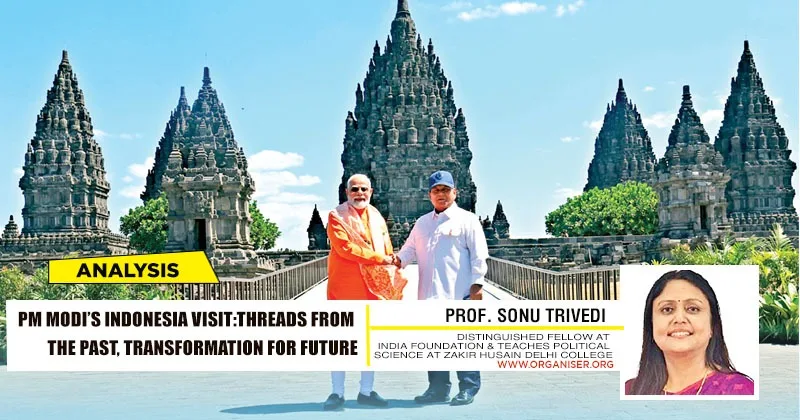
India and Indonesia relations have evolved into a robust, comprehensive strategic partnership, anchored by defence, maritime security, trade and cultural diplomacy. Both countries are making effective use of the historical ties between them, spanning from the maritime dominance of the Chola empire to the shared philosophy of Tagore and Ki Hajar Dewantara. In recent times, both countries have also been using advanced technologies such as the BrahMos missile system and critical minerals, along with the joint development of the Sabang Port, thereby shaping the future Asian order.
Covering Defence, Digital & Culture
The historic visit of Prime Minister Narendra Modi from July 6-8, 2026, to the Republic of Indonesia marked a watershed moment in the Asian security landscape. It witnessed the signing of twenty significant agreements, covering a wide domain, including defence, digital infrastructure, critical minerals, and cultural preservation. The Bintang Adipurna, Indonesia’s highest civilian honour bestowed upon Prime Minister Modi, is a testament to the deep civilisational bonds that have connected the Indian subcontinent and the Indonesian archipelago for millennia, going far beyond the hard-core diplomacy.
Defence Agreements & its implications
India and Indonesia signed significant defence agreements, which include the landmark deal to supply the BrahMos supersonic cruise missile to the Indonesian Armed Forces. This makes Indonesia the third nation in the region, after the Philippines and Vietnam to acquire it.
It is noteworthy that Indonesia officially became the first international customer for India’s indigenous Astra Mk-1 Beyond-Visual-Range Air-to-Air Missile (BVRAAM). This will be integrated to the Indonesian Air Force, arming its Su-30 fighter jets. The integration of the Astra missile, which garnered significant international attention following its recent use by Indian forces in high-altitude border operations, will drastically enhance the aerial capabilities of the Indonesian Air Force. The implications of this collaboration are multifaceted as it will strengthen Indonesia’s deterrent capacity and provide an edge in a more contentious maritime environment. It will also boost India’s profile as a reliable defence exporter and offer regional partners a viable alternative for diversification in defence procurement, alleviating concerns about dependence on single major powers.
Sabang Port Development
The joint development of the Sabang Port in Indonesia’s Aceh province has been geo-strategically significant. Sabang, situated at the extreme northern tip of Sumatra, is located a mere 160 kilometres from India’s Andaman and Nicobar Islands, where India is undertaking a massive port development project at the Great Nicobar trans-shipment port.
The Sabang Port partnership is a significant geopolitical strategy. While the agreement is apparently framed around commercial ventures like marine tourism, ship repair and shore-based services for offshore energy in the Andaman Sea, its strategic implications are obvious. It acts as a direct, tangible countermeasure to China’s strategy involving the aggressive acquisition and militarisation of Indian Ocean ports (such as Gwadar, Hambantota and Djibouti).
The development of the Sabang deep seaport in Aceh provides India with potential logistical and maritime advantages, thereby linking bilateral defence cooperation with India’s larger geo-strategic posturing in the Indo-Pacific.
Maritime Domain Awareness
During this Summit, the existing MoU on Maritime Safety and Security has been extended, as maritime security is the most important pillar of this strategy, given the growing complexities in the Indo-Pacific region. The threats, such as piracy and terrorism, have been a major concern. In this connection, under the MOU, an Indonesian International Liaison Officer has been deployed at India’s Information Fusion Centre – Indian Ocean Region (IFC-IOR) on a permanent basis which will enable sharing of real-time data from Indonesia’s Maritime Security Agency (Bakamla) and Indian Navy for enhanced Maritime Domain Awareness (MDA) where information, intelligence and networked warfare capabilities hold paramount importance to naval doctrine today. The Indo-Pacific initiative reflects India’s broader strategy to transition from a cooperative security framework under the Security and Growth for All in the Region (SAGAR) doctrine of 2015 to a more ambitious strategy encompassing Mutual and Holistic Advancement for Security and Growth Across Regions (MAHASAGAR), proposed by the Prime Minister in 2025.
Cultural Diplomacy
During the State Visit to Indonesia by Indian Prime Minister Narendra Modi, India and Indonesia signed a landmark bilateral agreement to jointly conserve and restore the 9th-century Prambanan Temple complex in Yogyakarta, Indonesia, which is a UNESCO World Heritage site. The initiative will be led by the Archaeological Survey of India (ASI) and marks a major milestone in shared civilizational heritage preservation and cultural diplomacy.
The architecture of Prambanan is based on Hindu cosmology, deeply embedded in the ancient texts that travelled from the Indian subcontinent. The complex is constructed on the idea of Tri Murti symbolism, featuring three main temples dedicated to Brahma, Vishnu and Shiva. India, though, this commitment of archaeological conservation is reasserting its role as the civilisational fountainhead of the region. This act of preservation gives the strategic partnership historical legitimacy and public resonance.
Centenary of Tagore’s Historic Voyage
Recognising the significance of intellectual renaissance and decolonising the Asian minds, the two leaders made a historic announcement declaring the year 2026-27 as the “Tagore-Dewantara Year of India-Indonesia Cultural and Educational Diplomacy”. This year-long commemoration marks the centenary of Gurudev Rabindranath Tagore’s historic voyage to Indonesia in 1927. During his visit, Tagore developed a deep intellectual connection with Ki Hajar Dewantara, the Indonesian nationalist educator. Dewantara, a descendant of Javanese nobility, was exiled for his anti-Dutch colonial activism.
Later, he founded the Taman Siswa (Garden of Students) movement in Yogyakarta in 1922. He rejected the elitist Dutch colonial education system and advocated for a holistic, nationalist pedagogical framework deeply rooted in Javanese cultural values. By elevating the Tagore-Dewantara legacy a century later, the two governments are projecting a powerful narrative and translating it into tangible, modern outcomes.
The 2026 summit saw the historic agreement to establish an overseas campus of the Indian Institute of Management (IIM) Bangalore in Indonesia. The campus will be developed at the Singhasari Special Economic Zone in East Java province. This initiative represents a significant advancement in capacity building and aims to shape the next generation of ASEAN business leaders through Indian academic excellence.
Geo-economic and Resource Partnership
India’s assistance to Indonesia in the domain of technology and supply chains has also been significant. An agreement has been signed for integrating India’s UPI payments system with the digital economy infrastructure of Indonesia. This will bring significant improvements in cross-border payments and promote trade and tourism. ION (Indonesia Open Network) modelled on the Open Network for Digital Commerce (ONDC) developed by India, is being developed to promote e-commerce in Indonesia. This project aims to democratise and create an inclusive digital infrastructure empowering small and medium-sized enterprises.
India is also helping Indonesia to develop and deploy Electronic Voting Machines (EVMs) for the upcoming 2029 general elections. This demonstrates a mutual commitment to reinforcing democratic institutions. The two countries have also signed a critical minerals cooperation agreement. Indonesia controls vast nickel reserves and is a major producer of copper, tin, and bauxite, essential for the renewable energy transition and the production of advanced electronics.
The historic monopolisation of these critical minerals by China had created global vulnerabilities. India will invest significantly in rare-earth magnet production in Indonesia, ensuring a stable, bilateral supply chain for electric vehicle (EV) and aerospace applications, and actively de-linking from adversarial supply chains. Additionally, India’s Steel Authority of India Limited (SAIL) and Indonesia’s PT Krakatau Steel have agreed to collaborate on a large-scale stainless-steel slab manufacturing facility, and an MoU between the National Disaster Management Authority of India and the National Agency for Disaster Management of Indonesia on disaster governance has also been established.
The Modi-Subianto summit of July 2026 will be a watershed moment in India-Indonesia’s civilisational relations. Twenty MoUs may not look like a big accomplishment on paper, but they symbolise an ancient but often unfulfilled destiny common to both countries, which has impacted the Asian continent over the centuries. A key aspect of the summit’s success will lie in transforming ceremonial pacts into lasting, institutionalised cooperation. These must proceed and be achieved together in a time frame manner, if the visit is to mark a milestone in India–Indonesia relations.