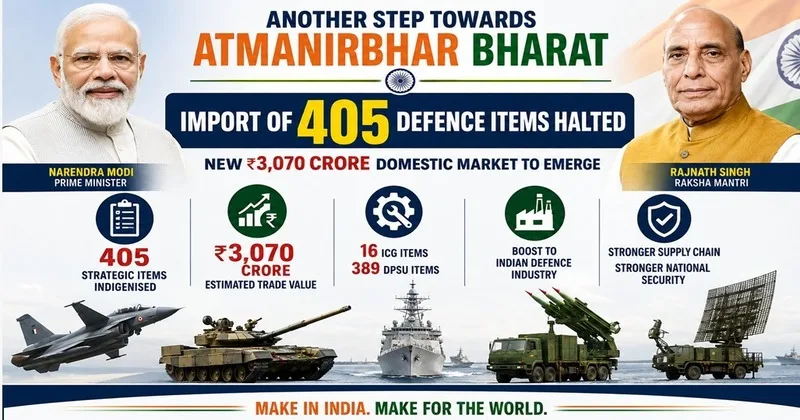
New Delhi: India’s drive for defence self-reliance now emphasises domestic manufacturing of the thousands of parts, spare parts, sub-systems, sub-assemblies, components and raw materials essential for the operational capability of any military system. The Ministry of Defence has now notified the sixth ‘Positive Indigenisation List’ comprising 405 strategically important defence items.
Notably, the estimated trade value of these items stands at Rs 3,070 crore. Once indigenisation is complete, these items will be procured from the Indian defence industry. In effect, India has not only reduced foreign dependency in the defence sector but has also opened up a new market worth Rs 3,070 crore for the domestic industry.
Crucially, the items on this list span a wide range of weapon systems. They relate to capabilities such as India’s fighter aircraft, helicopters, tanks, infantry combat vehicles, warships, missiles, radars, sonars, fire control systems and satellite communication systems. The list includes 16 items for the Indian Coast Guard and 389 items for Defence Public Sector Undertakings (DPSUs), encompassing Line Replaceable Units (LRUs), sub-systems, sub-assemblies, spare parts, components and raw materials.
According to the Ministry of Defence, an indicative timeline has been set for the indigenisation of each item, and upon successful indigenisation, the respective item will be procured from the Indian defence industry. This signifies that the policy of self-reliance is moving beyond merely manufacturing weapons domestically to indigenising the entire industrial supply chain required for them.
Expanding Self-Reliance: From Sukhoi-30 to T-90
The new list includes items related to air platforms such as the Advanced Light Helicopter, Light Utility Helicopter, Su-30MKI, Light Combat Aircraft, and AL-31FP engines. Regarding ground combat capabilities, products associated with armoured platforms like the T-72, T-90 and BMP-II are also included. In the maritime sector, items related to warships have been added, while in the missile domain, products linked to systems like Konkurs-M, Invar and MRSAM have been brought under the ambit of indigenisation.
Defence electronics items include radars, sonars, fire control systems and satellite communication systems. Additionally, high-explosive anti-tank ammunition and other critical defence equipment feature on the list. In essence, the scope of indigenisation, spanning everything from fighter jet engines to critical tank components and warship systems, touches upon almost every major dimension of the defence sector.
The Real Shift: Reducing Dependence on Foreign Supplies During Wartime
In this context, Dr Rajesh Sharma, a defence expert and retired Air Force officer, observes that the importance of defence self-reliance becomes most apparent during times of war or major global crises, when there is a constant need for weapons, spare parts and critical components. Relying on others does not guarantee immediate access to required items; however, indigenisation eliminates this dependency. Thus, the indigenisation of these 405 items is effectively an effort to strengthen the national security supply chain. Domestic availability of critical components means that India’s military systems will be relatively better insulated against potential disruptions in foreign supplies.
Successful Indigenisation of 15,700 Items
Presenting the data, Dr Sharma notes that over 15,700 defence items have been successfully indigenized in the last five years. This is estimated to result in import substitution worth approximately Rs 9,000 crore. Additionally, Defence Public Sector Undertakings (DPSUs) have placed procurement orders worth around Rs 10,000 crore with domestic vendors, orders that encompass indigenous production.
He stated that the picture becomes even clearer when these figures are viewed alongside the sixth list. On one hand, the government is identifying items that can be manufactured in India; on the other, it is providing a market for the domestic industry through procurement. This process of indigenisation creates a cycle involving demand, production and market access.
Srijan Portal Paves the Way for Indigenisation
It is worth noting that the Department of Defence Production’s ‘Srijan Defence Portal’ has emerged as a crucial link in this entire process. Launched in August 2020, the portal aims to showcase items required by DPSUs and Service Headquarters to the Indian industry, items that can be developed and manufactured within the country.
By June 2026, the Srijan portal had facilitated the listing of over 33,000 defence items for indigenisation. This figure includes the 5,012 items notified across the first five ‘Positive Indigenisation Lists.’ These statistics demonstrate that the Central Government is building an industrial network that enables private companies, MSMEs and startups to become integral parts of the defence production supply chain.
Defence Production Reaches Rs 1.78 Lakh Crore
Rising defence production stands as the greatest testament to India’s self-reliance in the defence sector. In the 2025-26 financial year, the country’s annual defence production hit a record Rs 1.78 lakh crore. Naturally, this growth is driven by a combination of factors: prioritising domestic procurement, increasing private sector participation, enhancing the production capacity of Defence Public Sector Undertakings (DPSUs), expanding the MSME sector and implementing policies such as positive indigenisation lists.
India Selling Arms Globally While Reducing Imports
Defence exports serve as another crucial benchmark for the success of self-reliance in this sector. India’s defence exports reached a record Rs 38,424 crore in the 2025-26 financial year, a 62.66 per cent increase over the previous year’s figure of Rs 23,622 crore. This signifies that, in its pursuit of self-reliance, India is developing the capability to manufacture defence products that are in demand in the international market. The government has set a target to raise defence exports to Rs 50,000 crore by 2029.
The most significant economic impact of this shift is the expansion of the defence industry. Indigenisation in the defence sector creates numerous opportunities for MSMEs and startups to meet the domestic demand for thousands of smaller components alongside major defence platforms. According to the Ministry of Defence, materials are being made available to the industry, including MSMEs and startups, for indigenous development and production through the ‘Srijan’ portal.
This process not only increases the number of defence manufacturing facilities in India but also fosters domestic capabilities in fields such as design, engineering, electronics, sensors, machining, materials science, avionics and software. Consequently, the Central Government’s decision underscores India’s growing capacity to transform the ‘Make in India’ initiative into a broader defence industrial powerhouse defined by ‘Make, Maintain and Export in India.’