Bharat needs a national registry of Hindu Religious Institutions
June 16, 2026
  • Read Ecopy
  • Circulation
  • Advertise
  • Careers
  • About Us
  • Contact Us
Android AppiPhone AppArattai
Organiser
  • ‌
  • Bharat
    • Assam
    • Bihar
    • Chhattisgarh
    • Jharkhand
    • Maharashtra
    • View All States
  • World
    • Asia
    • Europe
    • North America
    • South America
    • Africa
    • Australia
  • Editorial
  • International
  • Opinion
  • RSS @ 100
  • More
    • Op Sindoor
    • Analysis
    • Sports
    • Defence
    • Politics
    • Business
    • Economy
    • Culture
    • Special Report
    • Sci & Tech
    • Entertainment
    • G20
    • Azadi Ka Amrit Mahotsav
    • Vocal4Local
    • Web Stories
    • Education
    • Employment
    • Books
    • Interviews
    • Travel
    • Law
    • Health
    • Obituary
  • Subscribe
    • Subscribe Print Edition
    • Subscribe Ecopy
    • Read Ecopy
  • ‌
  • Bharat
    • Assam
    • Bihar
    • Chhattisgarh
    • Jharkhand
    • Maharashtra
    • View All States
  • World
    • Asia
    • Europe
    • North America
    • South America
    • Africa
    • Australia
  • Editorial
  • International
  • Opinion
  • RSS @ 100
  • More
    • Op Sindoor
    • Analysis
    • Sports
    • Defence
    • Politics
    • Business
    • Economy
    • Culture
    • Special Report
    • Sci & Tech
    • Entertainment
    • G20
    • Azadi Ka Amrit Mahotsav
    • Vocal4Local
    • Web Stories
    • Education
    • Employment
    • Books
    • Interviews
    • Travel
    • Law
    • Health
    • Obituary
  • Subscribe
    • Subscribe Print Edition
    • Subscribe Ecopy
    • Read Ecopy
Organiser
  • Home
  • Bharat
  • World
  • Operation Sindoor
  • Editorial
  • Analysis
  • Opinion
  • Culture
  • Defence
  • International Edition
  • RSS @ 100
  • Magazine
  • Read Ecopy
Home Bharat

Need for a national registry of Hindu religious institutions

India’s vast network of temples, mutts, ashrams, Vedic schools, and charitable institutions remains largely undocumented despite shaping Bharat’s civilisational continuity for centuries. The National Registry of Hindu Religious Institutions is essential to preserve traditions, customs, oral histories, and institutional memory for future generations.

Ramachandra VishnubhattaRamachandra Vishnubhatta
May 26, 2026, 02:30 pm IST
in Bharat, Opinion
Follow on Google News
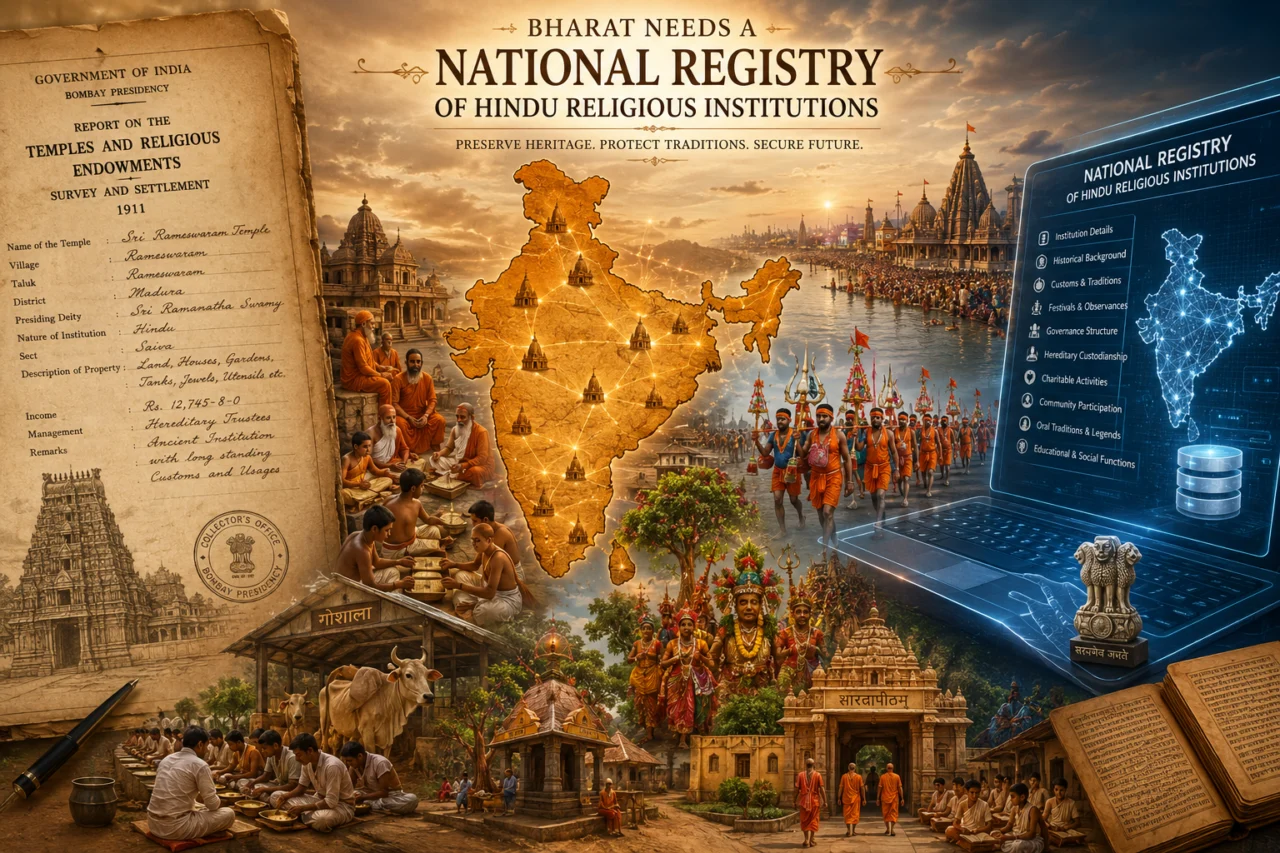
Representative AI image

Representative AI image

FacebookTwitterWhatsAppTelegramEmail

India, historically known as Bharat, has been called as cradle of human civilisation, that evolved over millennia as a civilisational continuum shaped by a shared spiritual worldview as wella as a political territory that gave and nurtured all elements of cosmos and its existence. This was all connected under the idea of oneness, and rest are manifestation of that oneness. In today context, the this sacred land is filled with languages, customs, and regional practices vary, an underlying ethical, philosophical, and cultural framework binds the subcontinent together. This continuity is visible in its sacred geography, literary traditions, pilgrimage routes, and institutions of worship that have sustained society across centuries.

Within this civilisational framework, Hindu religious institutions constitute one of the world’s oldest and most extensive cultural networks. The religious and philosophical landscape flourished with diverse thoughts and practices broadly under Vaishnavites, Shaivites, Shaktas, Jains, Buddhists, Advaita Vedantins, Dvaita Vedantins, Vishishtadvaitins, Sikhs, and so on at every corner of the country.

Temples, mutts, ashrams, Vedic schools, gurukulas, dharmashalas, annadana centres, goshalas, and charitable establishments have historically functioned not only as places of worship but also as centres of education, healthcare, food distribution, social service, and preservation of community traditions.

Also Read: Temple properties retrieval- Hindu Religious & Charitable Endowments Department book bereft of truth

During the colonial period, British administrators conducted surveys of many major temples and religious establishments. These records extended far beyond land ownership. They documented institutional history, customs, festivals, jewellery, ritual practices, hereditary trusteeship, and management systems. After independence in 1947, however, no comparable nationwide effort was undertaken, an opportunity and a moment in history that we missed.  As a result, Bharat today lacks a complete and authoritative registry of Hindu religious institutions.

This absence has serious implications and challenges. There is no consolidated national data showing the number of temples, mutts, ashrams, Vedic schools, or charitable institutions operate across the country. We are also missing the administrative details like who manages them; what customs they preserve; the public functions they serve; and rights and traditions are associated with such institutions. The issue is therefore not merely administrative, but one of preserving civilisational memory.

The importance of such documentation becomes evident when traditional practices come under legal or public scrutiny. The debates surrounding Sabarimala Temple illustrate this. The shrine’s practices are rooted in centuries-old customs linked to the nature of the deity and the spiritual discipline of devotees. Such traditions evolved over time and can be properly understood only in the context of the institution’s own religious history.

Similarly, Sammakka Saralamma Jatara in Telangana represents a living tribal tradition preserved through oral memory and inherited ritual connecting several parts of central Bharat. Its significance lies not only in the annual gathering but in the customs maintained by generations of tribal communities.

Across northern India, the Kanwar Yatra and the periodic Kumbh Mela demonstrate how faith traditions bind communities across regions through shared observance. These evolved through local custodianship over centuries and continue to shape cultural life of Bharat.

At the local level, countless small shrines preserve equally significant traditions. Many temples are associated with rituals that devotees believe bring blessings, healing, or fulfilment of wishes. Their legends, annual festivals, oral histories, and community practices are often transmitted only through hereditary priests, trustees, or elders. When these custodians pass away, valuable historical knowledge can disappear permanently.

The need today is for a systematic national registry covering Hindu institutions in villages, forests, tribal regions, towns, metropolitan centres, and urban slums. Every institution, irrespective of size, deserves documentation because even a small village shrine may preserve unique traditions of historical value.

A national documentation programme led by Government of India should record:

• institutional existence

• historical background

• customs and traditions

• festivals and observances

• governance structures

• hereditary custodianship

• charitable activities

• community participation

• oral traditions and local legends

• educational and social functions.

Such a registry would preserve institutional memory, strengthen cultural continuity, support policy planning, and create authoritative records for future generations. It would also reduce misuse by encroachers, fraudulent actors, intermediaries, and unlawful claimants who exploit the absence of clear documentation.

Also Read: Sabrimala Case | “The state should stay away from religious matters, except …” Jainacharya Yugbhushan Suri Ji

Hindu institutions also constitute a vast but largely undocumented economic ecosystem. Temples, mutts, ashrams, Vedic schools, pilgrimage centres, annadana programmes, and charitable  institutions generate substantial activity through employment, tourism, education, healthcare, agriculture, cattle care, handicrafts, and local commerce. Much of this remains outside formal economic measurement, despite contributing to livelihoods and national production.

A nationwide enumeration would therefore reveal not only the number and spread of institutions, but also their contribution to Gross Domestic Product, employment, and rural economies. It would help quantify a major civilisational infrastructure that has remained outside standard policy assessment.

It is therefore time for sants, mahanths, dharmacharyas, Shankaracharyas, and heads of Hindu spiritual institutions like VHP, to collectively urge the Government of India to undertake such an exercise. The objective is larger than administration. It is to understand the true institutional, cultural, economic, and spiritual strength that these establishments collectively represent.

A nation that can digitally record its population, taxation, land revenue, and infrastructure can also document the institutions that preserve its oldest spiritual traditions. Establishing a National Registry of Hindu Religious Institutions is not merely a governance measure. It is an essential step toward preserving one of the world’s oldest living civilisations and understanding the full scale of its social, cultural, and spiritual power.


Topics: Hindu TemplesReligious institutionsHindu institutionsHindu spiritual institutionsNational Registry
Ramachandra Vishnubhatta
A senior corporate professional with extensive experience across the oil & energy sector, Spatial Data in infrastructure, and corporate affairs. [Read more]
ShareTweetSendShareSend
✮ Subscribe Organiser YouTube Channel. ✮
✮ Join Organiser's WhatsApp channel for Nationalist views beyond the news. ✮
Previous News

Karnataka: Puncture mafia back in Bengaluru; Hundreds of nails scattered near police station to trap motorists

Next News

QUAD Foreign Ministers Meet: Members pledge for Indo-Pacific security; Unveil initiatives for maritime surveillance

Related News

Keralam: Audit finds gold and silver ornaments missing from nearly 20 temples under Neyyattinkara Devaswom sub group

Tamil Nadu: Activist flags Rs 2,700 crore temple money in to TNPFC, seeks rollback of DMK-era HR&CE amendments

Swami Vivekamruthananda at Kerala Kshethra Samrakshana Samiti at Kozhikode

Keralam: Swami Vivekamruthananda seeks movement to safeguard temple traditions and wealth

Maharashtra govt’s move to abolish Devasthan Inam lands triggers debate over Temple rights & cultural heritage

VHP International President Alok Kumar

Hindu temples should be administered independently by Hindu society & govt control over it must end: Alok Kumar

Hindu groups in Canada condemn planned Khalistan rallies outside temples

Canada: Hindu groups condemn planned Khalistan rallies outside temples; urge authorities to act

Load More

Latest News

Addressing the Samapan Samahroh of 15-day Sangh Shiksha Varg, RSS Akhil Bharatiya Sah Prachar Pramukh Pradeep Joshi

Dehradun | Anti-national forces & foreign conspiracies seeking to weaken Bharat: Pradeep Joshi askes people to be alert

Akal Takht panel declares Punjab CM Bhagwant Mann ‘anti-Guru’

Akal Takht declares Bhagwant Mann ‘anti-Guru’, summons Punjab cabinet over controversial Sikh legislation

Strong demand across Asia, Africa and Europe drove India's highest-ever monthly export performance

India’s exports hit record high in May 2026 despite global uncertainties; Trade deficit narrows

DRDO successfully tests Long-Range Precision Missile

India’s ‘Tomahawk’ Takes Flight: DRDO successfully tests long-range precision cruise missile

Tamil Nadu Education Minister Rajmohan (file photo)

Tamil Nadu Education Minister Rajmohan takes U-turn on religious symbols in schools after severe public backlash

A representative image generated via AI

MP: Mohd Sameer booked under POCSO for raping minor Hindu girl for years, forcing abortions and conversion to Islam

Bangladesh Dhaka University Hindu students demand arrests after Islamists desecrate Bhagwan Ram’s murti in Gaibandha

Bangladesh: Dhaka University Hindu students launch protest over Islamist desecration of Bhagwan Ram’s murti

Bhaurao Bhuskute

Bhaurao Bhuskute: A silent architect of nation-building and an exemplary karmayogi

United States: Life-size statue of Swami Vivekananda unveiled in Chicago; Resonates the message of service & harmony

NTA welcomed the centre's decision to impose temporary restrictions on Telegram platform in India ahead of the NEET-UG 2026 re-examination

NEET-UG 2026 Re-Exam: NTA welcomes government’s temporary restrictions on Telegram to curb paper leak and fraud

Load More
  • Privacy
  • Terms
  • Cookie Policy
  • Refund and Cancellation
  • Delivery and Shipping

© Bharat Prakashan (Delhi) Limited.
Tech-enabled by Ananthapuri Technologies

  • Home
  • Search Organiser
  • Bharat
    • Assam
    • Bihar
    • Chhattisgarh
    • Jharkhand
    • Maharashtra
    • View All States
  • World
    • Asia
    • Africa
    • North America
    • South America
    • Europe
    • Australia
  • Editorial
  • Operation Sindoor
  • Opinion
  • Analysis
  • Defence
  • Culture
  • Sports
  • Business
  • RSS @ 100
  • Entertainment
  • More ..
    • Sci & Tech
    • Vocal4Local
    • Special Report
    • Education
    • Employment
    • Books
    • Interviews
    • Travel
    • Health
    • Politics
    • Law
    • Economy
    • Obituary
  • Subscribe Magazine
  • Read Ecopy
  • Advertise
  • Circulation
  • Careers
  • About Us
  • Contact Us
  • Policies & Terms
    • Privacy Policy
    • Cookie Policy
    • Refund and Cancellation
    • Terms of Use

© Bharat Prakashan (Delhi) Limited.
Tech-enabled by Ananthapuri Technologies