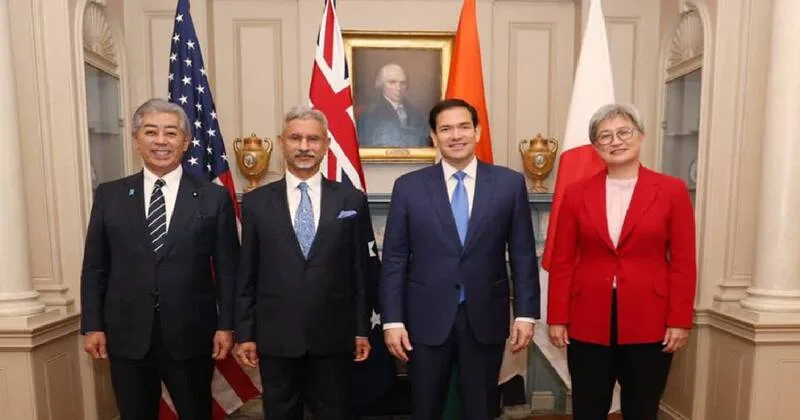
New Delhi: US Secretary of State Marco Rubio, Japanese Foreign Minister Toshimitsu Motegi and Australian Foreign Minister Penny Wong underscored the economic and strategic significance of the Quad grouping, describing it as a coalition of major democracies committed to shared interests across the Indo-Pacific. They also reiterated their comitment t ensure free, open, inclusive and rule-based Indo-Pacific. QUAD group also announced series of initiatives to enhance coordinated maritime surviellance, ensure security and real-time awareness across the Indo-Pacific. The four nations also agreed to work on a joint port project in Fiji and proposed a joint critical mineral framework.
US Secretary of State Marco Rubio highlighted the economic significance of the QUAD grouping by reiterating, “The stage today represented countries that collectively are about a third of the world’s GDP, and these aren’t just countries that have economic reach, they are countries who share strong values, strong vibrant democracies, who also are committed to many of the same concepts with regards to economic development”.
Indo-Pacific Maritime Initiative for regional surveillance & real-time awareness
Highlighting key outcomes from the meeting, Rubio announced a new Indo-Pacific maritime initiative aimed at enhancing regional surveillance coordination among Quad members. “On the issue of maritime security, there are two big announcements. The first is the launch of the Indo-Pacific Maritime Surveillance Cooperation Initiative, which is going to leverage each of our country’s maritime surveillance capabilities in the Indo-Pacific to enhance information sharing”, Rubio stated.
Related to that is also the expansion of the Indo-Pacific Maritime Domain Awareness Initiative, which provides and can provide near-real-time commercial maritime domain awareness data to countries throughout the Indo-Pacific”, he said. Rubio also announced a partnership focused on improving port infrastructure in Pacific Island nations, with an initial focus on Fiji.
“I also want to thank India for committing to hosting the next iteration of the Quad at Sea mission, which brings together our respective coast guards together in one place on one ship. The reason why maritime security is so important, beyond the fact that current events remind us of what can happen when maritime security is impeded, is the fact that 60 per cent of global maritime trade passes through the Indo-Pacific and it’s a vital national interest not just to the four countries represented here today, but to dozens of countries, countless countries around the world”, Rubio further added.
“The second initiative: we’re going to be partnering on issues of port infrastructure. In particular, in response to insufficient port capacity in the Pacific Islands. We’re announcing plans to work with Fiji to advance that country’s port infrastructure. It’ll be the first time that the Quad partners work together on a port infrastructure project”, Rubio said.
QUAD Critical Minerals Framework
On supply chain resilience, Rubio said the Quad nations would launch a new framework focused on securing access to critical minerals. “The third topic, which we hear a lot about these days, that we’ll have some deliverables on today, is the issue of critical minerals,” Rubio said. He added, “We’ll announce the Quad Critical Minerals Framework, which will guide each of us to leverage economic policy tools and coordinate investment to strengthen critical mineral supply chains, including in mining and processing and in critical minerals recycling”.
Japan Foreign Minister advocates for free & open Indo-Pacific
Japanese Foreign Minister Toshimitsu Motegi highlighted how Quad serves as an important platform towards advancing cooperation in the Indo-Pacific region and expressed optimism that the discussions at the Foreign Ministers’ Meet would deepen collaboration between the partner countries. “This Quad meeting signifies the firm message to the world that Quad will strongly promote cooperation to realise free and open Indo-Pacific”, he further added.
He underlined how it is imperative for the Indo-Pacific nations to enhance their resilience and economic security and said, “The Indo-Pacific nations should strengthen resilience and the necessary capacity to determine their own future, including economic security”, Japanese Foreign Minister added.
“We would like to work together among the Quad to develop resilience and strengthen capacity and to promote cooperation that truly benefits this region”, he said. Japanese Foreign Minister also expressed concern over the export restrictions of critical minerals.
Speaking on the West Asia crisis, Japanese Foreign Minister said, “As the Iranian situation imposes enormous impact on the Indo-Pacific region, energy supply viewpoint included, we confirmed the importance of diplomatic efforts in ensuring free and safe navigation in the Strait of Hormuz as well as stability to be brought to the Middle East”.
Australia commits for deeper Indo-Pacifc cooperation via QUAD
Australian Foreign Minister Penny Wong emphasised the importance of safeguarding sovereign choice and maintaining a free and open Indo-Pacific, while reaffirming Australia’s commitment to deeper Quad cooperation. Addressing the Quad Foreign Ministers’ meeting, Wong praised India’s role in the region and highlighted the strategic significance of the gathering.
“We meet in the world’s largest democracy and a power that is so important in the shaping of the Indo-Pacific and the world”, Wong said during her opening remarks. Referring to an earlier 2025 Quad discussion in Washington, Wong recalled EAM Jaishankar’s remarks on strategic autonomy and sovereign decision-making. “This is central to how Australia approaches our engagement in the Quad,” Wong added.
“We are four sovereign nations, have our own histories and interests, but there is great alignment between our interests”, Wong said. “We all share a vision for the Indo-Pacific, a region that is free and open”, she added. Wong also underlined the practical outcomes achieved through Quad cooperation, particularly in areas of humanitarian response, maritime security and supply chains. “We have also cooperated on critical infrastructure, undersea cables, maritime security and critical minerals”, she added.
“We all want the Quad to be as strong and as effective as we can make it be, focused on delivering and we are determined to continue its momentum”, she said. “This is the future we want for our region, a peaceful, stable, prosperous region and today we continue the work to build that”, Wong said.
Australian Foreign Minister also warned that the Indo-Pacific region is under mounting economic pressure and pointed to concerns surrounding maritime security and global energy flows. “The region is facing acute economic stress. We know the consequences for our region of the Iranian closure of the Strait of Hormuz and what that means for our energy security”, Wong stated.
(With Inputs from ANI)