
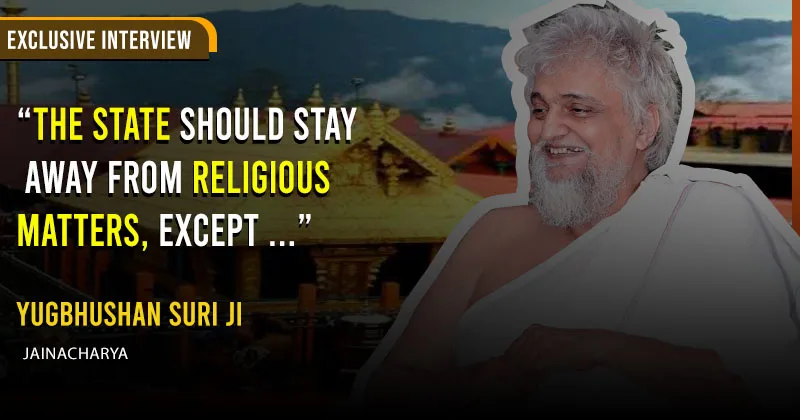
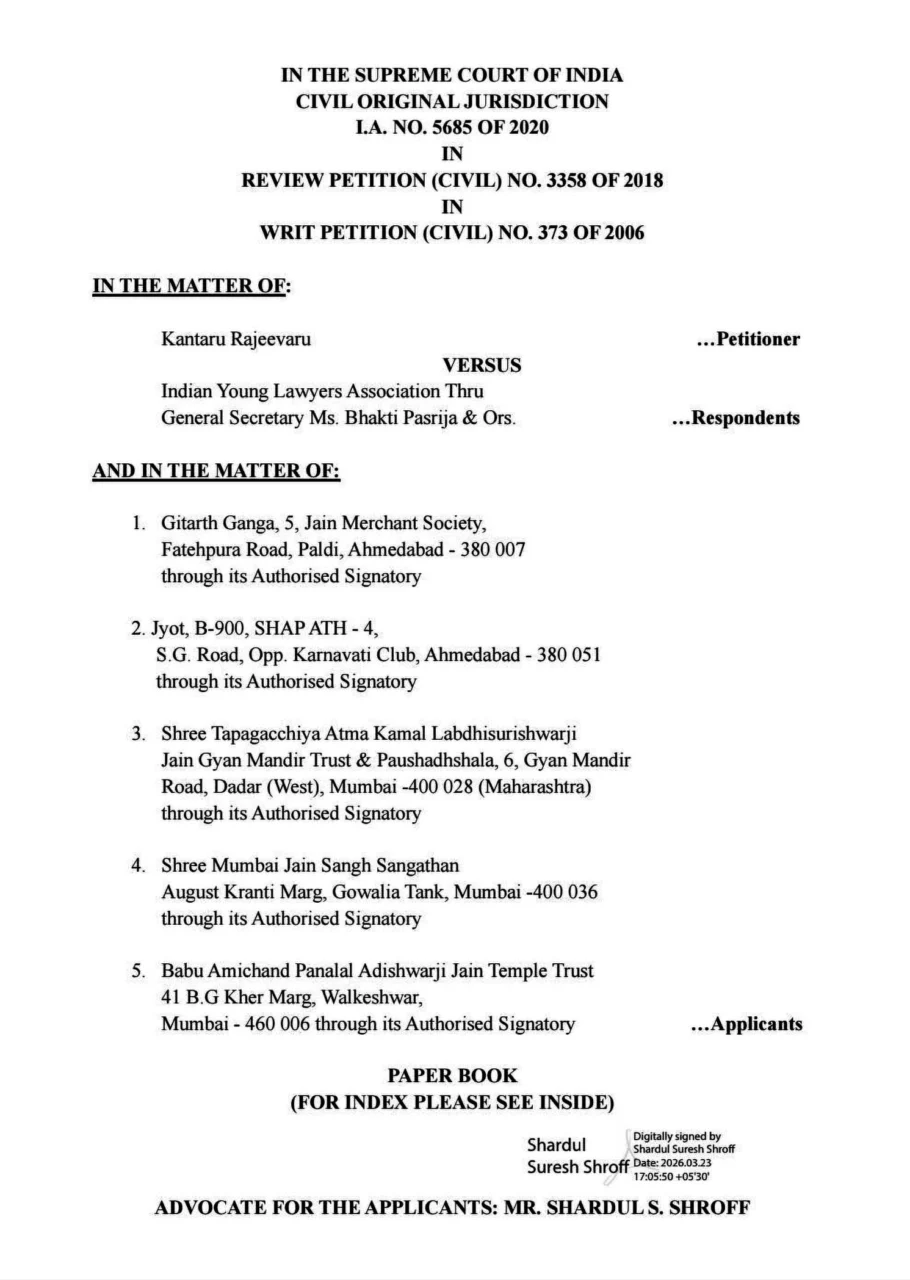
On March 23, 2026, Gitarth Ganga, a spiritual research institute led by Jainacharya Yugbhushan Suri Ji, filed a review petition in the Sabarimala case. In its petition, it has urged the Supreme Court to restore religious freedom, recognise religions and religious groups as legal entities and interpret Articles 25 and 26 of the Constitution in a manner that reflects Bharat’s unique civilisational context. On April 7, 2026, a nine-judge bench of the Supreme Court heard all review petitions challenging its 2018 verdict of permitting women of all age groups to enter the Sabarimala Sree Dharma Sastha Mandir in Kerala. Gitarth Ganga has pointed out a fundamental concern that religions that originated in Bharat, broadly including Hindus, Buddhists, Jain, and Sikhs, are still not recognised as legal entities. As a result, they are unable to safeguard their own rights, hold property in their own name, or even approach courts as independent entities. The institute describes this as a serious gap in the legal framework, that leaves these religious communities without adequate protection. Here is an exclusive conversation with the petitioner by Vayuveg, who makes a clear distinction between the roles of the state and religion. Excerpts:
How do you view the Supreme Court’s 2018 verdict, and what is your take on the 50–60 review petitions that have been filed since then?
During the review proceedings, the Apex Court chose to step back and frame a set of broader constitutional questions — seven larger issues — instead of limiting itself only to the matter of entry into the Sabarimala Mandir. Because of this wider scope, many parties have already stepped in and several new participants have also shown interest. There is clearly an ongoing effort to identify and accommodate representative viewpoints so that the final judgement is both balanced and comprehensive. Naturally, a process of this nature takes time, and the Court will need that time to do justice to the issues involved.
Politics, by its very nature, operates within the framework of governance and power. ‘Dharmaneeti’, or the ethical framework rooted in Dharma, is inherently wider in scope and is guided by the idea of justice for all. The State’s role is to function as a governing authority and ensure social justice for its citizens, that is its primary responsibility. Religion, on the other hand, is anchored in a more universal vision of justice, one that extends concern to all forms of existence. In that sense, when it comes to justice, the scope of Dharma is broader than that of the state. We expect that, in the Sabarimala case, the Apex Court’s eventual verdict will clearly articulate and reaffirm this principle.
If the Court does go ahead and define what constitutes “essential religious practices”, how do you see that playing out?
It is not the State’s role to tell religions what they should or should not practice. Questions of rituals, forms of worship and religious observances should remain outside the State’s reach. Notably, Articles 25 and 26 of the Constitution do not explicitly use the term “essential” at all. So, the expectation is for the State to stay away from religious matters, except under the six clearly recognised constitutional grounds: public health, morality, public order, social reform, other fundamental rights, and secular activities associated with religion.
Could it become problematic if the State follows the non-interference approach when it comes to Abrahamic religions as well?
The State certainly has the authority to act. Wherever there is a social crime, the State has full power to take necessary action. For instance, if someone commits a murder and then takes refuge inside a temple, it does not mean that the State cannot act against them. Law and order must always prevail. Under the Indian constitutional framework, foreign embassies are treated as sovereign spaces. This principle is well-established in international law and recognised through the Vienna Convention. However, in practice, religious institutions or places of worship have not been accorded the status of sovereign spaces within the constitutional framework. We believe these should be granted a certain degree of sovereign recognition.
“Politics, by its very nature, operates within the framework of governance and power. ‘Dharmaneeti’, or the ethical framework rooted in Dharma, is inherently wider in scope and is guided by the idea of justice for all. The state’s role is to function as a governing authority and ensure social justice for its citizens, that is its primary responsibility”
If the concern is that certain sections promote fundamentalism, shouldn’t the focus be on addressing fundamentalism itself, rather than targeting any particular religion?
It is important to draw a clear line between religion and fundamentalism. When religious principles are interpreted through an extreme or rigid lens, they can easily turn into fundamentalism. Every religion has the right to express and practice its beliefs. But, responding with intolerance, aggression, or attempts to silence others is neither justified nor sustainable. If such tendencies take hold, society risks sliding into rigidity and conflict, something that goes against the larger ideals of co-existence and mutual respect.
This boundary between religious wisdom and fanaticism is a very thin line. It exists within every religion. Within that space, one should be able to express thoughts, beliefs, and perspectives with clarity and openness. At the same time, there has to be a conscious effort to ensure that such expression does not slip into imposition or fanaticism. The intent should be to share and deepen understanding, not to dominate or enforce. When this balance is maintained, religion continues to remain a source of wisdom rather than drifting into fanaticism. Just as the State does not permit acts of disloyalty or rebellion against itself, in a similar way, attitudes or actions that foster hostility in the name of religion should have no place in a civilised society.
It is often argued in the Sabarimala case that women do not have the right to enter the temple.
Women do have that right. However, there is a restriction that applies only during a specific phase of life. Bharat’s religious landscape is incredibly diverse, with a wide range of traditions and places of worship. Not everyone is permitted to enter every religious space. In some places, even men are not allowed. Similarly, access to the sanctum sanctorum is not always open to all; there are often conditions and traditions that determine who may enter. In certain temples, entry is allowed even during the menstrual cycle, while in others, the practices are different. But then, what role does an outsider—someone with no connection to that specific faith—have in interfering? If those within a tradition are at peace with it, external intervention to decide what is right or wrong is like a stranger walking into a home and telling a content family how they should live.
What is the bridge between Article 25, which deals with religious rights, and Article 14, which speaks about individual Fundamental Rights?
Article 14 guarantees equality before the law and equal protection of laws; it is a core fundamental right. These rights are not limited only to the religious sphere; they extend across the broader social domain as well. At the same time, the State is essentially a temporal, or worldly authority, not a spiritual one. Its primary role is to govern society and ensure justice within the social framework. Religion, on the other hand, is rooted in personal belief and spiritual practice, and therefore lies largely outside the State’s direct domain, especially within a secular system.
Real equality is about ensuring fairness among equals, not forcing inherently different situations into an artificial sameness. Even today, there are several laws that, in practice, seem to raise questions about this principle of equality. The larger goal should always be to move towards a just, fair, and peaceful social order, and when we speak of the welfare of society as a whole, ensuring justice for women has to remain central to that vision.
In other Constitutions, is the relationship between religion and the State any different, or does it lead to similar debates and tensions?
In many Western and European constitutional systems, what is described as secularism does not always translate into a complete separation between religion and the State. In practice, it can sometimes resemble what critics call “pseudo-secularism,” where the divide is not as clear-cut as it appears. For instance, in Parliament of United Kingdom (UK), Bishops hold reserved seats in the House of Lords and actively take part in discussions and policy-making. When religious figures are given such institutional roles, it naturally raises questions about how strictly secular the system really is.
Some say this case is an attempt to dismantle or weaken the Constitution.
That is not a fair assessment. An issue like this, by itself, cannot fundamentally alter the Constitution. Changes of that scale require far deeper and more foundational questions to be addressed. Whatever is valuable and relevant within the Constitution should be engaged constructively and upheld without bias. If certain principles serve not just the State but also contribute to the larger good of society and even the world, there should be no hesitation in preserving them. In fact, nations can set examples for others by adopting and demonstrating such positive principles in practice. The emphasis, therefore, should be on nurturing ideas and guidance that can inspire and offer meaningful direction. Notably, Dr BR Ambedkar, one of the principal architects of the Constitution, himself acknowledged soon after its framing that there were gaps and scope for improvement.
Many people argue that while you call for the State to stay out of religious matters, there are also voices that believe certain religious traditions themselves need reform and change.
If interference is justified, then the State does have the authority to step in. There must be a clearly defined policy framework in place. If a State calls itself secular, it must act with neutrality and restraint. On the other hand, if it is theocratic, it will naturally lean towards protecting and promoting a particular religion. Reform is acceptable, but only when it is meaningful and constructive.
“Women do have that right. However, there is a restriction that applies only during a specific phase of life. Bharat’s religious landscape is incredibly diverse, with a wide range of traditions and places of worship. Not everyone is permitted to enter every religious space. In some places, even men are not allowed”
Are we aiming for a society with only one religion? Should society be pushed towards conflict between communities? These questions go to the very heart of how a society is shaped. Bharat has, for centuries, functioned as a pluralistic society where multiple faiths have coexisted. The real question is whether that pluralism is to be preserved, or whether it will be replaced by a system that privileges one belief over others or suppresses diversity altogether. Any reform or intervention, therefore, must be legitimate, balanced, and well-justified. If it is not, it will naturally face resistance. The guiding principle should be coexistence, fairness, and respect for diversity, not imposition or conflict.
How should this issue be framed — Religion vs Social, or Orthodox vs Progressive?
The more meaningful way to look at it is through the lens of justice versus injustice. The starting point should always be what is legitimate in terms of law and principles of justice. The goal is not to seek favour, but to seek what is right. If a claim is valid, it deserves to be recognised and upheld. And if there is injustice, it must be identified and corrected; that is ultimately the Court’s responsibility.
Religion, in that sense, does not need to become the central battleground of this discussion. Even in the Sabarimala case, there are multiple dimensions and contributors involved beyond just religion. The arguments, therefore, should be framed in the language of justice, not as a demand for favour. This is not about promoting religion; it is about seeking justice and upholding sound governance. The focus remains firmly on justice, not on religious favour.
Apart from legal means, what other steps do you plan to take in this matter?
Beyond the legal route, there is a lot that can be done. Efforts can be made to build public awareness, shape informed opinion, and present the facts clearly so that people can understand the issue in its true light. Engaging in reasoned dialogue and constructive conversations is an important part of that process. With a sincere sense of purpose, we are committed to contributing in this direction as well, using methods that are responsible, appropriate, and rooted in ethical engagement.