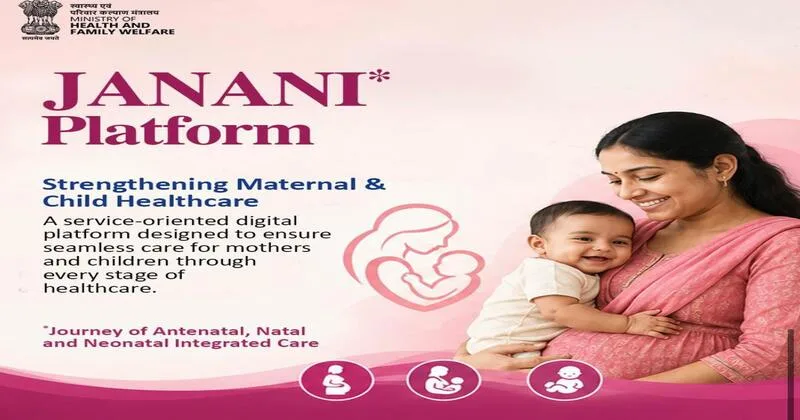
Every two minutes, a woman somewhere in the world dies from a pregnancy-related complication. India still accounts for a significant share of that global burden. The Maternal Mortality Ratio (MMR) has fallen sharply from 384 per one lakh live births in 2000 to 93 in 2019–21 according to the Sample Registration System, and IndiaMMR has declined by 86 per cent between 1990 and 2023, outpacing the global reduction of 48 per cent over the same period. The Sustainable Development Goal demands an MMR below 70 by 2030. To bridge this gap, the Government of India has launched JANANI.
Formally unveiled at the National Summit on Innovation and Inclusivity Best Practices Shaping India’s Health Future, JANANI (Journey of Antenatal, Natal and Neonatal Integrated Care) is a service-oriented digital platform designed to comprehensively monitor and maintain digital health records of women across their reproductive years. It is a structural reimagining of how the state tracks, supports and intervenes in the lives of mothers and newborns from the first antenatal visit to family planning counselling after delivery.
From RCH Portal to Care Record
JANANI is developed as an upgraded version of the existing Reproductive and Child Health (RCH) portal, which has served as the backbone of India’s maternal and child health data infrastructure for years. While the RCH portal captured transactional data at individual service points, JANANI creates a longitudinal health record, which is a continuous, time-stamped chronicle of every key service delivery event across the entire continuum of care.
This means that from the moment a woman is registered as pregnant, every antenatal check-up, immunisation, delivery event, postnatal visit and newborn care milestone is captured in a single, unified digital record. The platform covers antenatal care, delivery preparedness, institutional delivery, postnatal care, newborn care, home-based newborn and family planning, ensuring that no stage of the mother-child health journey falls through the administrative cracks that have historically allowed preventable deaths to go undetected and unaddressed.
The QR-Enabled MCH Card: Portability at Last
One of the most transformative features of JANANI is the introduction of QR-enabled digital Mother and Child Health (MCH) cards. For generations, the pink antenatal card has been the primary document of a pregnant woman’s health journey in India, which easily gets lost, making it illegible and useless if the woman crosses a district or state boundary. The digital MCH card changes this entirely.
By encoding a woman’s complete health record into a QR code, JANANI makes that record instantly readable by any empanelled health worker anywhere in the country. A migrant worker from Uttar Pradesh delivering in a Mumbai hospital or a tribal woman transferred from a primary health centre to a district hospital in an emergency can have her entire antenatal history accessed within seconds by eliminating dangerous information gaps at the most critical moments. JANANI has generated more than 30 lakh such digital MCH cards.
Intelligence Built In: Alerts, Dashboards and Due Lists
JANANI incorporates a suite of active monitoring tools designed to transform data into timely action. The platform generates automated alerts for high-risk pregnancies, ensuring that women identified with danger signs of hypertension, anaemia, gestational diabetes or a history of complications are flagged immediately to the appropriate health worker or supervisor.
Real-time dashboards allow programme managers, district officers and state health departments to view the status of beneficiaries across geographies at a glance, enabling supervisory review without waiting for monthly paper reports. Due-list generation ensures that ASHA workers and Auxiliary Nurse Midwives know exactly which women in their catchment area are due for an antenatal visit, a vaccination or a postnatal check, enabling targeted outreach rather than reactive care.
For citizens, the platform enables timely scheduling and monitoring of antenatal visits and immunisations, with alerts and reminders sent directly to beneficiaries so that no critical health milestone is missed. It also provides information on nearby healthcare facilities, expected place of delivery and health education content to support informed decision-making throughout pregnancy and early childhood.
One ID, Seamless Care: ABHA, Aadhaar and POSHAN Integration
A challenge in Indian public health administration has been the duplication of records and the loss of continuity when a beneficiary moves. JANANI directly addresses this through unique identifier-based registration. Beneficiaries can be enrolled using their ABHA (Ayushman Bharat Health Account) ID, Aadhaar number via OTP or biometric authentication or mobile number, backed by pan-India search functionality. This ensures that a woman registered in one district is not re-registered as a new beneficiary in another, and that her health history travels with her.
The platform’s interoperability architecture extends beyond individual records. JANANI is designed to integrate with national platforms, including U-WIN, the Unified Vaccine Intelligence Network that tracks immunisation delivery, and POSHAN, the government’s flagship nutritional monitoring system. This means that for the first time, a child vaccination record, a mother’s nutritional status and her complete antenatal history can be viewed in a converged manner, enabling health workers and supervisors to identify and address multi-dimensional vulnerabilities rather than working in sectoral silos.
JANANI also provides self-registration facilities through web and mobile platforms, empowering beneficiaries to actively participate in their own healthcare journey rather than remaining passive recipients of government services. This citizen-facing dimension is particularly significant in an era when smartphone penetration is expanding rapidly into rural India, and digital literacy among young women is rising.
JANANI’s reach is already visible through numbers:
• 1.34 Crore Beneficiary registrations
• 30+ Lakh Pregnant women registrations
• 30+ Lakh Digital MCH cards generated
• 1+ Lakh Biometric verifications completed
Reform Embedded in Bharatiya Values
The name JANANI is derived from the Sanskrit and Hindi word for mother. It reflects a civilisational recognition that the health of the mother is the health of the nation. India’s philosophical and social traditions have always accorded primacy to the role of the mother; JANANI, the platform operationalises this value through the language of twenty-first-century digital governance.
Schemes like Janani Suraksha Yojana, Pradhan Mantri Surakshit Matritva Abhiyan and the Poshan Abhiyan have already demonstrated the Government’s sustained commitment to maternal and child health. JANANI builds on this foundation, providing the digital nervous system that connects these programmes, tracks their impact in real time and identifies where interventions are most urgently needed.
India’s MMR has fallen by 37 points from 130 to 93 per lakh live births between 2014–16 and 2019–21 alone. The Infant Mortality Rate has declined from 39 to 27 per thousand live births between 2014 and 2021. The Neonatal Mortality Rate has dropped from 26 to 19 per thousand live births in the same period. These are not small numbers; they represent hundreds of thousands of lives saved. JANANI is the instrument designed to accelerate this trajectory towards the SDG goal and beyond.
The Road Ahead
The launch of JANANI at the National Summit on Innovation and Inclusivity is more than a technology announcement. It is a statement of administrative intent that India will use the full power of its digital infrastructure to leave no mother or newborn behind. The challenge now is implementation at scale, ensuring that every ASHA worker, every ANM and every primary health centre across the country’s 700-plus districts can access, use and trust the system.
This will require sustained investment in digital literacy, reliable connectivity in remote areas and rigorous supervision to ensure data quality. It will require the kind of grassroots mobilisation that India’s public health system has demonstrated it is capable of in the polio eradication campaign and the Covid-19 vaccination drive.
If JANANI has the early adoption numbers, it will represent one of the most significant advances in maternal and child health governance in independent India’s history. The digital MCH card in a mother’s hand, the alert on an ASHA’s phone, the dashboard on a collector’s screen.